Introduction to Equilibrium
Introducido| English | Significado |
|---|---|
| dynamic equilibrium/daɪˈnæmɪk ˌiːkwɪˈlɪbrɪəm/ | A state in which opposing processes continue at equal rates, so there is no overall change in composition. |
| forward rate | The rate at which reactants turn into products in a reversible reaction. |
| closed system/kləʊzd ˈsɪstəm/ | A system that no substance can enter or leave; equilibrium needs one. |
A sealed tube that stops changing
- Seal colourless $\text{N}_2\text{O}_4$ gas in a glass tube. It turns brown as $\text{NO}_2$ forms, and the colour deepens for a while. Then the colour stops changing, even though there is still plenty of $\text{N}_2\text{O}_4$ left.
- The reaction has not stopped. It has reached dynamic equilibrium 动态平衡: $\text{N}_2\text{O}_4(g)\rightleftharpoons2\text{NO}_2(g)$ is running both ways at the same rate.
When the colour in the sealed tube stops changing, both reactions have stopped.
Dificultad 1/5 · 100 monedas + un pequeño bono en el primer intento de hoy
Both reactions continue at equal rates. The colour is constant because the amounts do not change overall.
Two reactions, one rate
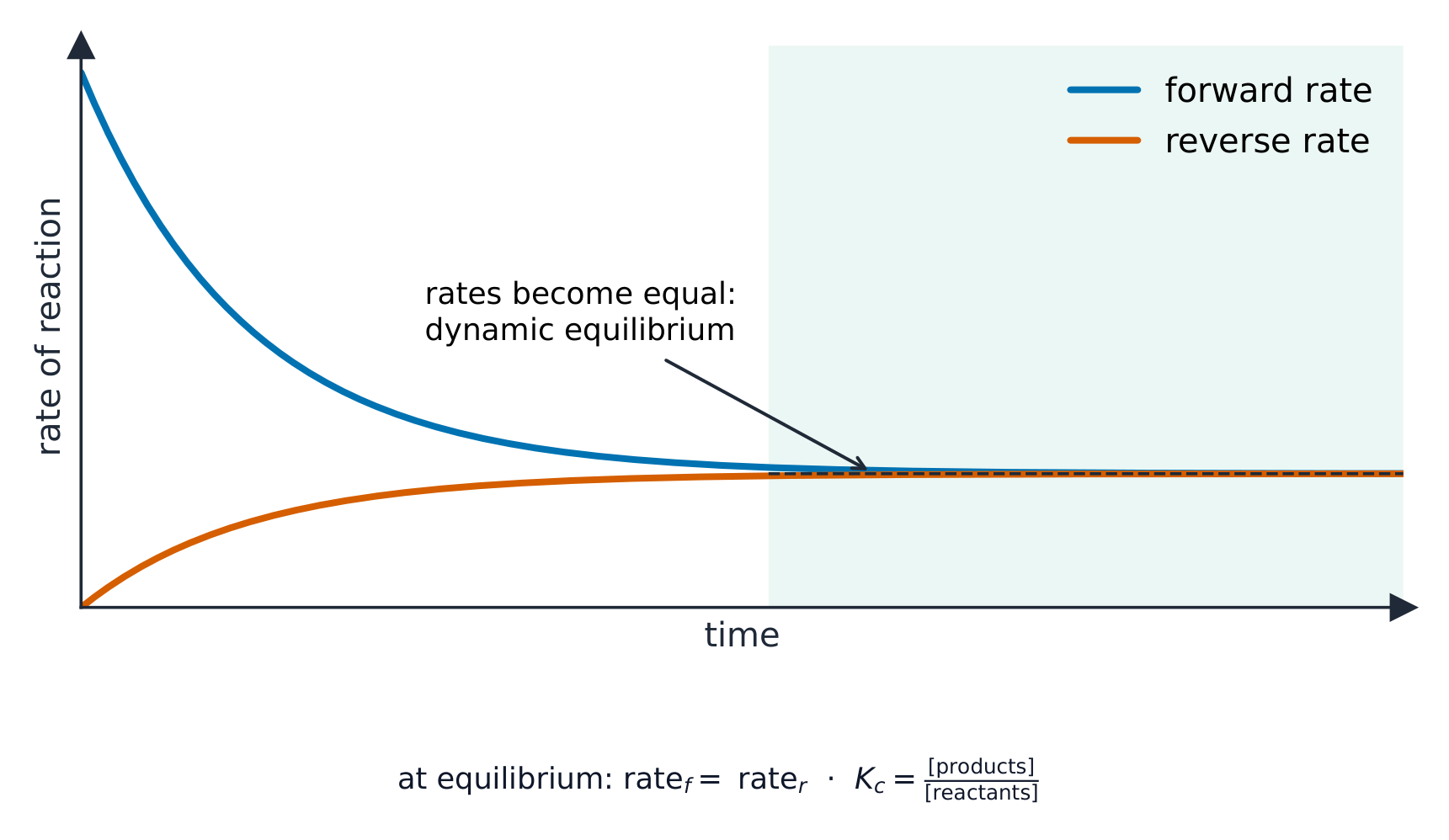
- At the start only the forward reaction can happen, so it is fast. As $\text{N}_2\text{O}_4$ is used up, the forward rate 正反应速率 falls. As $\text{NO}_2$ builds up, the reverse rate rises.
- When the two rates become equal, every $\text{N}_2\text{O}_4$ that breaks apart is replaced by one that forms. From then on, nothing changes overall.
Which statement is true at equilibrium?
Dificultad 1/5 · 100 monedas + un pequeño bono en el primer intento de hoy
The two rates are equal. The rate constants $k_f$ y $k_r$ are usually different.
Constant does not mean equal
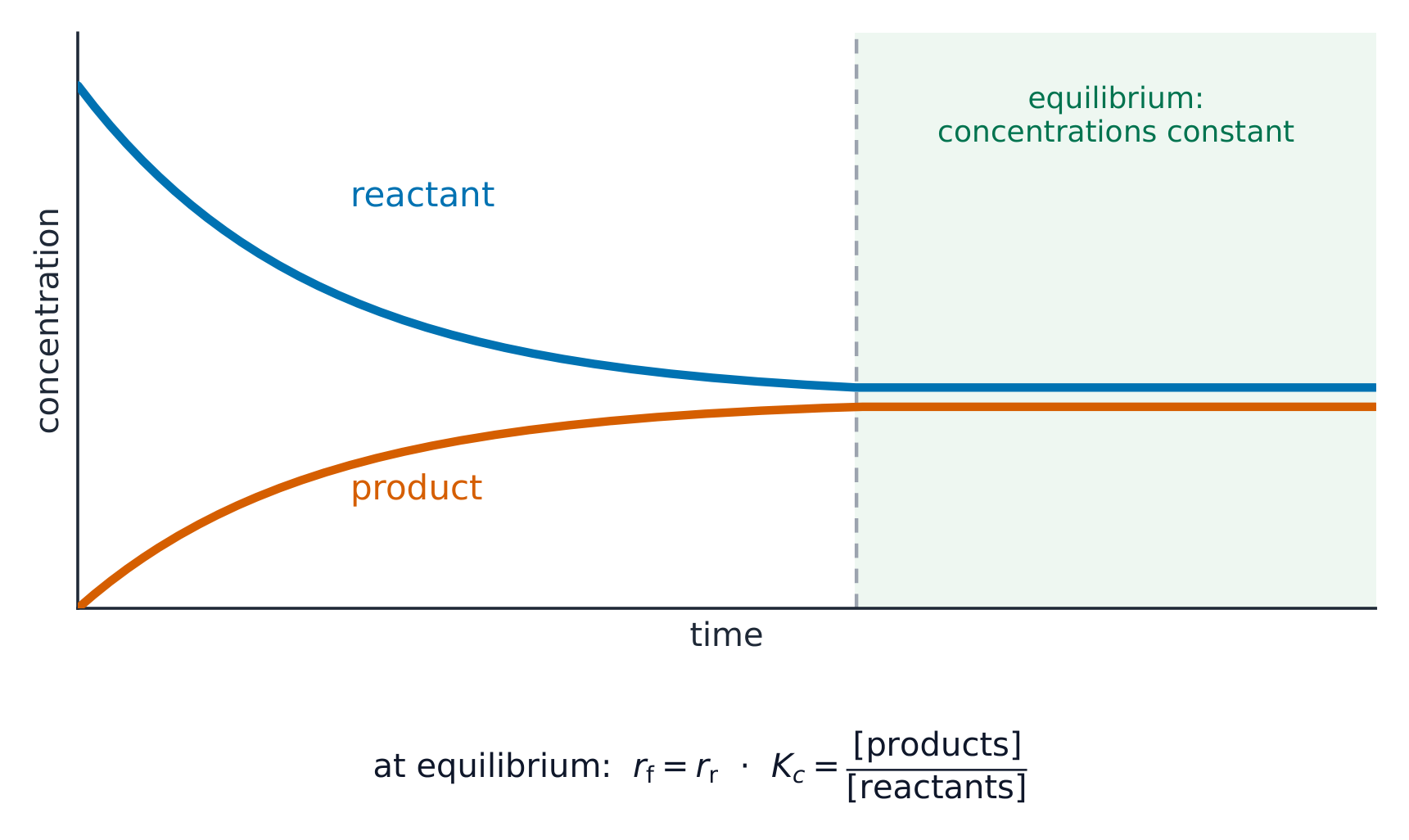
- At equilibrium the concentrations are constant. They are not usually equal to each other, and neither is zero.
- On a concentration–time graph, equilibrium starts where all the lines become flat. The lines can be flat at very different heights.
Reaching dynamic equilibrium
Watch a reversible reaction settle into equilibrium.
Select all statements that are true for a system at equilibrium.
Dificultad 2/5 · 140 monedas + un pequeño bono en el primer intento de hoy
Constant, not equal; both reactions keep running; nothing is zero.
Read the slopes with the coefficients
- Before equilibrium, the curves change in the ratio of the coefficients. In $\text{N}_2\text{O}_4\rightleftharpoons2\text{NO}_2$, $[\text{NO}_2]$ rises twice as fast as $[\text{N}_2\text{O}_4]$ falls.
- So if $[\text{N}_2\text{O}_4]$ drops by $0.020\ \text{M}$ before equilibrium, $[\text{NO}_2]$ rises by $0.040\ \text{M}$.
In $\text{N}_2(g)+3\text{H}_2(g)\rightleftharpoons2\text{NH}_3(g)$, $[\text{N}_2]$ falls by $0.050\ \text{M}$ before equilibrium. By how much does $[\text{NH}_3]$ rise, in M?
Dificultad 2/5 · 140 monedas + un pequeño bono en el primer intento de hoy
The ratio is 1 N$_2$ to 2 NH$_3$, so $[\text{NH}_3]$ rises by $2\times0.050=0.100\ \text{M}$.
A flask starts with $0.100\ \text{M}\ \text{N}_2\text{O}_4$ and no $\text{NO}_2$. Measurements:
| time (s) | 0 | 20 | 40 | 60 | 80 |
|---|---|---|---|---|---|
| $[\text{N}_2\text{O}_4]$ (M) | 0.100 | 0.080 | 0.072 | 0.070 | 0.070 |
- Equilibrium is reached by $60\ \text{s}$: after that, $[\text{N}_2\text{O}_4]$ stays at $0.070\ \text{M}$.
- $[\text{N}_2\text{O}_4]$ fell by $0.030\ \text{M}$, so $[\text{NO}_2]$ rose by $2\times0.030=0.060\ \text{M}$.
- At equilibrium the two concentrations ($0.070$ and $0.060\ \text{M}$) are constant but not equal.
A flask starts with $0.50\ \text{M}$ of A in $\text{A}\rightleftharpoons2\text{B}$. $[\text{A}]$ reads $0.50,\ 0.38,\ 0.32,\ 0.30,\ 0.30\ \text{M}$ at equal time intervals. What is $[\text{B}]$ at equilibrium, in M?
Dificultad 2/5 · 140 monedas + un pequeño bono en el primer intento de hoy
A fell by $0.20\ \text{M}$ in total, so B rose by $2\times0.20=0.40\ \text{M}$.
It needs a closed system
- Equilibrium needs a closed system 封闭体系: nothing gets in or out. If $\text{NO}_2$ could escape from an open flask, the reverse reaction would keep losing its reactant, and equilibrium would never be reached.
- Physical changes reach equilibrium too. In a sealed bottle of water, evaporation and condensation happen at the same rate, so the water level stays the same.
Why can $\text{CaCO}_3(s)\rightleftharpoons\text{CaO}(s)+\text{CO}_2(g)$ never reach equilibrium in an open dish?
Dificultad 1/5 · 100 monedas + un pequeño bono en el primer intento de hoy
Equilibrium needs a closed system. Escaping $\text{CO}_2$ removes the reactant of the reverse reaction.
Evidence that it is still moving
- Chemists can prove the reactions continue. Add a little hydrogen made of heavy atoms (deuterium, D) to an equilibrium mixture of $\text{N}_2$, $\text{H}_2$ and $\text{NH}_3$.
- The total amounts do not change, but D soon appears in the ammonia as $\text{NH}_2\text{D}$. Ammonia must still be breaking up and forming again.
When deuterium appears in ammonia at equilibrium, it shows the equilibrium is ____, not static.
Dificultad 1/5 · 100 monedas + un pequeño bono en el primer intento de hoy
Ammonia is still breaking up and re-forming, so the equilibrium is dynamic.
Three common mistakes: saying the reaction has stopped at equilibrium (both directions continue); saying the concentrations are equal (they are constant); and saying the rate constants are equal (it is the rates that are equal, not $k_f$ and $k_r$).
At dynamic equilibrium in a closed system, the forward and reverse rates are equal, so the concentrations stay constant. They are usually not equal and never zero. On a graph, equilibrium begins where the lines go flat; before that, the concentrations change in the ratio of the coefficients.