Writing the Rate Law
Introducido| English | Significado |
|---|---|
| rate law/reɪt lɔː/ | ley de velocidad |
| rate constant/reɪt ˈkɒnstənt/ | constante de velocidad |
| order/ˈɔːdə/ | orden |
The formula for speed
- Double a reactant and the speed might double — or quadruple.
- Each reaction has its own sensitivity to concentration.
- A short equation captures exactly how speed depends on amounts.
- But you can only find it by experiment, not by guessing.
The rate law
- The rate law 速率定律 links speed to concentrations:
- Here $k$ is the rate constant 速率常数, and $m$ and $n$ are the orders.
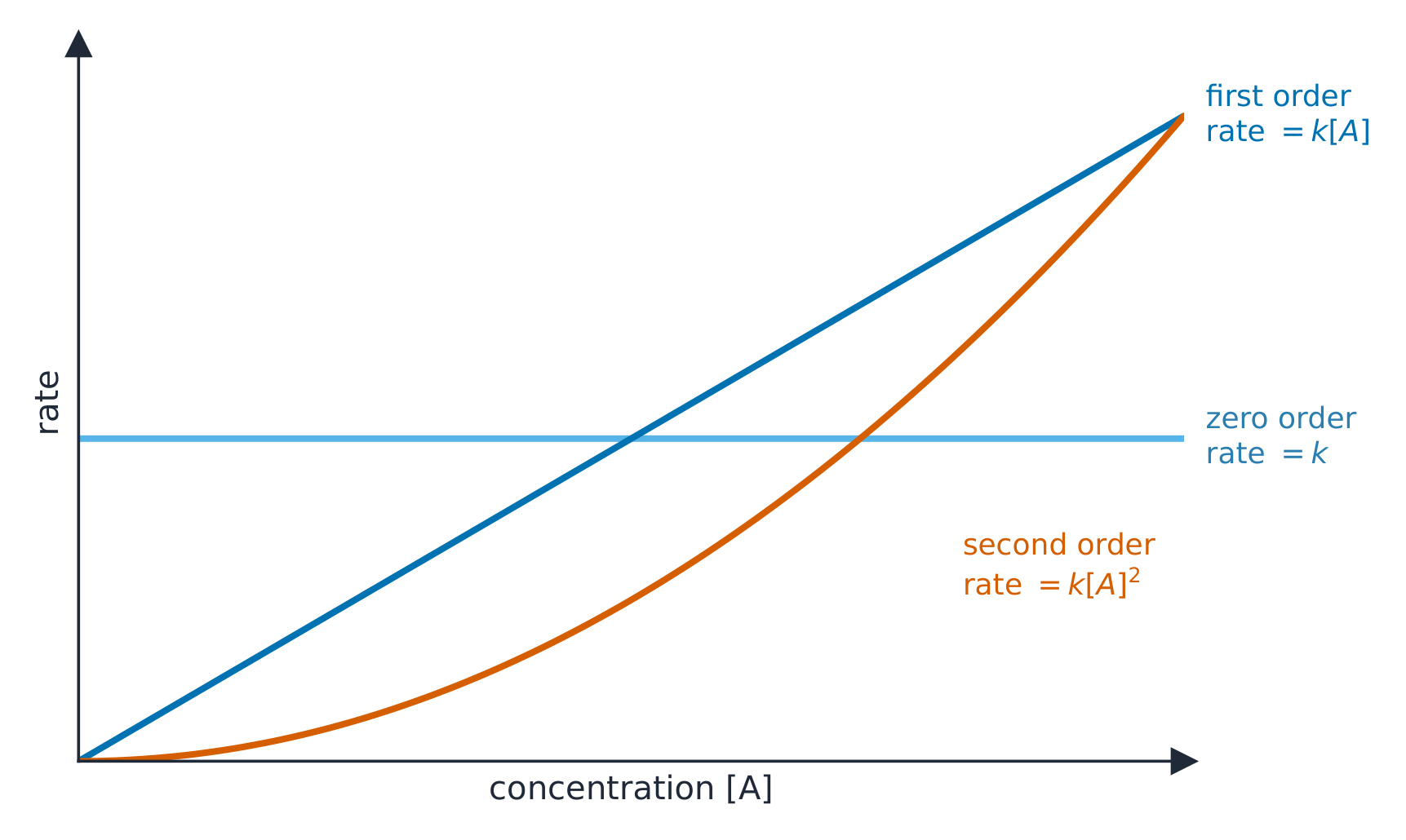
Rate against concentration for zero-, first-, and second-order reactions
The rate constant $k$ changes when the reactant concentrations change.
Dificultad 1/5 · 100 monedas + un pequeño bono en el primer intento de hoy
False. $k$ depends on temperature (and catalysts), not on concentration; concentrations appear separately in the rate law.
Reaction orders
- The order 反应级数 tells how strongly a concentration affects the rate.
- Holding temperature and other concentrations fixed: first order in A means doubling $[A]$ doubles rate; second order means it quadruples.
- Orders come from experiments, not from the equation's coefficients.
A favor $\text{rate} = k[A]^2$, doubling $[A]$ multiplies the rate by...
Dificultad 1/5 · 100 monedas + un pequeño bono en el primer intento de hoy
Second order means $2^2 = 4$ times the rate.
Reaction orders are determined by...
Dificultad 1/5 · 100 monedas + un pequeño bono en el primer intento de hoy
Orders must be found experimentally, not from coefficients.
A reaction is first order in A. At fixed temperature and other concentrations, tripling [A] changes the rate by a factor of...
Dificultad 1/5 · 100 monedas + un pequeño bono en el primer intento de hoy
First order means the rate scales directly, so 3 times.
Overall order
- Add the individual orders to get the overall order ($m + n$).
- It sums up the reaction's total sensitivity to concentration.
- The units of $k$ depend on that overall order.
A favor $\text{rate} = k[A]^2[B]^1$, what is the overall order?
Dificultad 2/5 · 140 monedas + un pequeño bono en el primer intento de hoy
Overall order $= 2 + 1 = 3$.
For $\text{rate} = k[A]^2[B]$, what happens if you double $[A]$?
- $[A]$ is second order, so doubling it multiplies the rate by $2^2 = 4$.
- The rate quadruples.
Find the reaction order
Use how the rate responds to concentration to find the order in A.
For a simple initial forward reaction with negligible products and no catalyst, the rate law is usually written using the ____ concentrations.
Dificultad 1/5 · 100 monedas + un pequeño bono en el primer intento de hoy
In this stated case, use reactant concentrations. This is not a general exclusion rule: catalysts, products or intermediates can affect rates in other mechanisms.
Orders are found by experiment, not read off the balanced equation's coefficients — a very common trap. For a simple initial forward reaction, reactant concentrations often suffice. Catalysts can appear even though they cancel overall; products can enter reverse or inhibited rate laws. And the rate constant $k$ changes with temperature but not with concentration.
The rate law $\text{rate} = k[A]^m[B]^n$ links speed to concentrations through the rate constant $k$ and the orders $m$, $n$. Orders come from experiment, not coefficients, and their sum is the overall order. A concentration's order sets how strongly it changes the rate.