Recognizing a Chemical Reaction
Introducido| English | Significado |
|---|---|
| chemical reaction/ˈkemɪkl rɪˈækʃn/ | reacción química |
| law of conservation of mass/lɔː ɒv ˌkɒnsəˈveɪʃn ɒv mæs/ | ley de conservación de la masa |
Signs that something new was made
- A gas stove burns propane, rust forms on a bike chain, and baking soda fizzes in vinegar. In each, atoms rearrange into new substances.
- A chemical reaction 化学反应 keeps every atom: it only rearranges them. That is why equations must balance.
Clues of a reaction
- A chemical reaction 化学反应 makes new substances from old ones.
- Watch for a colour change, a gas, a precipitate, or heat and light.
- These signs hint that bonds broke and reformed.
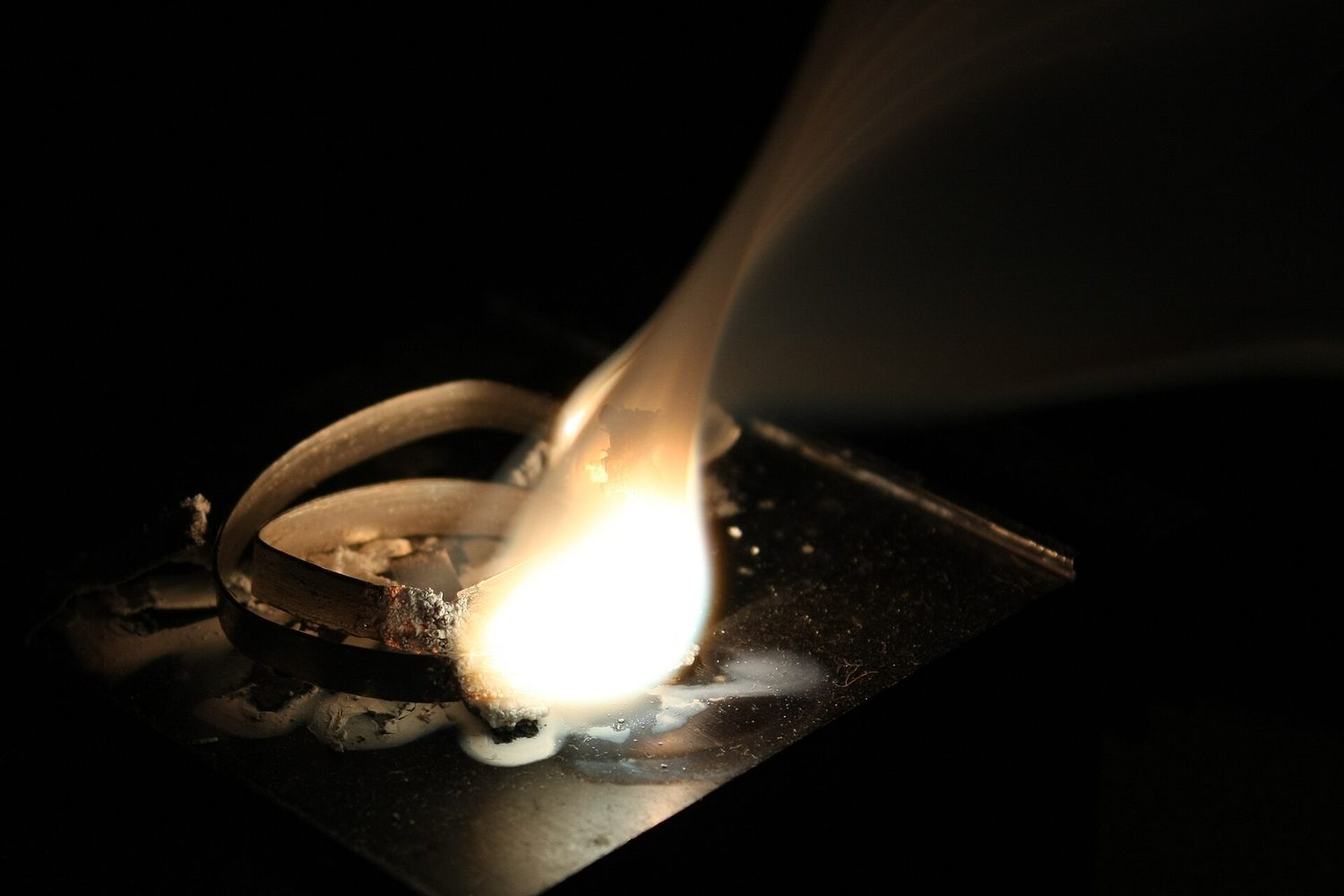
Magnesium burning: a chemical reaction rearranges atoms and releases energy as light and heat
Select todos signs that suggest a chemical reaction.
Dificultad 2/5 · 140 monedas + un pequeño bono en el primer intento de hoy
Colour change, gas, and a precipitate all hint at new substances.
Mass is conserved
- Atoms are only rearranged, never created or destroyed.
- For a closed system, the measured total mass stays the same before and after; in an open vessel, include any gas entering or escaping.
- This is the law of conservation of mass 质量守恒定律.
In a chemical reaction, the total mass of reactants equals the total mass of products.
Dificultad 1/5 · 100 monedas + un pequeño bono en el primer intento de hoy
Atoms and total mass are conserved. A closed vessel retains all products; an open-vessel mass reading can change if gas enters or leaves. Constant mass alone does not prove a reaction occurred.
Mass is conserved even when a ____ escapes during the reaction.
Dificultad 1/5 · 100 monedas + un pequeño bono en el primer intento de hoy
The escaped gas still has mass, so total mass is unchanged.
Balancing the equation
- A balanced equation has equal atoms of each element on both sides.
- Adjust the coefficients (never the subscripts) to balance it.
- $2\text{H}_2 + \text{O}_2 \to 2\text{H}_2\text{O}$ is balanced.
Chemical reaction or not?
Decide whether each observation is a sign of a chemical reaction or just a physical change.
To balance an equation, you adjust the...
Dificultad 1/5 · 100 monedas + un pequeño bono en el primer intento de hoy
Change coefficients only; changing subscripts changes the substance.
Changing a subscript to balance an equation is allowed.
Dificultad 1/5 · 100 monedas + un pequeño bono en el primer intento de hoy
Changing a subscript changes the compound itself, so it is not allowed.
Is $\text{H}_2 + \text{O}_2 \to \text{H}_2\text{O}$ balanced?
- The left has 2 oxygen atoms; the right has 1, so it is not balanced.
- First place 2 before water to balance oxygen. This gives 4 H atoms on the right, so place 2 before hydrogen: $2\text{H}_2+\text{O}_2\to2\text{H}_2\text{O}$. Both sides now have 4 H and 2 O atoms.
In $2\text{H}_2 + \text{O}_2 \to 2\text{H}_2\text{O}$, how many oxygen atoms are on each side?
Dificultad 2/5 · 140 monedas + un pequeño bono en el primer intento de hoy
$\text{O}_2$ has 2 O; $2\text{H}_2\text{O}$ has 2 O -- balanced.
Physical or chemical change?
| Change | Type | Why |
|---|---|---|
| ice melting | physical | still H₂O; only the arrangement changes |
| sugar dissolving | physical | sugar molecules stay intact |
| iron rusting | chemical | new substance, iron(III) oxide |
| propane burning | chemical | new substances, CO₂ and H₂O |
- Dissolving an ionic solid is a borderline case: ionic bonds break, but no new substance forms.
Which is a chemical change?
Dificultad 1/5 · 100 monedas + un pequeño bono en el primer intento de hoy
Burning wax forms new substances (CO₂ and H₂O). Melting, dissolving and boiling keep the same substance.
Balance a combustion. Propane burns in oxygen: $\text{C}_3\text{H}_8 + \text{O}_2 \rightarrow \text{CO}_2 + \text{H}_2\text{O}$.
- Balance C first (3 CO₂), then H (8 H → 4 H₂O): $\text{C}_3\text{H}_8 + \text{O}_2 \rightarrow 3\text{CO}_2 + 4\text{H}_2\text{O}$.
- Count O on the right: $3(2)+4(1)=10$, so $5\,\text{O}_2$. Final: $\text{C}_3\text{H}_8 + 5\text{O}_2 \rightarrow 3\text{CO}_2 + 4\text{H}_2\text{O}$. Balance O last, because it appears in two products.
Balance with the smallest whole numbers: __C₂H₆ + __O₂ → __CO₂ + __H₂O. What is the coefficient of O₂?
Dificultad 2/5 · 140 monedas + un pequeño bono en el primer intento de hoy
2C₂H₆ + 7O₂ → 4CO₂ + 6H₂O. Right side O = 8 + 6 = 14, so 7 O₂.
- Balance with coefficients, never subscripts: changing H₂O to H₂O₂ changes the substance.
- One sign (bubbles, heat) suggests a reaction but does not prove it: boiling also makes bubbles.
- Mass is conserved even when a gas escapes; the gas carries the "missing" mass.
A chemical reaction turns old substances into new ones, hinted at by colour change, gas, a precipitate, or heat and light. Atoms are only rearranged, so the law of conservation of mass holds. Balance an equation by adjusting coefficients, never subscripts.