Working with the Intermediate Value Theorem (IVT) · Trabajando con el Teorema del Valor Intermedio (TVI)
| English | Español |
|---|---|
| Intermediate Value Theorem/ˌɪntəˈmiːdɪət ˈvæljuː ˈθɪərəm/ | Teorema del Valor Intermedio |
| solution/səˈluːʃn/ | disolución |
| zero/ˈzɪərəʊ/ | cero |
If you climbed from 1 m to 3 m, you passed 2 m
- Walk continuously from a height of $1$ m to $3$ m. At some instant you were at exactly $2$ m — you couldn't skip it.
- That obvious-sounding fact is the Intermediate Value Theorem 介值定理 (IVT).
- It guarantees a function hits every height between its endpoint values.
- The one catch: the path must be continuous — no teleporting, no jumps.
Si subes de 1 m a 3 m, pasas por 2 m
- Camina continuamente desde una altura de $1$ m hasta $3$ m. En algún instante estarás exactamente a $2$ m — no puedes saltártelo.
- Ese hecho que parece obvio es el Teorema del Valor Intermedio (TVI).
- Garantiza que una función alcanza cada altura entre sus valores en los extremos.
- La única condición: el camino debe ser continuo — sin teleportarse, sin saltos.
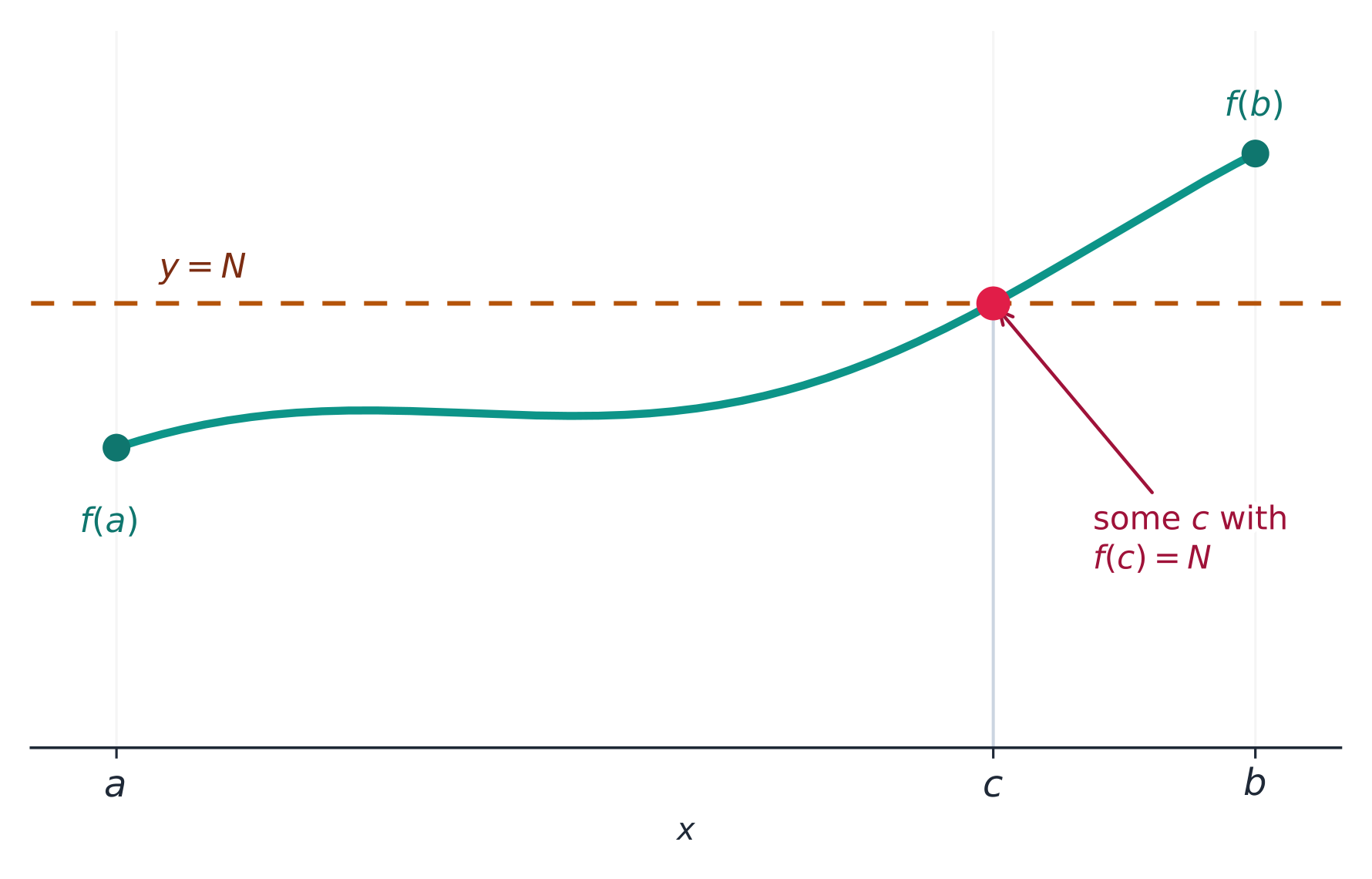
A continuous climb crosses every level · Una escalada continua cruza cada nivel
y = ax³ + bx + c
This continuous curve passes through every height between its ends — pick a target $N$ in range and it is hit somewhere. · Esta curva continua pasa por cada altura entre sus extremos: elige un objetivo $N$ en el rango y será alcanzado en algún lugar.
What the theorem promises
- If $f$ is continuous on the closed interval $[a,b]$, and $N$ is any value between $f(a)$ and $f(b)$,
- then there exists at least one $c$ in $(a,b)$ with $f(c)=N$.
- In words: a continuous function takes every intermediate output somewhere in between.
- It is an existence theorem — it promises a $c$ exists, but does not tell you its value.
Lo que promete el teorema
- Si $f$ es continua en el intervalo cerrado $[a,b]$, y $N$ es cualquier valor entre $f(a)$ y $f(b)$,
- entonces existe al menos un $c$ en $(a,b)$ tal que $f(c)=N$.
- En palabras: una función continua toma cada valor intermedio en alguna parte intermedia.
- Es un teorema de existencia — promete que existe un $c$, pero no te dice su valor.
The IVT tells you the exact value of $c$ where $f(c)=N$. · El TVI te dice el valor exacto de $c$ donde $f(c)=N$.
It is an existence theorem — it guarantees a $c$ exists but does not locate it. · Es un teorema de existencia — garantiza que existe un $c$ pero no lo localiza.
Check the hypotheses first
- Before you use the IVT, confirm the two requirements out loud:
- (1) $f$ is continuous on $[a,b]$ (a polynomial, or otherwise verified — see 1.12).
- (2) the target $N$ lies strictly between $f(a)$ and $f(b)$.
- Skip either check and the conclusion is not guaranteed — for a function with a jump, IVT says nothing.
Verifica las hipótesis primero
- Antes de usar el TVI, confirma en voz alta los dos requisitos:
- (1) $f$ es continua en $[a,b]$ (un polinomio, u otro caso verificado — véase 1.12).
- (2) el objetivo $N$ se encuentra estrictamente entre $f(a)$ y $f(b)$.
- Si omites cualquiera de estas verificaciones, la conclusión no está garantizada — para una función con salto, el TVI no dice nada.
To apply the IVT on $[a,b]$ with target $N$, you need all · todos of... · Para aplicar el TVI en $[a,b]$ con objetivo $N$, necesitas todos los...
IVT needs continuity and a target in range. Differentiability is not · no required. · El TVI necesita continuidad y un objetivo en el rango. La diferenciabilidad no es requerida.
The IVT requires the function to be ____ on the closed interval. · El TVI requiere que la función sea ____ en el intervalo cerrado.
Without continuity a jump can skip the target value. · Sin continuidad, un salto puede omitir el valor objetivo.
A continuous $f$ has $f(2)=5$ and · y $f(6)=9$. For which target $N$ does the IVT guarantee a solution $f(c)=N$? · Una función continua $f$ tiene $f(2)=5$ y $f(6)=9$. ¿Para qué objetivo $N$ garantiza el TVI una solución $f(c)=N$?
$N$ must lie between $5$ and · y $9$; only $7$ qualifies. · $N$ debe estar entre $5$ y $9$; solo $7$ califica.
The classic use: guaranteeing a root
- To show an equation has a solution 解 in $[a,b]$, rewrite it as $g(x)=0$ and target $N=0$.
- If $g$ is continuous and $g(a)$ and $g(b)$ have opposite signs, then $0$ is between them.
- IVT then guarantees a zero 零点 $c$ where $g(c)=0$ — the equation has a root in $(a,b)$.
- This "sign change ⇒ a root" argument is the theorem's most common exam appearance.
El uso clásico: garantizar una raíz
- Para demostrar que una ecuación tiene una solución 解 en $[a,b]$, reescríbela como $g(x)=0$ y busca $N=0$.
- Si $g$ es continua y $g(a)$ y $g(b)$ tienen signos opuestos, entonces $0$ está entre ellos.
- El TVI garantiza entonces un cero 零点 $c$ tal que $g(c)=0$ — la ecuación tiene una raíz en $(a,b)$.
- Este argumento de "cambio de signo ⇒ una raíz" es la aparición más común del teorema en exámenes.
A continuous $g$ has $g(1)=-2$ and · y $g(3)=4$. The IVT guarantees... · Una función continua $g$ tiene $g(1)=-2$ y $g(3)=4$. El TVI garantiza...
Opposite signs bracket $0$; IVT guarantees existence of a root, not its count or location. · Signos opuestos acotan el $0$; el TVI garantiza la existencia de una raíz, no su cantidad ni ubicación.
For · A favor $g(x)=x^2-2$ on $[1,2]$, compute $g(1)$ to check for a sign change with $g(2)=2$. · Para $g(x)=x^2-2$ en $[1,2]$, calcula $g(1)$ para verificar un cambio de signo con $g(2)=2$.
$g(1)=1-2=-1<0$ and · y $g(2)=2>0$: a sign change, so $\sqrt2$ is a root in $(1,2)$. · $g(1)=1-2=-1<0$ y $g(2)=2>0$: hay un cambio de signo, por lo tanto $\sqrt2$ es una raíz en $(1,2)$.
The IVT needs continuity on the whole closed interval and a target strictly between the endpoint values. Without continuity it fails: a function that jumps from $1$ to $3$ never equals $2$. And the IVT only guarantees existence — it does not locate $c$ or say how many such $c$ there are.
El TVI requiere continuidad en todo el intervalo cerrado y un objetivo estrictamente entre los valores en los extremos. Sin continuidad falla: una función que salta de $1$ a $3$ nunca vale $2$. Y el TVI solo garantiza existencia — no localiza $c$ ni dice cuántos $c$ hay así.
Show $x^3 + x - 1 = 0$ has a solution in $[0,1]$.
- Let $g(x)=x^3+x-1$; it is a polynomial, so continuous on $[0,1]$. ✓
- $g(0)=-1$ (negative) and $g(1)=1$ (positive) — opposite signs, so $N=0$ is between them.
- By the IVT, there is a $c\in(0,1)$ with $g(c)=0$. The equation has a root in $(0,1)$.
Demuestra que $x^3 + x - 1 = 0$ tiene una solución en $[0,1]$.
- Sea $g(x)=x^3+x-1$; es un polinomio, por lo tanto continuo en $[0,1]$. ✓
- $g(0)=-1$ (negativo) y $g(1)=1$ (positivo) — signos opuestos, así que $N=0$ está entre ellos.
- Por el TVI, existe un $c\in(0,1)$ tal que $g(c)=0$. La ecuación tiene una raíz en $(0,1)$.
The Intermediate Value Theorem: if $f$ is continuous on $[a,b]$ and $N$ lies between $f(a)$ and $f(b)$, then $f(c)=N$ for some $c$ in $(a,b)$. Always verify continuity and that $N$ is in range first. Its headline use: a sign change of a continuous function guarantees a root in the interval — an existence result, not a value.
Teorema del Valor Intermedio: si $f$ es continua en $[a,b]$ y $N$ está entre $f(a)$ y $f(b)$, entonces $f(c)=N$ para algún $c$ en $(a,b)$. Siempre verifica primero la continuidad y que $N$ esté en el rango. Su uso principal: un cambio de signo de una función continua garantiza una raíz en el intervalo — un resultado de existencia, no un valor.