Exploring Types of Discontinuities · Explorando tipos de discontinuidades
| English | Español |
|---|---|
| discontinuity/dɪskɒntɪˈnjuːɪti/ | discontinuidad |
| removable discontinuity/rɪˈmuːvəbl dɪskɒntɪˈnjuːɪti/ | discontinuidad removable |
| jump discontinuity/dʒʌmp dɪskɒntɪˈnjuːɪti/ | discontinuidad de salto |
| infinite discontinuity/ˈɪnfɪnət dɪskɒntɪˈnjuːɪti/ | discontinuidad infinita |
| vertical asymptote/ˈvɜːtɪkl ˈæsɪmptəʊt/ | asíntota vertical |
Where a graph "breaks"
- A continuous curve can be drawn without lifting your pen. A discontinuity 间断点 is a break in that flow.
- Not all breaks are the same — there are three distinct types, each with its own graph signature.
- Naming the type tells you instantly whether the break can be repaired.
- Let's meet all three: removable, jump, and infinite.
Donde una gráfica "se rompe"
- Una curva continua se puede dibujar sin levantar el lápiz. Una discontinuidad es una ruptura en ese flujo.
- No todas las rupturas son iguales: existen tres tipos distintos, cada uno con su propia firma gráfica.
- Identificar el tipo te dice al instante si la ruptura puede repararse.
- Conozcamos los tres: removible, salto e infinita.
Removable: a single missing point
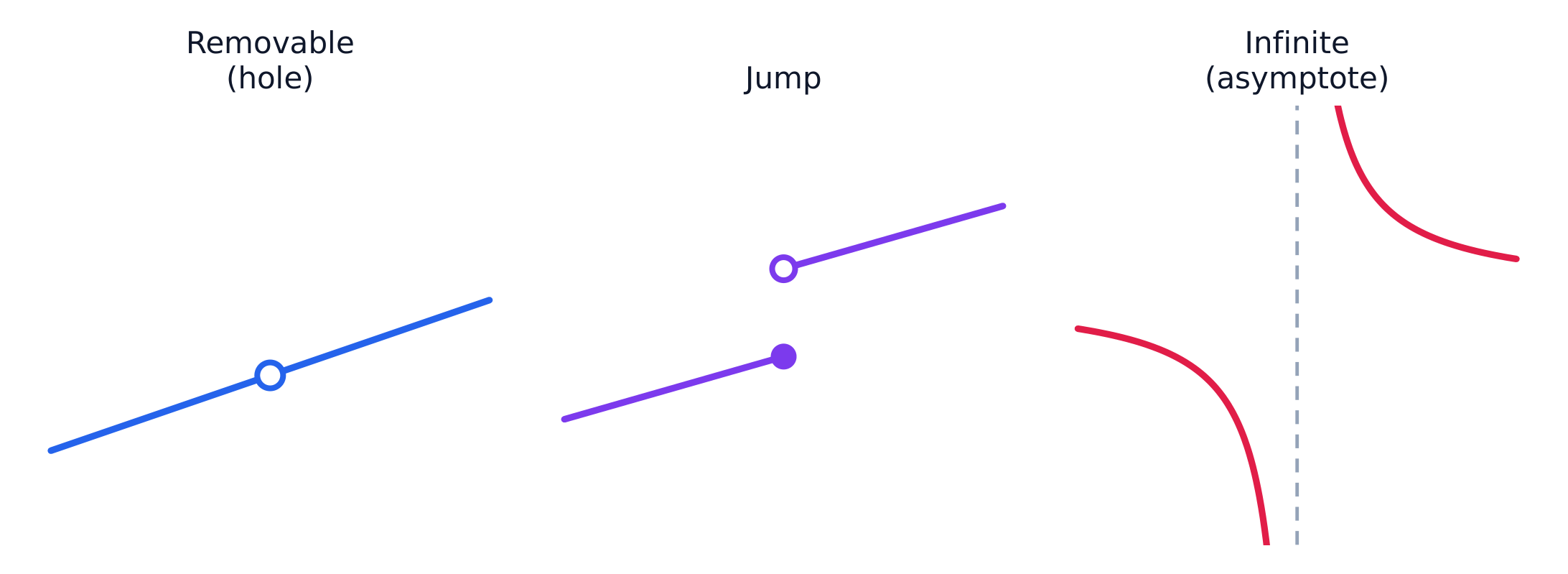
- A removable discontinuity 可去间断点 is just a hole in an otherwise smooth curve.
- The limit exists (both sides meet at one height), but $f(c)$ is missing or plotted elsewhere.
- $f(x)=\dfrac{x^2-4}{x-2}$ has a hole at $x=2$: the limit is $4$, yet $f(2)$ is undefined.
- Because the limit exists, you could "fill the hole" — hence removable (lesson 1.13).
Removible: un solo punto faltante
- Una discontinuidad removible es simplemente un agujero en una curva de lo contrario suave.
- El límite existe (ambos lados coinciden a una misma altura), pero $f(c)$ falta o está graficado en otro lugar.
- $f(x)=\dfrac{x^2-4}{x-2}$ tiene un agujero en $x=2$: el límite es $4$, pero $f(2)$ no está definido.
- Como el límite existe, se podría "rellenar el agujero"; por eso se llama removible (lección 1.13).
At $x=3$, $f(x)=\dfrac{x^2-9}{x-3}$ has a limit of $6$ but $f(3)$ undefined. The discontinuity is... · En $x=3$, $f(x)=\dfrac{x^2-9}{x-3}$ tiene un límite de $6$ pero $f(3)$ está indefinido. La discontinuidad es...
A limit exists but the value is missing — a hole, i.e. removable. · Existe un límite pero falta el valor — un agujero, es decir, evitable.
Jump: the sides disagree
- A jump discontinuity 跳跃间断点 happens when the left and right limits are both finite but different.
- The graph leaps from one height to another — think of a step or a tax bracket.
- Here $\displaystyle\lim_{x\to c}f(x)$ does not exist, because the one-sided limits disagree.
- No single point value can bridge a gap of nonzero width, so a jump is not removable.
Salto: los lados no coinciden
- Una discontinuidad de salto ocurre cuando los límites laterales son ambos finitos pero diferentes.
- La gráfica salta de una altura a otra —piensa en un escalón o una banda impositiva.
- Aquí $\displaystyle\lim_{x\to c}f(x)$ no existe, porque los límites laterales no coinciden.
- Ningún valor puntual único puede puentear una brecha de anchura distinta de cero, por lo que un salto no es removible.
A curve that blows up · Una curva que explota
y = a / (x − b)
A reciprocal shoots to $\pm\infty$ near where its denominator hits zero — that is an infinite discontinuity and a vertical asymptote. · Un recíproco tiende a $\pm\infty$ cerca de donde su denominador se hace cero — esa es una discontinuidad infinita y una asíntota vertical.
A jump discontinuity can be removed by redefining the function at the single point. · Una discontinuidad de salto puede eliminarse redefiniendo la función en el punto único.
The one-sided limits differ, so no single value bridges the gap — jumps are not removable. · Los límites laterales son diferentes, por lo que ningún valor único puede cerrar la brecha — los saltos no son evitables.
A step function is $1$ for $x<0$ and · y $4$ for $x\ge0$. What is the size of the jump at $x=0$? · Una función escalonada vale $1$ para $x<0$ y $4$ para $x\ge0$. ¿Cuál es el tamaño del salto en $x=0$?
Right minus left: $4-1=3$. · Derecho menos izquierdo: $4-1=3$.
Infinite: off to $\pm\infty$
- An infinite discontinuity 无穷间断点 is where the function grows without bound near $c$.
- The graph rockets up or down along a vertical asymptote — as in $f(x)=\dfrac1{x-2}$ at $x=2$.
- The limit is infinite (or DNE), so this break is also not removable.
- Signature: a denominator heading to zero while the numerator does not.
Infinita: hacia $\pm\infty$
- Una discontinuidad infinita es donde la función crece sin límite cerca de $c$.
- La gráfica sube o baja rápidamente a lo largo de una asíntota vertical —como en $f(x)=\dfrac1{x-2}$ en $x=2$.
- El límite es infinito (o no existe), así que esta ruptura también no es removible.
- Firma: un denominador que tiende a cero mientras el numerador no.
An infinite discontinuity appears on a graph as a vertical ____. · Una discontinuidad infinita aparece en una gráfica como una ____ vertical.
The function grows without bound along the vertical asymptote. · La función crece sin límite a lo largo de la asíntota vertical.
Which discontinuity type is the only one where the two-sided limit exists? · ¿Qué tipo de discontinuidad es la única en la que el límite bidireccional existe?
Removable = a hole where both sides agree, so the limit exists. · Evitable = un agujero donde ambos lados coinciden, por lo que el límite existe.
Select all · todos functions with an infinite discontinuity at the marked point. · Seleccione todas las funciones con una discontinuidad infinita en el punto marcado.
The third is removable (limit $=2$). The others blow up to $\pm\infty$. · La tercera es evitable (límite $=2$). Las otras explotan hacia $\pm\infty$.
Only the removable type has a genuine two-sided limit. For jump and infinite discontinuities the limit does not exist, so no clever redefinition at the single point can make the function continuous. Don't try to "fill" a jump — the gap has real width.
Solo el tipo removible tiene un verdadero límite bidireccional. Para las discontinuidades de salto e infinitas, el límite no existe, por lo que ninguna redefinición ingeniosa en el punto único puede hacer que la función sea continua. No intentes "rellenar" un salto; la brecha tiene anchura real.
Classify the discontinuity of each at the marked point:
- $\dfrac{x^2-9}{x-3}$ at $x=3$: limit $=6$, value undefined → removable (hole).
- $f(x)=\begin{cases}1,&x;<0\\2,&x;\ge0\end{cases}$ at $x=0$: left $\to1$, right $\to2$ → jump.
- $\dfrac{1}{x^2}$ at $x=0$: grows to $+\infty$ → infinite.
Clasifica la discontinuidad de cada una en el punto marcado:
- $\dfrac{x^2-9}{x-3}$ en $x=3$: límite $=6$, valor indefinido → removible (agujero).
- $f(x)=\begin{cases}1,&x;<0\\2,&x;\ge0\end{cases}$ en $x=0$: izquierda $\to1$, derecha $\to2$ → salto.
- $\dfrac{1}{x^2}$ en $x=0$: crece hacia $+\infty$ → infinita.
Three discontinuity types: removable (a hole — the limit exists but $f(c)$ doesn't match), jump (finite one-sided limits that disagree), and infinite (unbounded near $c$, a vertical asymptote). Only the removable type has a two-sided limit, so only it can be repaired.
Tres tipos de discontinuidad: removible (un agujero —el límite existe pero $f(c)$ no coincide), salto (límites laterales finitos que no coinciden) e infinita (sin acotar cerca de $c$, una asíntota vertical). Solo el tipo removible tiene un límite bidireccional, por lo que solo este puede repararse.