Determining Limits Using Algebraic Properties of Limits
Introducido| English | Significado |
|---|---|
| limit laws/ˈlɪmɪt lɔːz/ | leyes de los límites |
| direct substitution/daɪˈrekt ˌsʌbstɪˈtjuːʃn/ | sustitución directa |
| polynomial/ˌpɒlɪˈnəʊmɪəl/ | polinomio |
| rational/ˈræʃənl/ | racional |
| indeterminate form/ˌɪndɪˈtɜːmɪnət fɔːm/ | A limiting expression whose apparent form alone does not determine its limit, such as zero over zero. |
Limits obey friendly algebra
- If you know where $f$ and $g$ are heading, you know where $f+g$, $f-g$, $fg$ and (usually) $\frac fg$ are heading.
- These are the limit laws 极限法则. They split a messy limit into simple pieces.
The limit laws, in one place
- If $\displaystyle\lim_{x\to c} f(x)=L$ and $\displaystyle\lim_{x\to c} g(x)=M$: $\lim (f\pm g) = L\pm M$, $\lim (fg) = LM$, $\lim (kf)=kL$, $\lim f^n=L^n$.
- Quotient: $\displaystyle\lim \frac{f}{g}=\frac{L}{M}$, only if $M\neq 0$.
Given $\lim f = 6$ y $\lim g = 3$, find $\lim \dfrac{f}{g}$.
Dificultad 2/5 · 140 monedas + un pequeño bono en el primer intento de hoy
Quotient law (denominator limit $3\neq0$): $\frac{6}{3}=2$.
The quotient law $\lim\frac fg=\frac LM$ requires that $M$, the denominator's limit, is not ____.
Dificultad 1/5 · 100 monedas + un pequeño bono en el primer intento de hoy
If $M=0$ the law does not apply directly — you may have an indeterminate form.
AP style: given limits. $\displaystyle\lim_{x\to2}f(x)=3$ and $\displaystyle\lim_{x\to2}g(x)=-2$. Find $\displaystyle\lim_{x\to2}\frac{2f(x)-g(x)^2}{f(x)+g(x)}$.
- Top: $2(3)-(-2)^2=6-4=2$. Bottom: $3+(-2)=1$, which is not 0, so the quotient law applies.
- Limit $=\dfrac21=2$.
$\displaystyle\lim_{x\to5}f(x)=4$ y $\displaystyle\lim_{x\to5}g(x)=-1$. Find $\displaystyle\lim_{x\to5}\frac{f(x)^2+3g(x)}{f(x)-2g(x)}$ to 3 decimal places.
Dificultad 2/5 · 140 monedas + un pequeño bono en el primer intento de hoy
Top: $4^2+3(-1)=13$. Bottom: $4-2(-1)=6$, not 0. Limit $=\tfrac{13}{6}\approx2.167$.
Direct substitution: the fast lane
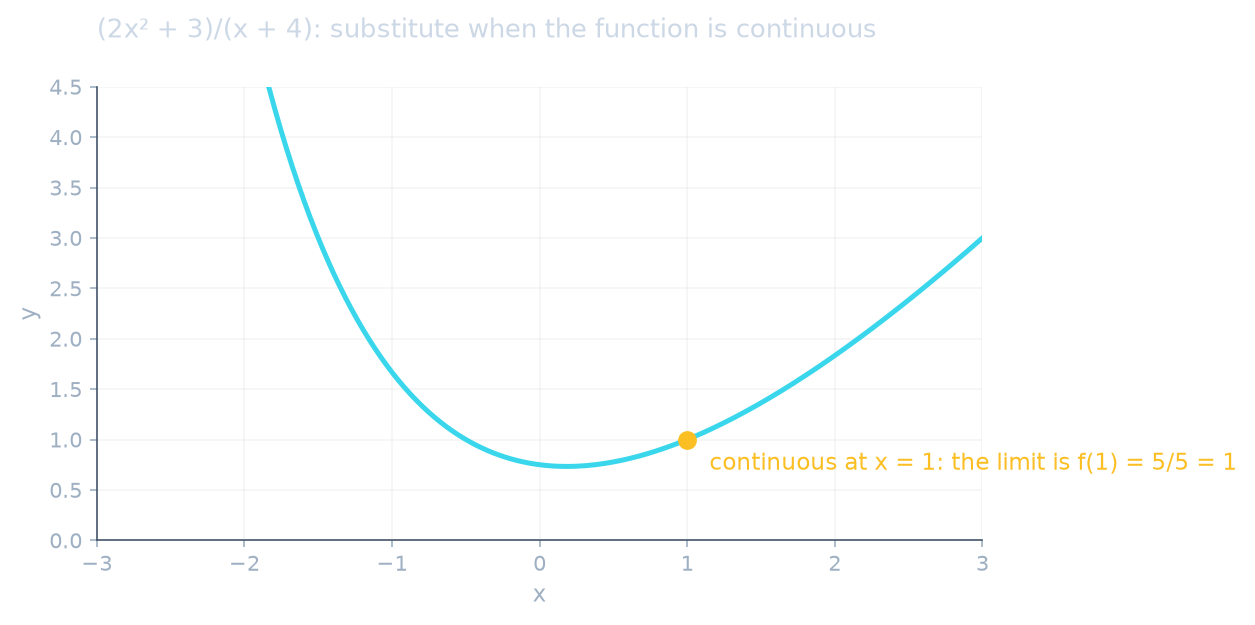
- For a polynomial 多项式, or a rational 有理 function whose denominator is not 0 at $c$, direct substitution 直接代入 works: plug in $c$.
- $\displaystyle\lim_{x\to 1}\dfrac{2x^2+3}{x+4}=\dfrac{5}{5}=1$. Always try this first.
Un polinomio no tiene sorpresas
y = ax² + bx + c
Polynomials are smooth everywhere — drag the coefficients and see why plugging in $c$ (direct substitution) simply reads off the height.
Evaluate $\displaystyle\lim_{x\to 2}(3x^2 - x + 4)$.
Dificultad 2/5 · 140 monedas + un pequeño bono en el primer intento de hoy
Direct substitution: $3(4)-2+4 = 14$.
For which limits does direct substitution give the answer immediately?
Dificultad 2/5 · 140 monedas + un pequeño bono en el primer intento de hoy
The third gives $\tfrac00$ (denominator limit $0$) so substitution stalls; the others give a finite value straight away.
When you meet a new limit, direct substitution is the sensible first thing to try.
Dificultad 1/5 · 100 monedas + un pequeño bono en el primer intento de hoy
It is fastest when it works; only switch strategies if it yields an indeterminate form.
When substitution stalls
- $\dfrac{0}{0}$ is an indeterminate form 不定型: substitution can't decide. Simplify first (1.6). $\displaystyle\lim_{x\to2}\frac{x^2-4}{x-2}$ gives $\tfrac00$ but equals 4.
- A nonzero number over 0 (like $\tfrac50$) is different: the limit is $\pm\infty$ or does not exist.
Direct substitution gives $\tfrac00$. This means...
Dificultad 1/5 · 100 monedas + un pequeño bono en el primer intento de hoy
$\tfrac00$ is indeterminate: a cue to do algebra, not a final answer.
When the laws don't apply. $\displaystyle\lim_{x\to0}x=0$, and $\sin\tfrac1x$ has no limit at 0. What is $\displaystyle\lim_{x\to0}x\sin\tfrac1x$?
- The product law needs both limits to exist, so it says nothing here.
- Another tool settles it: $-|x|\le x\sin\tfrac1x\le|x|$, and both bounds go to 0, so the limit is 0 (the squeeze theorem, 1.8).
If $\displaystyle\lim_{x\to c}g(x)$ does not exist, then $\displaystyle\lim_{x\to c}f(x)g(x)$ cannot exist either.
Dificultad 1/5 · 100 monedas + un pequeño bono en el primer intento de hoy
The product law just does not apply. $x\sin\tfrac1x$ still has limit 0 at $x=0$, although $\sin\tfrac1x$ has no limit there.
A favor $f(x)=2x+1$ as $x$ approaches 4, what is the limit, and what would a 0/0 substitution mean instead?
Polynomials are safe to substitute.
What is $\displaystyle\lim_{x\to4}(2x+1)$?
Dificultad 1/5 · 100 monedas + un pequeño bono en el primer intento de hoy
Polynomials are continuous; substitute $x=4$ to get $2(4)+1=8+1=9$.
- $\tfrac00$ is not an answer and does not mean DNE. It means "do more algebra".
- The laws need each piece's limit to exist. Check the denominator's limit is not 0 before using the quotient law.
- Use limits, not values: $\lim f$ can differ from $f(c)$.
Split limits across $+$, $-$, $\times$, $\div$ and powers when each piece's limit exists (and the denominator's limit is not 0). For polynomials and rationals, use direct substitution. $\tfrac00$ is an indeterminate form: a cue to simplify.