Orígenes de la vida en la Tierra
Introducido| English | Significado |
|---|---|
| organic molecules/ɔːˈɡænɪk ˈmɒlɪkjuːlz/ | moléculas orgánicas |
Where did the first life come from?
- Natural selection explains how life changed — but not how it first began.
- The earliest cells appeared on Earth billions of years ago.
- Before them, there was only chemistry, no biology.
- How that chemistry became the first living cell is one of science's great questions.
A very different young Earth
- Early Earth was hot, with volcanoes, lightning, and no free oxygen.
- Its air held simple gases, and its surface held water.
- These provided the ingredients and the energy for reactions.
- The stage was set for chemistry to become complex.
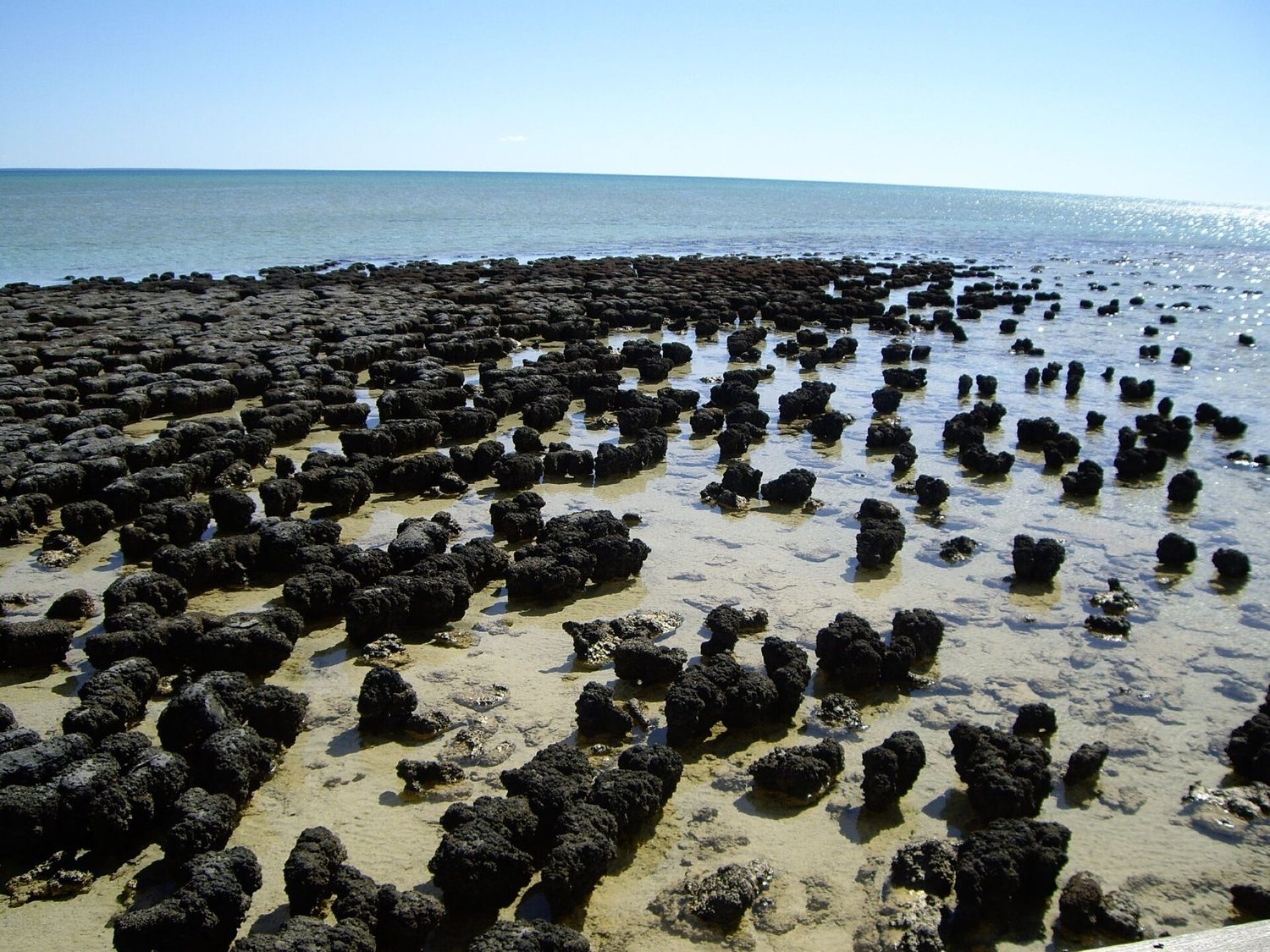
Stromatolites: layered microbial mats are among the oldest evidence of life on Earth
¿Qué proporcionó la Tierra primitiva que podría impulsar reacciones químicas?
Dificultad 1/5 · 100 monedas + un pequeño bono en el primer intento de hoy
La Tierra primitiva tenía energía de relámpagos, volcanes y luz solar, pero poco oxígeno libre y aún no había vida.
Building organic molecules
- Given energy, simple gases can react to form small organic molecules 有机分子.
- The famous Miller-Urey experiment showed this in the lab, making amino acids.
- Over time, these small molecules could join into larger polymers, including RNA.
- Step by step, the chemistry grew more life-like.
De la química a la primera célula
Paso a paso, ver cómo los químicos simples de la Tierra primitiva podrían haberse acumulado para formar las primeras células vivas.
El experimento de Miller-Urey demostró que las condiciones de la Tierra primitiva podían formar…
Dificultad 1/5 · 100 monedas + un pequeño bono en el primer intento de hoy
Miller y Urey produjeron moléculas orgánicas (aminoácidos) a partir de gases simples y energía —un primer paso clave.
The first cells
- Molecules that could copy themselves had a huge advantage.
- Wrapped inside simple membranes, they formed the first cell-like structures.
- Once such a structure could copy itself, life — and natural selection — could begin.
- From that first cell, all of today's diversity slowly branched out.
Se cree que la vida se construyó gradualmente: pequeñas moléculas, luego polímeros, luego células.
Dificultad 1/5 · 100 monedas + un pequeño bono en el primer intento de hoy
Los pasos se acumulan: moléculas simples, luego polímeros más grandes, luego células encapsuladas por membranas que se copian a sí mismas.
Una vez que existieron las primeras células, la diversidad de la vida surgió a través de la ____ natural.
Dificultad 1/5 · 100 monedas + un pequeño bono en el primer intento de hoy
El origen de la primera célula es separado de la selección natural, que luego produjo toda la diversidad posterior.
Seleccione todas las afirmaciones verdaderas sobre el origen de la vida.
Dificultad 2/5 · 140 monedas + un pequeño bono en el primer intento de hoy
Se cree que la vida se construyó gradualmente, no apareció instantáneamente. Las otras tres son correctas.
This lesson is about the origin of the first life — a chemistry question. It is separate from natural selection, which explains the diversity of life after the first cell existed. Do not use "evolution" to mean the origin of life itself.
The Miller-Urey experiment:
- In 1953, scientists sealed simple gases and water in a flask and added sparks (like lightning).
- After days, the flask contained amino acids — the building blocks of proteins.
- It showed that life's ingredients can form from non-living chemistry, given energy.
The origin of life asks how the first cell arose from chemistry. On early Earth, energy drove simple gases to form organic molecules (shown by Miller-Urey), which built up into polymers and eventually membrane-enclosed, self-copying cells. This is a separate question from natural selection, which then produced all later diversity.
Write from this case
- A lab sparks inorganic gases like those proposed for early Earth.
- No cells are put in the flask.
¿Qué monómeros biológicos pueden formarse?
La síntesis abiótica puede producir aminoácidos.
¿Qué produjo este tipo de experimento con chispas?
Dificultad 1/5 · 100 monedas + un pequeño bono en el primer intento de hoy
Se formaron monómeros. No se formaron células.