Evolución continua
Introducido| English | Significado |
|---|---|
| antibiotic resistance/ˌæntɪbaɪˈɒtɪk rɪˈzɪstəns/ | Resistencia a los antibióticos |
Evolution is not finished
- Evolution is not just a story about the distant past.
- It is happening right now, all around us.
- In fast-breeding organisms, we can even watch it unfold.
- Nowhere is this clearer than in bacteria facing antibiotics.
Fast lives, fast evolution
- Bacteria can divide every twenty minutes.
- So thousands of generations pass in a matter of days.
- With each generation, selection has another chance to act.
- Evolution that takes millions of years in whales takes weeks in bacteria.
¿Por qué podemos ver la evolución ocurriendo en las bacterias dentro de nuestra vida?
Dificultad 1/5 · 100 monedas + un pequeño bono en el primer intento de hoy
Las bacterias se dividen en minutos, por lo que muchas generaciones y mucha selección ocurren en poco tiempo.
Antibiotic resistance
- A few bacteria carry a chance mutation that makes them resistant to a drug.
- When the antibiotic is used, it kills the non-resistant bacteria.
- The resistant survivors multiply, and soon the whole population resists the drug.
- This spread of antibiotic resistance 抗生素耐药性 is natural selection in fast-forward.
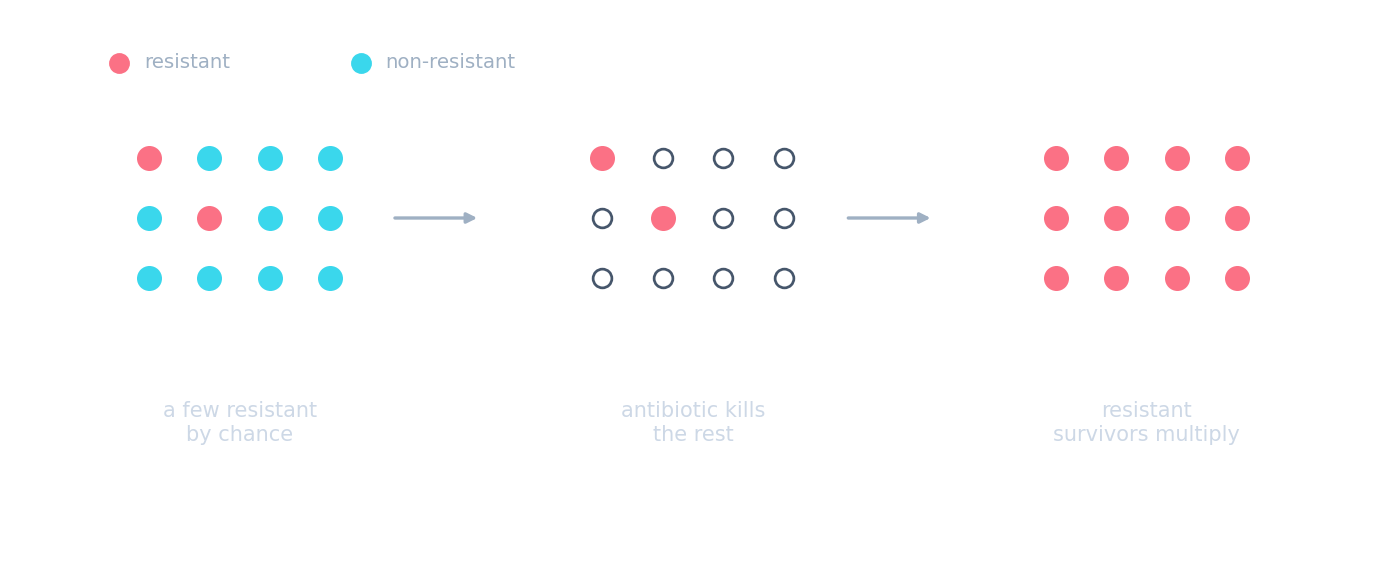
Selección para la resistencia
Observa cómo un medicamento mata a la mayoría de las bacterias, pero las raras resistentes sobreviven y toman el control.
¿Cómo se dispersa la resistencia a los antibióticos a través de una población bacteriana?
Dificultad 1/5 · 100 monedas + un pequeño bono en el primer intento de hoy
Algunas bacterias son naturalmente resistentes; el antibiótico mata a las demás, por lo que los supervivientes toman el control.
Las bacterias resistentes aparecen primero por medio aleatorio de ____, no por intentar resistirse.
Dificultad 1/5 · 100 monedas + un pequeño bono en el primer intento de hoy
Una mutación casual hace que una bacteria sea resistente antes de que llegue el medicamento; luego la selección la favorece.
Why overuse is dangerous
- Every use of an antibiotic favours any resistant bacteria present.
- Overusing them speeds up the evolution of resistance.
- This is why doctors urge us not to misuse antibiotics.
- Resistant "superbugs" are a real and growing danger.
El uso excesivo de antibióticos hace menos probable que las bacterias se vuelvan resistentes.
Dificultad 1/5 · 100 monedas + un pequeño bono en el primer intento de hoy
Falso. Cada uso elimina las bacterias susceptibles y deja a las resistentes para que se multipliquen, por lo que el exceso acelera la evolución de la resistencia.
Selecciona todas las afirmaciones verdaderas sobre la evolución continua.
Dificultad 2/5 · 140 monedas + un pequeño bono en el primer intento de hoy
Las bacterias no eligen resistirse; la resistencia surge por mutación aleatoria. Las otras tres son correctas.
Bacteria do not "try" to become resistant, and the drug does not teach them. Resistance comes first, by random mutation, in a few bacteria. The antibiotic then simply selects those survivors. Evolution has no goal — it only favours what already works.
The rise of a superbug:
- In a patient, one bacterium happens to carry a resistance mutation.
- Antibiotics wipe out its non-resistant neighbours, leaving it to multiply.
- Within days the infection is dominated by resistant bacteria — a superbug, evolved before our eyes.
Evolution continues today, fastest in quick-breeding organisms. Antibiotic resistance spreads when a chance mutation makes a few bacteria resistant, the drug kills the rest, and the survivors multiply. Overusing antibiotics speeds this up. Bacteria do not choose to resist — selection favours those that already can.
Write from this case
- An antibiotic kills most bacteria in a population.
- A few bacteria already carry a resistance allele and they reproduce.
¿Qué queda, y sigue ocurriendo esta evolución?
La selección cambia la población mientras observamos.
¿Qué permanece después del antibiótico?
Dificultad 1/5 · 100 monedas + un pequeño bono en el primer intento de hoy
La selección deja la resistencia heredada.