Respiración Celular
Introducido| English | Significado |
|---|---|
| proton gradient/ˈprəʊtɒn ˈɡreɪdɪənt/ | gradiente de protones |
| cellular respiration/ˈseljʊlə ˌrespɪˈreɪʃn/ | Respiración celular |
| glycolysis/ɡlaɪˈkɒləsɪs/ | Glucólisis |
| aerobic respiration/eəˈrəʊbɪk ˌrespɪˈreɪʃn/ | Respiración aeróbica |
| fermentation/fɜːmənˈteɪʃn/ | Fermentación |
| citric acid cycle/ˈsɪtrɪk ˈæsɪd ˈsaɪkl/ | Ciclo del ácido cítrico |
| electron transport chain/ɪˈlektrɒn ˈtrænspɔːt tʃeɪn/ | Cadena de transporte de electrones |
| ATP synthase/ˌeɪ tiː ˈpiː ˈsɪnθeɪs/ | ATP sintasa |
| chemiosmosis/ˌkemɪəzˈməʊsɪs/ | Quimiosmosis |
| anaerobic respiration/ˌæneəˈrəʊbɪk ˌrespɪˈreɪʃn/ | Respiración anaeróbica |
Why yeast can raise dough without oxygen
- Yeast releases carbon dioxide while fermenting sugar, so dough expands even without an oxygen supply. Yet aerobic cells can obtain much more ATP from the same sugar.
- Follow the electrons and proton gradient 质子梯度 to explain this difference; a list of reaction products alone cannot explain ATP production.
The overall reaction
- Cellular respiration 细胞呼吸 breaks glucose down using oxygen.
- $\text{C}_6\text{H}_{12}\text{O}_6 + 6\text{O}_2 \rightarrow 6\text{CO}_2 + 6\text{H}_2\text{O} + \text{ATP}$.
- The energy released is captured as ATP.
- Carbon dioxide and water leave as waste.
¿Cuál es el propósito de la respiración celular?
Dificultad 1/5 · 100 monedas + un pequeño bono en el primer intento de hoy
La respiración celular descompone la glucosa para liberar energía como ATP.
Stage 1: glycolysis 糖酵解
- Glycolysis splits glucose in the cytoplasm.
- It makes two smaller molecules (pyruvate) and a little ATP.
- This first step needs no oxygen.
- If oxygen is present, the pyruvate goes on to the mitochondria.
Las etapas de la respiración
Recorra las etapas de la respiración: la glucosa se divide, luego se descompone completamente en la mitocondria para liberar gran cantidad de ATP.
La primera etapa, que consiste en dividir la glucosa en el citoplasma, se llama ____.
Dificultad 1/5 · 100 monedas + un pequeño bono en el primer intento de hoy
La glicólisis divide la glucosa en dos moléculas de piruvato y produce una pequeña cantidad de ATP.
With or without oxygen
- Aerobic respiration 有氧呼吸 uses oxygen in the mitochondria to finish breaking glucose down.
- It releases a large amount of ATP.
- Without oxygen, muscle cells can use fermentation 发酵 to regenerate NAD⁺.
- Glycolysis then supplies only two net ATP per glucose; other products include lactate.
¿Qué produce más ATP por glucosa: la respiración aeróbica completa o la glicólisis seguida de fermentación?
Dificultad 1/5 · 100 monedas + un pequeño bono en el primer intento de hoy
El transporte aeróbico de electrones apoya la producción oxidativa de ATP. La fermentación regenera NAD⁺ pero no añade ATP adicional más allá de la glicólisis.
La glucólisis seguida de fermentación produce más ATP por glucosa que la respiración aeróbica completa.
Dificultad 1/5 · 100 monedas + un pequeño bono en el primer intento de hoy
Falso. La fermentación solo regenera NAD⁺ para que la glucólisis continúe, generando dos ATP netos por glucosa; la respiración aeróbica produce mucho más a través de la fosforilación oxidativa.
Seleccione todas las afirmaciones verdaderas sobre la respiración.
Dificultad 2/5 · 140 monedas + un pequeño bono en el primer intento de hoy
Construir glucosa a partir de CO₂ es la fotosíntesis — lo opuesto a la respiración. Las otras tres son correctas.
Load the electron carriers
- Glycolysis yields two pyruvate, a net two ATP and NADH per glucose. Pyruvate oxidation and the citric acid cycle 柠檬酸循环 in the mitochondrial matrix release carbon dioxide and load NADH and FADH₂ with electrons.
- The cycle also makes a small amount of ATP directly. NADH and FADH₂ carry electrons to the inner-membrane electron transport chain 电子传递链, rather than carrying ATP themselves.
Build a proton gradient
- As electrons move along the chain, released energy pumps protons from the matrix into the intermembrane space. This builds a proton gradient: more H⁺ outside the inner membrane, so that side has the lower pH.
- Oxygen is the final electron acceptor in aerobic respiration and contributes to water formation. The folded inner membrane provides a large surface for transport proteins; aerobic prokaryotes use their plasma membrane instead.
Durante el transporte activo de electrones mitocondrial, ¿qué compartimento tiene un pH más bajo?
Dificultad 1/5 · 100 monedas + un pequeño bono en el primer intento de hoy
La bomba de protones aumenta la concentración de H⁺ en el espacio intermembranal.
Let protons drive ATP synthase ATP合酶
- Protons flow back into the matrix through ATP synthase. This flow, called chemiosmosis 化学渗透, powers the joining of ADP and inorganic phosphate to make ATP.
- Electron transport and ATP production are coupled by the gradient. If an uncoupler lets protons cross elsewhere, electron transport may continue but ATP yield falls and more energy becomes heat.
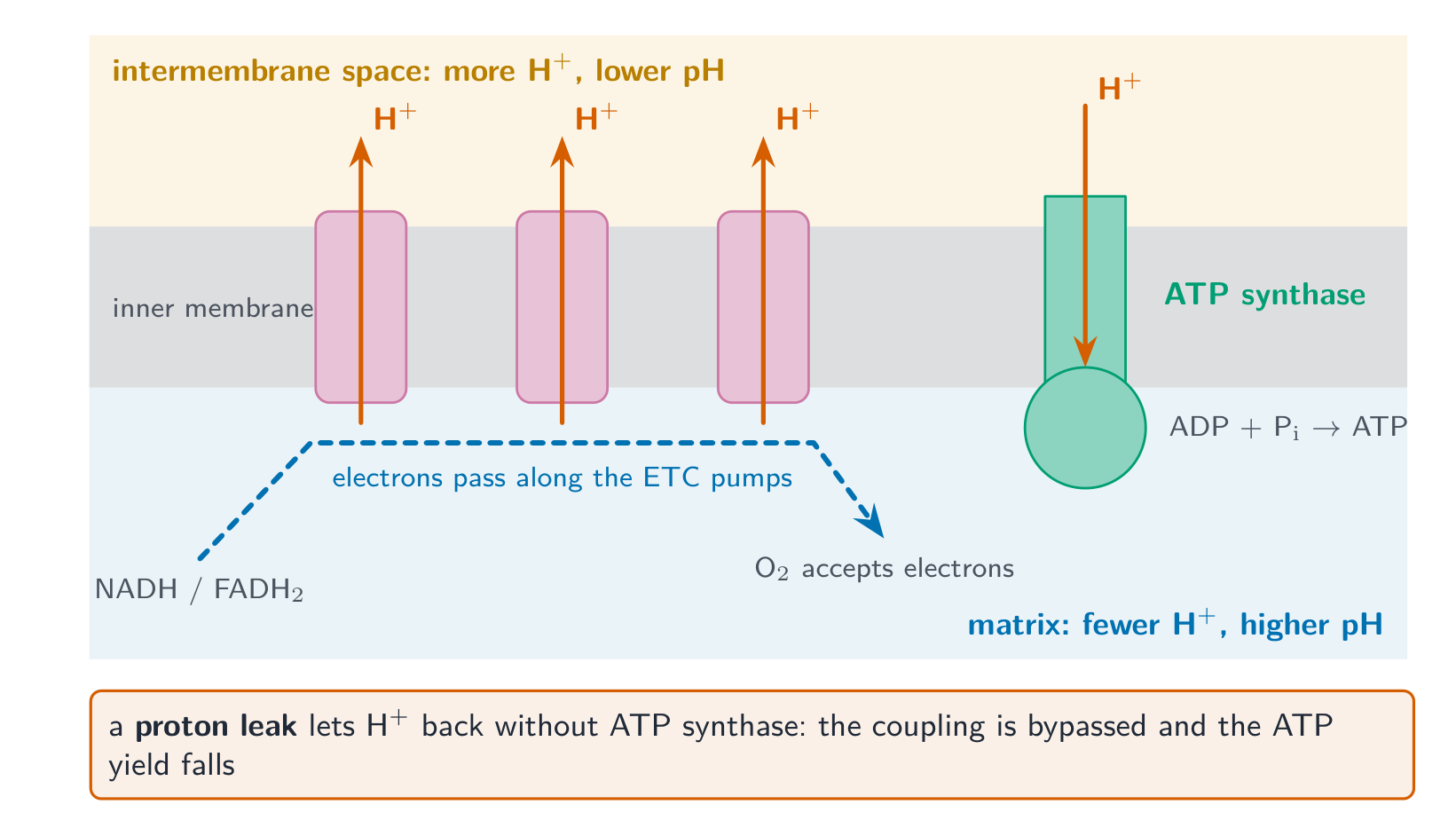
Una fuga de protones a través de la membrana interna puede reducir el rendimiento de ATP incluso mientras los electrones se mueven a lo largo de la cadena.
Dificultad 1/5 · 100 monedas + un pequeño bono en el primer intento de hoy
La fuga contornea la ATP sintasa y debilita el gradiente.
Fermentation keeps glycolysis running
- Fermentation transfers electrons from NADH to an organic molecule, regenerating NAD⁺. Without NAD⁺, glycolysis stops even if plenty of glucose remains.
- Lactate fermentation or alcohol fermentation adds no extra ATP beyond glycolysis. Some prokaryotes instead use anaerobic electron transport with an acceptor other than oxygen: this is not the same process as fermentation.
¿Cómo permite la fermentación que la glucólisis continúe?
Dificultad 1/5 · 100 monedas + un pequeño bono en el primer intento de hoy
La glucólisis necesita NAD⁺ oxidado para aceptar electrones.
Worked prediction: remove oxygen
- In an aerobic mitochondrion, blocking oxygen supply prevents the chain from passing electrons to its final acceptor. NADH is no longer efficiently oxidized; proton pumping and oxidative ATP production fall.
- A cell able to ferment can recycle NAD⁺ and maintain glycolysis with two net ATP per glucose. Fermentation does not restart the mitochondrial electron transport chain.
Usando el rendimiento neto de glucólisis indicado, ¿cuántos ATP se producen a partir de cinco moléculas de glucosa mediante glucólisis seguida de fermentación?
Dificultad 2/5 · 140 monedas + un pequeño bono en el primer intento de hoy
5 × 2 = 10 ATP netos. La fermentación regenera NAD⁺ en lugar de añadir ATP.
Fermentation and anaerobic respiration 无氧呼吸 are different. Fermentation regenerates NAD⁺ without an electron transport chain. Anaerobic respiration uses a chain with a terminal acceptor other than oxygen. Do not treat every oxygen-free pathway as the same mechanism.
- A yeast cell can keep glycolysis running without oxygen by converting pyruvate into ethanol and carbon dioxide, regenerating NAD⁺.
- Its ATP comes from glycolysis. Compare this with aerobic respiration, where an electron transport chain and a proton gradient enable a much larger ATP yield.
Cellular respiration releases energy from glucose as ATP. It starts with glycolysis in the cytoplasm (no oxygen needed). With oxygen, aerobic respiration finishes the job in the mitochondria and releases a lot of ATP; fermentation maintains glycolysis by recycling NAD⁺. Photosynthesis and respiration have related overall reactants and products, but use different pathways.
Write from the data: find the ATP total
- Yeast ferments four glucose molecules.
- Use the net glycolysis yield, and do not use the five-glucose lesson total.
¿Cuántos ATP se producen netamente?
La fermentación recicla NAD+ y no eleva el neto por encima de lo producido en la glucólisis.
¿Cuál es el ATP neto obtenido de cuatro moléculas de glucosa aquí?
Dificultad 1/5 · 100 monedas + un pequeño bono en el primer intento de hoy
Cuatro veces la red de 2 es 8.