Comunicación Celular
Introducido| English | Significado |
|---|---|
| signal/ˈsɪɡnl/ | Señal |
| receptor/rɪˈseptə/ | Receptor |
| ligand/ˈlɪɡænd/ | Ligando |
| target cell/ˈtɑːɡɪt sel/ | Célula diana |
Cells talk to each other
- A body is trillions of cells, yet they act as one.
- To do that, cells must constantly send and receive messages.
- One cell releases a signal; another detects it and responds.
- This constant conversation keeps the whole organism working together.
Signals and receptors
- A signal 信号 is a molecule one cell sends to affect another.
- The signal molecule is also called a ligand 配体.
- It is detected when it binds a matching receptor 受体 on the target cell.
- Ligand and receptor fit together like a key in a lock.
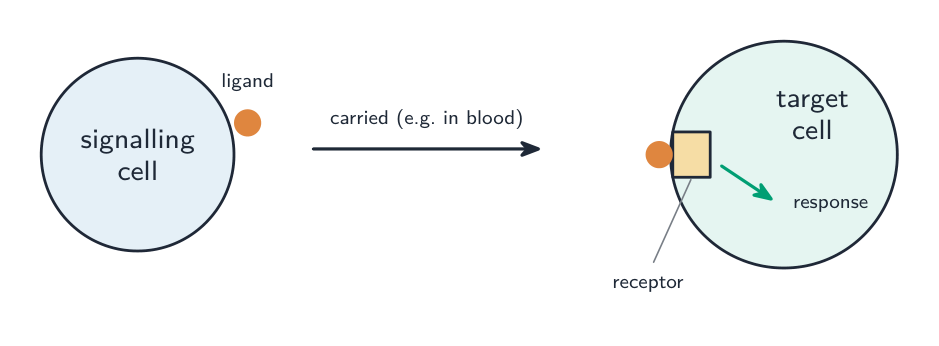
A signal molecule (ligand) binds a matching receptor on the target cell
¿Por qué las células de un cuerpo necesitan comunicarse?
Dificultad 1/5 · 100 monedas + un pequeño bono en el primer intento de hoy
Las células deben comunicarse para actuar conjuntamente: crecer, defenderse y responder como un cuerpo coordinado.
Only target cells respond
- A target cell 靶细胞 is one that carries the right receptor.
- Only target cells can detect and respond to a given signal.
- Other cells lack the receptor, so the signal passes them by.
- This is how one signal can reach many cells but affect only some.
Una molécula señal (ligando) es detectada cuando se une a un…
Dificultad 1/5 · 100 monedas + un pequeño bono en el primer intento de hoy
Un ligando se une a un receptor específico, como una llave en una cerradura, entregando el mensaje.
Signals travel different distances
- Some cells signal by direct contact, touching a neighbour.
- Some send local signals to nearby cells, like a growth factor.
- Some send long-distance signals — hormones — through the blood.
- The distance depends on how far the message needs to go.
¿Qué distancia recorre la señal?
Clasifica cada tipo de señalización celular según la distancia que debe recorrer el mensaje.
Una célula que tiene el receptor adecuado y puede responder a una señal se llama célula ____.
Dificultad 1/5 · 100 monedas + un pequeño bono en el primer intento de hoy
Solo una célula diana con el receptor correspondiente responde; otras células ignoran la señal.
Una hormona puede viajar a través de la sangre para alcanzar células distantes en todo el cuerpo.
Dificultad 1/5 · 100 monedas + un pequeño bono en el primer intento de hoy
Las hormonas son señales de larga distancia: viajan por la sangre hacia células diana lejanas.
Selecciona todas las afirmaciones verdaderas sobre la comunicación celular.
Dificultad 2/5 · 140 monedas + un pequeño bono en el primer intento de hoy
Una célula responde solo si tiene el receptor correspondiente, por lo que no todas las células responden a todas las señales.
A hormone floods the whole body, yet only some cells react. The reason is the receptor: a cell responds only if it carries the matching receptor. No receptor, no response — even if the signal is right there.
Adrenaline before a race:
- Your adrenal glands release adrenaline into the blood.
- It reaches almost every cell in your body.
- But only cells with adrenaline receptors — heart, muscle, liver — respond, speeding you up for action.
Cells communicate by sending a signal (a ligand) that binds a matching receptor on a target cell. Only cells with the right receptor respond. Signals travel by direct contact, locally to nearby cells, or long-distance through the blood as hormones.
Write from this case
- A hormone travels in the blood.
- The target cell is in a different organ.
¿Qué tipo de señalización es esta?
Las hormonas en la sangre son señales endocrinas.
¿Qué señalización usa la sangre hacia un órgano distante?
Dificultad 1/5 · 100 monedas + un pequeño bono en el primer intento de hoy
La distancia más el torrente sanguíneo es endocrino.