Cell Compartmentalization
Introducido| English | Significado |
|---|---|
| compartmentalization/kɒmpɑːtˌmentəlaɪˈzeɪʃn/ | compartimentación |
| membrane-bound/ˈmembreɪn baʊnd/ | acoplado a membrana |
A cell divided into rooms
- A eukaryotic cell is not one open space — it is divided into rooms.
- Each room is an organelle wrapped in its own membrane.
- Keeping jobs in separate rooms is a huge advantage.
- This organisation is what lets complex cells work so well.
What compartmentalization means
- Compartmentalization 区室化 divides the cell into separate spaces.
- Each space is a membrane-bound 膜包被的 organelle.
- The membrane keeps each compartment's contents apart from the rest.
- So the cell can run many different processes at once.
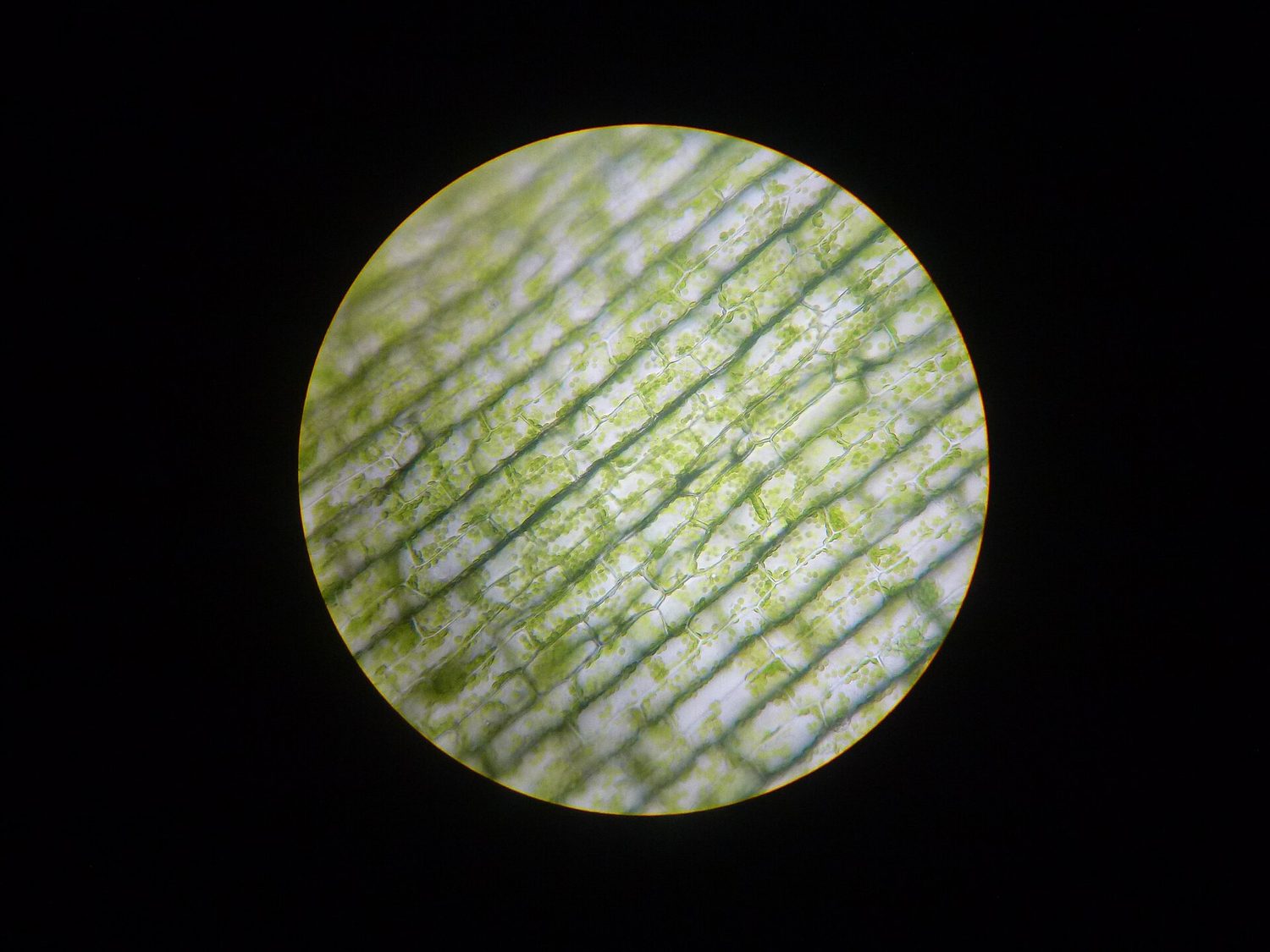
Leaf cells under the microscope: chloroplasts are membrane-bound compartments inside each cell
Compartmentalization in a eukaryotic cell means…
Dificultad 1/5 · 100 monedas + un pequeño bono en el primer intento de hoy
Compartmentalization divides the cell into membrane-bound organelles, each a separate space.
Why it helps
- Incompatible reactions can run side by side without interfering.
- Enzymes can be concentrated where they are needed, speeding reactions.
- Special conditions (like a low pH) can be kept inside one compartment.
- The result is a faster, better-controlled cell.
What is one advantage of keeping reactions in separate compartments?
Dificultad 1/5 · 100 monedas + un pequeño bono en el primer intento de hoy
Separate compartments let a cell run reactions that would otherwise interfere, and concentrate enzymes where needed.
Organelles wrapped in their own membrane are described as ____-bound.
Dificultad 1/5 · 100 monedas + un pequeño bono en el primer intento de hoy
A membrane-bound organelle has its own membrane separating it from the cytoplasm.
Protecting the cell
- Some compartments hold contents that would harm the cell if loose.
- A lysosome seals digestive enzymes safely away.
- The nucleus keeps DNA protected and separate from the busy cytoplasm.
- Membranes turn danger into a controlled, useful tool.
Why keep it in a compartment?
Sort each organelle by the main advantage its separate compartment gives the cell.
A lysosome releases its digestive enzymes freely into the cytoplasm.
Dificultad 1/5 · 100 monedas + un pequeño bono en el primer intento de hoy
False. The lysosome keeps its powerful enzymes sealed inside its membrane, protecting the rest of the cell from being digested.
Select todos true statements about compartmentalization.
Dificultad 2/5 · 140 monedas + un pequeño bono en el primer intento de hoy
Compartments are made of membranes, so they make membranes more important, not less. The other three are correct.
Prokaryotes (bacteria) lack membrane-bound compartments — their reactions all share one space. This works for small, simple cells, but it limits how much a prokaryote can specialise compared with a compartmentalized eukaryote.
The lysosome: a safe demolition room:
- Lysosomes are full of enzymes that digest worn-out parts.
- Loose in the cell, those enzymes would attack everything.
- Sealed inside the lysosome's membrane, they only digest what is delivered to them.
Worked FRQ answer
Lysosomal enzymes work best at pH 5, the pH inside the lysosome. The cytosol is at about pH 7.2.
(A) Explain how the lysosome membrane allows these enzymes to work. The membrane separates the lysosome from the cytosol, so the cell can keep a low pH and a high concentration of enzymes inside, the conditions they need.
(B) A few lysosomes break open. Predict the effect on the cell, and justify. Little damage at first: in the cytosol the pH is about 7.2, far from the enzymes' optimum, so they are much less active there. Compartments thus give a second layer of protection.
(C) The inner membrane of a mitochondrion is highly folded. Explain how this helps the mitochondrion. Folding increases the surface area of the membrane, so there is room for more of the proteins that make ATP, increasing the rate of respiration.
- Why it scores: each answer links a membrane to a condition it creates (pH, concentration, surface area) and then to the function.
Which compartment keeps these enzymes?
Lysosomes isolate digestive enzymes from the rest of the cell.
Where are these hydrolytic enzymes kept?
Dificultad 1/5 · 100 monedas + un pequeño bono en el primer intento de hoy
The lysosome membrane separates digestion from the cytosol.
Why is the inner membrane of a mitochondrion folded?
Dificultad 1/5 · 100 monedas + un pequeño bono en el primer intento de hoy
More membrane surface holds more of the proteins for respiration, increasing the rate of ATP production.
Compartmentalization divides a eukaryotic cell into membrane-bound organelles. Separate compartments let incompatible reactions run at once, concentrate enzymes where needed, and safely contain dangerous contents (like a lysosome's enzymes). Prokaryotes lack this, which limits their complexity.
Write from this case
- Hydrolytic enzymes work best at a low pH.
- They would damage the cytosol if they were loose there.