Mecanismos de Transporte
Introducido| English | Significado |
|---|---|
| pump/pʌmp/ | bomba |
| endocytosis/ˌendəʊsɪˈtəʊsɪs/ | endocitosis |
| exocytosis/eɡˌzɒsɪˈtəʊsɪs/ | exocitosis |
| vesicle/ˈvesɪkl/ | vesícula |
Pumping and hauling
- Sometimes a cell must move a substance the "wrong" way — against its gradient.
- Sometimes the load is far too big for any protein doorway.
- For both jobs, the cell spends energy and uses clever machinery.
- These are the active mechanisms of transport.
Protein pumps
- A pump 泵 is a carrier protein that moves ions against their gradient.
- It spends ATP to change shape and push the ion uphill.
- The sodium-potassium pump keeps nerve and muscle cells ready to fire.
- Without pumps, a cell could never build up ions above its surroundings.
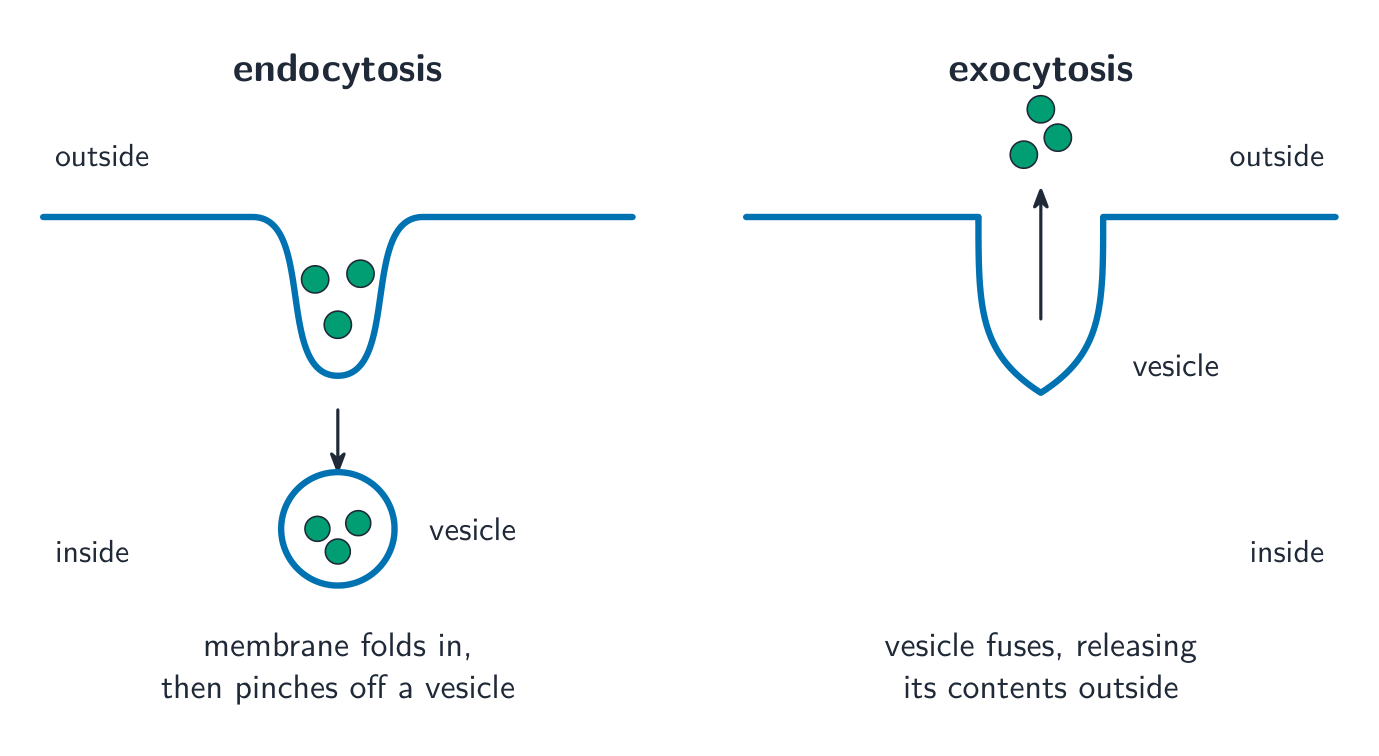
Endocytosis 胞吞作用 brings material in; exocytosis 胞吐作用 releases it out
Una bomba de proteínas mueve iones contra su gradiente utilizando…
Dificultad 1/5 · 100 monedas + un pequeño bono en el primer intento de hoy
Una bomba es transporte activo: gasta ATP para mover iones de baja a alta concentración.
Endocytosis: taking it in
- For big loads, the cell uses its membrane like a net.
- In endocytosis the membrane wraps around material and pinches inward.
- This forms a vesicle 囊泡 — a small bubble — carrying the load inside.
- This is how a cell can swallow something as big as a whole bacterium.
Una bomba de proteínas en acción
Recorre la bomba a través de su ciclo: gasta ATP para mover una partícula contra el gradiente, de baja a alta concentración.
En la endocitosis, la célula…
Dificultad 1/5 · 100 monedas + un pequeño bono en el primer intento de hoy
La endocitosis introduce material envolviendo la membrana alrededor de él para formar una vesícula.
Exocytosis: sending it out
- The reverse process ships material out of the cell.
- In exocytosis a vesicle moves to the membrane and fuses with it.
- Its contents spill to the outside.
- This is how cells release hormones, enzymes, and waste.
Liberar material fusionando una vesícula con la membrana se llama ____.
Dificultad 1/5 · 100 monedas + un pequeño bono en el primer intento de hoy
En la exocitosis, una vesícula se fusiona con la membrana y vierte su contenido hacia el exterior.
La endocitosis y la exocitosis mueven materiales demasiado grandes para pasar a través de una proteína de membrana.
Dificultad 1/5 · 100 monedas + un pequeño bono en el primer intento de hoy
El transporte masivo maneja cargas grandes, como células enteras o moléculas grandes, que ningún canal podría permitir pasar.
Selecciona todas las afirmaciones verdaderas sobre los mecanismos de transporte.
Dificultad 2/5 · 140 monedas + un pequeño bono en el primer intento de hoy
Las bombas son transporte activo y sí necesitan ATP. Las otras tres son correctas.
Pumps, endocytosis, and exocytosis all cost energy. Unlike diffusion, they can move things against a gradient or move loads too big for any channel — but the cell must pay for all of it with ATP.
A white blood cell eating a germ:
- The germ is far too big to fit through any membrane protein.
- The white blood cell flows its membrane around the germ (endocytosis).
- The germ is sealed inside a vesicle, then destroyed — how your body fights infection.
Active mechanisms move things diffusion cannot. A pump spends ATP to push ions uphill. Endocytosis wraps the membrane around a large load to bring it in as a vesicle; exocytosis fuses a vesicle with the membrane to release material out. All three cost energy.
Write from the data given
- The sodium-potassium pump completes one cycle and spends one ATP.
- Potassium moves the other way.
¿Cuántos iones de sodio salen de la célula en ese ciclo?
Un ciclo exporta tres iones de sodio e importa dos iones de potasio.
¿Cuántos iones de sodio exporta un ciclo?
Dificultad 1/5 · 100 monedas + un pequeño bono en el primer intento de hoy
La bomba mueve tres iones de sodio hacia afuera por cada ATP. Otras opciones — 2 (la cantidad de potasio); 1 (la cantidad de ATP).