Trabajo, energía y potencia
Introducido| English | Significado |
|---|---|
| work done/wɜːk dʌn/ | trabajo realizado |
| displacement/dɪˈspleɪsmənt/ | desplazamiento |
| conservation of energy/ˌkɒnsəˈveɪʃn ɒv ˈenədʒi/ | conservación de la energía |
| efficiency/ɪˈfɪʃənsi/ | eficiencia |
| thermal energy/ˈθɜːml ˈenədʒi/ | energía térmica |
| power/ˈpaʊə/ | potencia |
Holding a bag does no work
- Hold a heavy bag still and your arm aches — but in physics you do zero work.
- Work needs the force to move something along its own direction.
- No movement (or a sideways force) means no work done 功.
Work done by a force
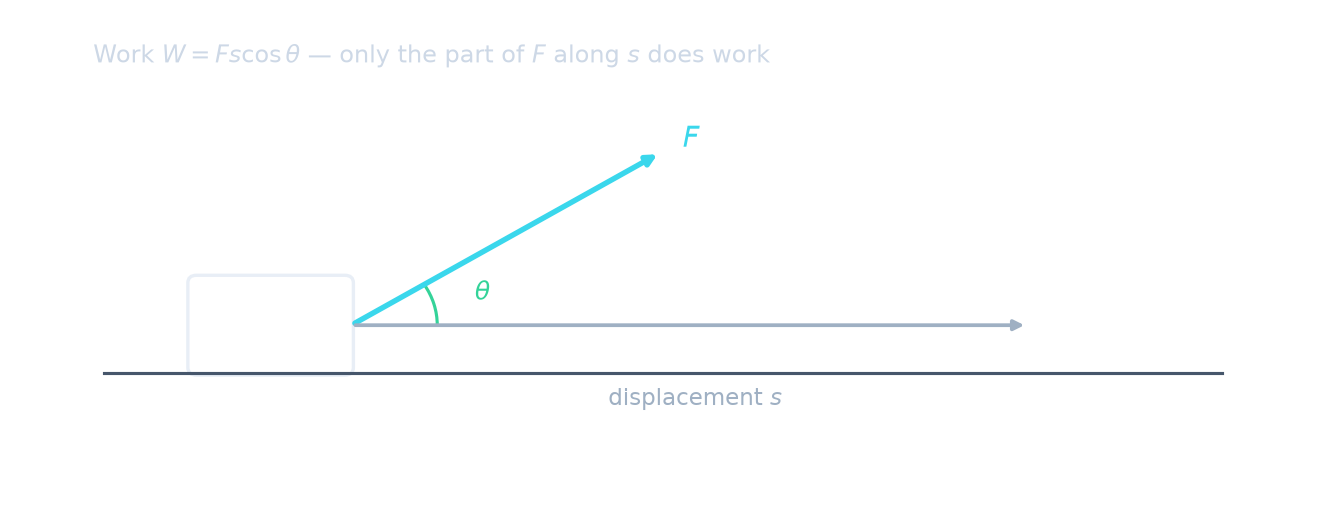
- $W = F s \cos\theta$, where $\theta$ is the angle between force and displacement 位移.
- Only the part of the force along the motion does work. Unit: $\text{J} = \text{N}\cdot\text{m}$.
Trabajo, energía y potencia
PE + KE = constante
El trabajo transfiere energía; al caer, la PE se convierte en KE con el total fijo.
Una fuerza de $10\ \text{N}$ empuja una caja $3.0\ \text{m}$ en la dirección de la fuerza. ¿Cuánto trabajo se realiza?
Dificultad 2/5 · 140 monedas + un pequeño bono en el primer intento de hoy
La fuerza está en la dirección del movimiento ($\theta = 0$), por lo tanto $W = Fs = 10 \times 3.0 = 30\ \text{J}$.
Positive, negative, zero
- Force along the motion → positive work (energy given to the object).
- Force opposite the motion → negative work (e.g. friction takes energy away).
- Force at right angles → zero work.
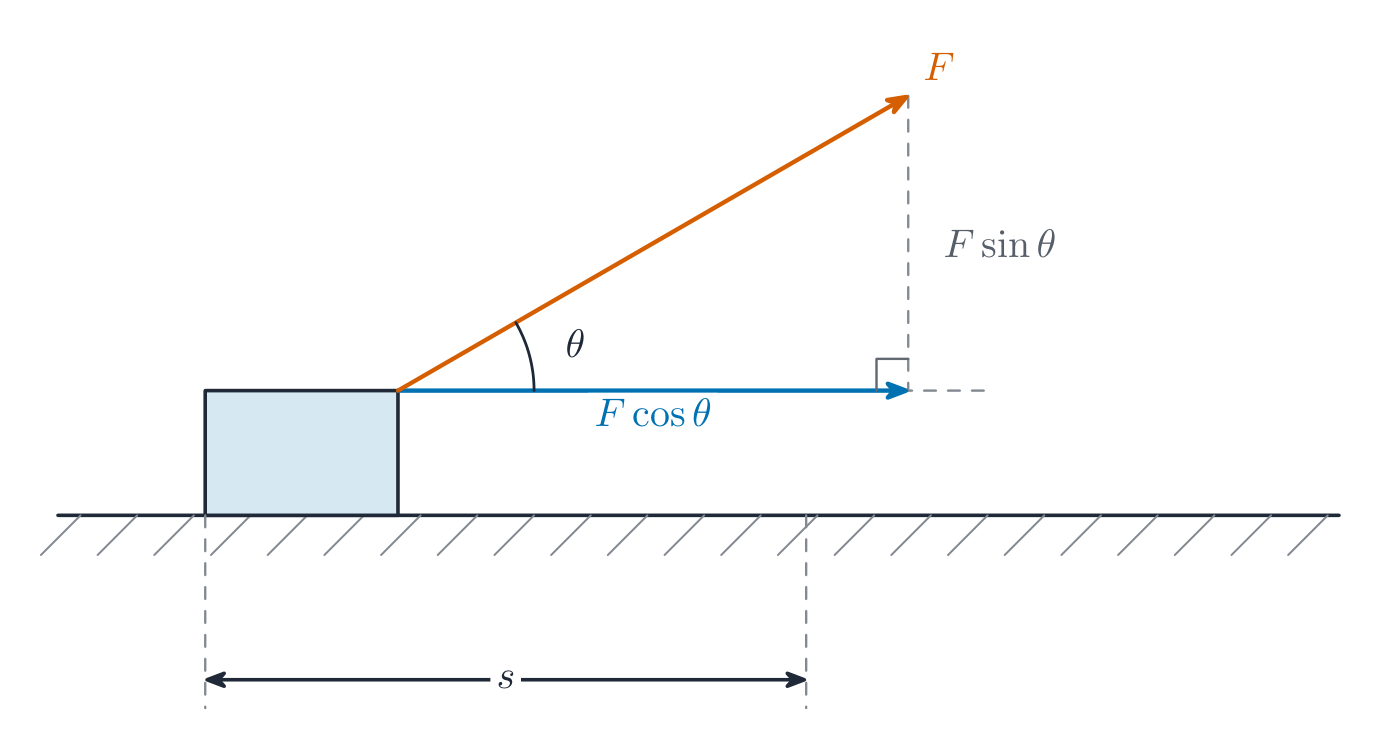
Only the component F cos(theta) along the displacement does work
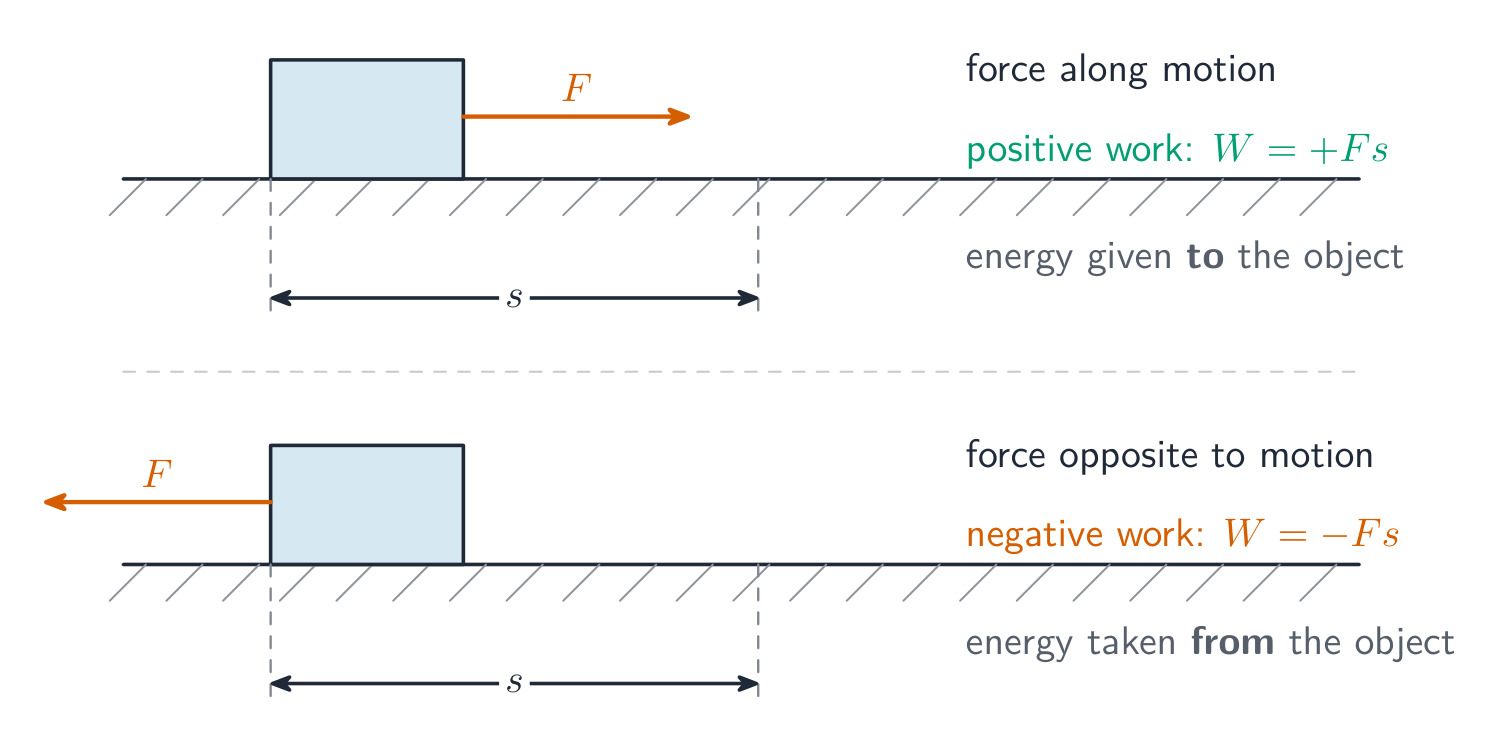
Positive work (force along motion) and negative work (force opposite motion)
¿Cuánto trabajo realiza una fuerza que actúa perpendicularmente al movimiento?
Dificultad 1/5 · 100 monedas + un pequeño bono en el primer intento de hoy
$W = Fs\cos 90^{\circ} = 0$. La fuerza de contacto normal sobre un coche en una carretera plana no realiza trabajo.
La fricción en un objeto deslizante realiza trabajo negativo.
Dificultad 1/5 · 100 monedas + un pequeño bono en el primer intento de hoy
La fricción apunta en dirección opuesta al movimiento ($\theta = 180^{\circ}$), por lo tanto $W = -Fs$ — retira energía.
Conservation of energy 能量守恒
- Energy is never made or destroyed — it only changes form or moves between objects.
- In a closed system the total energy stays constant.
La energía no puede crearse ni destruirse, solo ____ de una forma a otra.
Dificultad 1/5 · 100 monedas + un pequeño bono en el primer intento de hoy
Eso es conservación de energía: el total en un sistema cerrado permanece constante.
Asocia cada término con la definición que marca el evaluador.
Dificultad 2/5 · 140 monedas + un pequeño bono en el primer intento de hoy
La última frase de la definición de trabajo es lo que hace que una fuerza perpendicular al movimiento no realice ningún trabajo.
Efficiency 效率
- $\text{efficiency} = \dfrac{\text{useful output}}{\text{total input}} \times 100\%$.
- It is always below $100\%$ — some energy ends up as "useless" thermal energy 热能.
Flujo de energía y eficiencia
La energía de entrada se divide en trabajo útil y energía desperdiciada; la eficiencia = útil ÷ entrada, y útil + desperdiciado siempre es igual a la entrada.
Una máquina recibe $200\ \text{J}$ y entrega $60\ \text{J}$ de energía útil. ¿Cuál es su eficiencia (en %)?
Dificultad 2/5 · 140 monedas + un pequeño bono en el primer intento de hoy
$\dfrac{60}{200} \times 100\% = 30\%$. Los otros $140\ \text{J}$ se desperdician, principalmente como calor.
Power 功率
- Power is the rate of doing work: $P = \dfrac{W}{t} = \dfrac{\Delta E}{\Delta t}$.
- Unit: $\text{W} = \dfrac{\text{J}}{\text{s}}$.
Power, force and velocity
- For a force $F$ along the motion at speed $v$: $P = Fv$.
- A car at steady speed needs $P = F_{\text{resist}} \times v$; lifting a weight at speed $v$ needs $P = mgv$.
Una fuerza $F$ actúa sobre un objeto que se mueve a velocidad $v$ en la dirección de la fuerza. La potencia entregada es:
Dificultad 1/5 · 100 monedas + un pequeño bono en el primer intento de hoy
En un tiempo $\Delta t$, el desplazamiento es $v\Delta t$ y el trabajo es $Fv\Delta t$; dividiendo por $\Delta t$ se obtiene $P = Fv$.
Worked example: a car at steady speed
- A car travels at a steady $25\ \text{m/s}$ against a total resistive force of $600\ \text{N}$. Find the useful output power of its engine.
- At steady speed the resultant force is zero, so the driving force equals the resistive force: $F = 600\ \text{N}$.
- $P = Fv = 600 \times 25 = 1.5\times10^{4}\ \text{W} = 15\ \text{kW}$.
- The step that carries the mark is stating why the driving force equals $600\ \text{N}$: constant velocity means zero resultant force.
- If the car were accelerating, the driving force would be larger than $600\ \text{N}$ and you could not use the resistive force in $P = Fv$ at all.
Marks that slip away
- Efficiency is useful output divided by total input. The input is always the larger number, so an answer above $100\%$ means the two were swapped.
- In $P = Fv$, $F$ is the driving force. It equals the resistive force only at constant speed.
- Use the vertical height in $mg\Delta h$, never the distance along a slope.
- Work done by a force is the force times the distance moved in the direction of the force. A force at right angles to the motion does no work.
- On a force-extension graph the area is the energy stored. The gradient is the stiffness, and reading one for the other is a whole question lost.
Un coche circula a una velocidad constante de $25\ \dfrac{\text{m}}{\text{s}}$ contra una fuerza resistiva total de $600\ \text{N}$. ¿Cuál es la potencia útil de salida, en kW?
Dificultad 2/5 · 140 monedas + un pequeño bono en el primer intento de hoy
La velocidad constante implica fuerza resultante nula, por lo que la fuerza motriz es igual a $600\ \text{N}$ y $P = Fv = 15\ \text{kW}$. Explicar POR QUÉ la fuerza motriz es igual a la resistencia es lo que otorga los puntos.
¿En qué casos una fuerza no realiza trabajo? Seleccione todos los que correspondan.
Dificultad 2/5 · 140 monedas + un pequeño bono en el primer intento de hoy
Frenar realiza mucho trabajo, solo trabajo negativo. La órbita es el caso perfecto: la gravedad es siempre perpendicular al movimiento, por lo que la velocidad del satélite nunca cambia.
Ordene un cálculo de eficiencia.
Dificultad 3/5 · 200 monedas + un pequeño bono en el primer intento de hoy
La entrada es siempre el número más grande. Una eficiencia superior al 100% significa que los dos valores se intercambiaron, y dividir entre la energía desperdiciada es la otra ruta errónea común.
You've got it
- work $W = Fs\cos\theta$ — only the part of $F$ along the motion counts
- energy is conserved; efficiency = useful ÷ total (always < 100%)
- power $P = \dfrac{W}{t} = Fv$