Kinetic and potential energy · Energía cinética y potencial
| English | Español |
|---|---|
| kinetic energy/kɪˈnetɪk ˈenədʒi/ | energía cinética |
| gravitational potential energy/ˌɡrævɪˈteɪʃənl pəˈtenʃl ˈenədʒi/ | energía potencial gravitatoria |
| thermal energy/ˈθɜːml ˈenədʒi/ | energía térmica |
| momentum/məʊˈmentəm/ | momento |
| elastic potential energy/ɪˈlæstɪk pəˈtenʃl ˈenədʒi/ | energía potencial elástica |
| compression/kəmˈpreʃn/ | compresión |
The roller-coaster swap
- At the top of a drop a coaster crawls; at the bottom it races.
- Height has turned into speed — potential energy into kinetic energy 动能.
- Energy is just moving between two stores.
El intercambio del carrusel
- En la cima de una caída, el carrusel avanza lentamente; en el fondo, corre a toda velocidad.
- La altura se ha convertido en velocidad — energía potencial 势能 se transforma en energía cinética 动能.
- La energía simplemente se transfiere entre dos depósitos.
Gravitational potential energy 重力势能
- Lifting a mass $m$ through a height $\Delta h$ stores $\Delta E_{\text{P}} = mg\Delta h$.
- It comes from the work done against gravity: $W = mg \times \Delta h$.
Gravitational PE depends only on the change in height Δh, not on the path taken
Wind turbines transfer the kinetic energy of the wind into electrical energy
Energía potencial gravitatoria 重力势能
- Al elevar una masa $m$ una altura $\Delta h$, se almacena $\Delta E_{\text{P}} = mg\Delta h$.
- Proviene del trabajo realizado contra la gravedad: $W = mg \times \Delta h$.

La energía potencial gravitatoria depende únicamente del cambio de altura Δh, no de la trayectoria seguida

Las turbinas eólicas transfieren la energía cinética del viento en energía eléctrica
Kinetic & potential energy · Energía cinética y potencial
PE + KE = constant · PE + KE = constante
Potential · Potencial energy turns into kinetic energy — the total never changes. · La energía potencial se convierte en energía cinética — el total nunca cambia.
A $2.0\ \text{kg}$ book is lifted $5.0\ \text{m}$. How much gravitational PE does it gain? (Use $g = 9.81\ \dfrac{\text{m}}{\text{s}^2}$.) · Se levanta un libro de $2.0\ \text{kg}$ una altura de $5.0\ \text{m}$. ¿Cuánta energía potencial gravitatoria (EPG) gana? (Use $g = 9.81\ \dfrac{\text{m}}{\text{s}^2}$.)
$\Delta E_{\text{P}} = mg\Delta h = 2.0 \times 9.81 \times 5.0 \approx 98\ \text{J}$.
Kinetic energy
- A mass $m$ moving at speed $v$ has $E_{\text{K}} = \tfrac{1}{2}mv^{2}$.
- It comes from the work done to speed it up: $W = Fs = \tfrac{1}{2}mv^{2}$.
Energía cinética
- Una masa $m$ que se mueve a velocidad $v$ tiene $E_{\text{K}} = \tfrac{1}{2}mv^{2}$.
- Proviene del trabajo realizado para acelerarla: $W = Fs = \tfrac{1}{2}mv^{2}$.
A $4.0\ \text{kg}$ trolley moves at $3.0\ \dfrac{\text{m}}{\text{s}}$. What is its kinetic energy? · Un carrito de $4.0\ \text{kg}$ se mueve a $3.0\ \dfrac{\text{m}}{\text{s}}$. ¿Cuál es su energía cinética?
$E_{\text{K}} = \tfrac{1}{2}mv^{2} = \tfrac{1}{2} \times 4.0 \times 3.0^{2} = 18\ \text{J}$.
Match each energy store to what it depends on. · Empareje cada almacén de energía con lo que depende.
Two of the three go as a square, which is why doubling a speed or an extension quadruples the energy while doubling a height only doubles it. · Dos de las tres van al cuadrado, por lo que duplicar la velocidad o la elongación cuadruplica la energía mientras que duplicar la altura solo la duplica.
Two traps. Squaring: doubling the speed gives four times the kinetic energy, not two. Height: $\Delta h$ is the vertical change in height, never the distance along a slope — a ramp of length $3\ \text{m}$ that drops $1.5\ \text{m}$ uses $1.5\ \text{m}$.
Dos trampas. Elevar al cuadrado: duplicar la velocidad produce cuatro veces la energía cinética, no dos. Altura: $\Delta h$ es el cambio de altura vertical, nunca la distancia a lo largo de una pendiente — una rampa de longitud $3\ \text{m}$ que desciende $1.5\ \text{m}$ utiliza $1.5\ \text{m}$.
The energy swap
- On a frictionless ramp, GPE becomes KE: $mgh = \tfrac{1}{2}mv^{2}$, so $v = \sqrt{2gh}$.
- The mass cancels — every object reaches the same speed from the same height.
- With friction, some of it becomes thermal energy 热能 instead.
El intercambio de energía
- En una rampa sin fricción, la EPGr se convierte en EC: $mgh = \tfrac{1}{2}mv^{2}$, por lo tanto $v = \sqrt{2gh}$.
- La masa se cancela — todos los objetos alcanzan la misma velocidad desde la misma altura.
- Con fricción, parte de ella se convierte en energía térmica 热能 en su lugar.
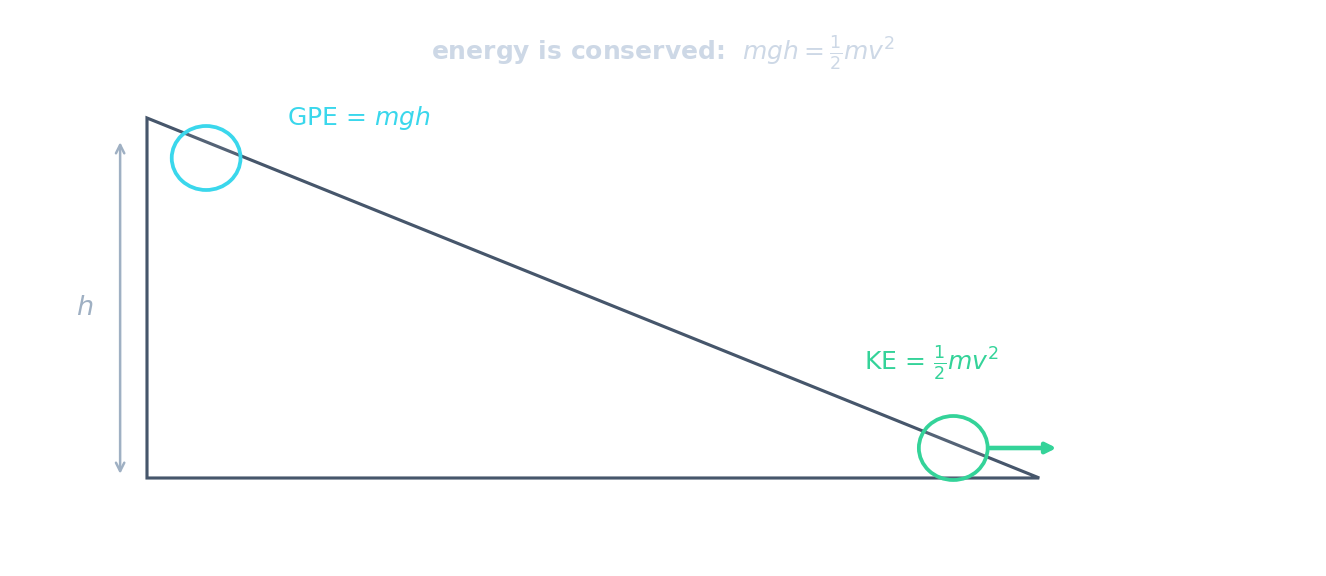
As a ball rolls down a frictionless ramp, its gravitational PE turns mainly into: · A medida que una bola rueda cuesta abajo por una rampa sin fricción, su energía potencial gravitatoria se convierte principalmente en:
With no friction, all the lost GPE becomes kinetic energy: $mgh = \tfrac{1}{2}mv^{2}$. · Sin fricción, toda la EPG perdida se convierte en energía cinética: $mgh = \tfrac{1}{2}mv^{2}$.
A 2.0 kg block slides from rest down a smooth ramp, dropping 1.5 m in height. What is its speed at the bottom, in m/s? (g = 9.81 m/s^2) · Un bloque de 2.0 kg desliza desde el reposo cuesta abajo por una rampa suave, descendiendo 1.5 m en altura. ¿Cuál es su velocidad al final, en m/s? (g = 9.81 m/s^2)
mgh = mv^2/2, and the mass cancels: v = sqrt(2 x 9.81 x 1.5) = 5.4 m/s. Use the VERTICAL drop, never the distance along the ramp. · mgh = mv^2/2, y la masa se cancela: v = sqrt(2 x 9.81 x 1.5) = 5.4 m/s. Use la CAÍDA VERTICAL, nunca la distancia a lo largo de la rampa.
In $mg\Delta h$ the height is the distance travelled along the slope. · En $mg\Delta h$ la altura es la distancia recorrida a lo largo de la pendiente.
It is the VERTICAL height gained or lost. Using the slope distance always overestimates the energy change, by a factor of 1/sin(theta). · Es la ALTURA VERTICAL ganada o perdida. Usar la distancia de la pendiente siempre sobreestima el cambio de energía, por un factor de 1/sin(theta).
Worked example: a ramp with friction
A $2.0\ \text{kg}$ trolley is released from rest at the top of a ramp $3.0\ \text{m}$ long that drops $1.5\ \text{m}$. It reaches the bottom at $4.0\ \dfrac{\text{m}}{\text{s}}$. Find the work done against friction and the average friction force.
- GPE lost: $mg\Delta h = 2.0 \times 9.81 \times 1.5 = 29\ \text{J}$.
- KE gained: $\tfrac{1}{2}mv^{2} = \tfrac{1}{2} \times 2.0 \times 4.0^{2} = 16\ \text{J}$.
- The difference is the work done against friction: $29 - 16 = 13\ \text{J}$.
- Friction force: work = force × distance along the ramp, so $F = \dfrac{13}{3.0} = 4.5\ \text{N}$.
- Check: without friction the speed would have been $\sqrt{2 \times 9.81 \times 1.5} = 5.4\ \dfrac{\text{m}}{\text{s}}$ — larger than $4.0$, as it must be.
Ejemplo resuelto: una rampa con fricción
Un carrito de $2.0\ \text{kg}$ se suelta desde el reposo en la cima de una rampa de $3.0\ \text{m}$ de largo que desciende $1.5\ \text{m}$. Alcanza el fondo a $4.0\ \dfrac{\text{m}}{\text{s}}$. Calcula el trabajo realizado contra la fricción y la fuerza de fricción media.
- EPGr perdida: $mg\Delta h = 2.0 \times 9.81 \times 1.5 = 29\ \text{J}$.
- EC ganada: $\tfrac{1}{2}mv^{2} = \tfrac{1}{2} \times 2.0 \times 4.0^{2} = 16\ \text{J}$.
- La diferencia es el trabajo realizado contra la fricción: $29 - 16 = 13\ \text{J}$.
- Fuerza de fricción: trabajo = fuerza × distancia a lo largo de la rampa, así que $F = \dfrac{13}{3.0} = 4.5\ \text{N}$.
- Comprobación: sin fricción, la velocidad habría sido $\sqrt{2 \times 9.81 \times 1.5} = 5.4\ \dfrac{\text{m}}{\text{s}}$ — mayor que $4.0$, como debe ser.
A trolley rolls down a rough ramp. Compared with a frictionless ramp, which statements are true? Select all that apply. · Un carrito rueda cuesta abajo por una rampa rugosa. En comparación con una rampa sin fricción, ¿cuáles afirmaciones son verdaderas? Seleccione todas las que correspondan.
The GPE lost is fixed by the height drop and is the same on both ramps. Friction takes some of it as thermal energy, so the KE at the bottom is smaller by exactly the work done against friction. · La EPG perdida está fija por la caída de altura y es la misma en ambas rampas. La fricción toma parte de ella como energía térmica, por lo que la EC en la parte inferior es menor exactamente en la cantidad del trabajo realizado contra la fricción.
Energy and momentum 动量
- Combining $p = mv$ with $E_{\text{K}} = \tfrac{1}{2}mv^{2}$ gives $E_{\text{K}} = \dfrac{p^{2}}{2m}$.
- Handy when you know the momentum but not the speed.
Energía y momento 动量
- Combinando $p = mv$ con $E_{\text{K}} = \tfrac{1}{2}mv^{2}$ se obtiene $E_{\text{K}} = \dfrac{p^{2}}{2m}$.
- Es útil cuando conoces el momento pero no la velocidad.
Kinetic energy written in terms of momentum $p$ is: · La energía cinética escrita en términos del momento lineal $p$ es:
From $p = mv$ and · y $E_{\text{K}} = \tfrac{1}{2}mv^{2}$, substituting $v = p/m$ gives $E_{\text{K}} = \dfrac{p^{2}}{2m}$. · De $p = mv$ y $E_{\text{K}} = \tfrac{1}{2}mv^{2}$, sustituyendo $v = p/m$ se obtiene $E_{\text{K}} = \dfrac{p^{2}}{2m}$.
Energy methods
- Write the energy at the start and end, then balance the books.
- Spring: a block's KE becomes elastic potential energy 弹性势能 $\tfrac{1}{2}kx^{2}$ at greatest compression 压缩.
- Bounce: the height ratio $\dfrac{h_2}{h_1}$ is the fraction of energy kept.
A stretched or compressed spring stores elastic PE ½kx², ready to become kinetic energy
Métodos energéticos
- Escribe la energía al inicio y al final, luego equilibra las cuentas.
- Resorte: la EC de un bloque se convierte en energía potencial elástica 弹性势能 $\tfrac{1}{2}kx^{2}$ en la máxima compresión 压缩.
- Rebote: la relación de alturas $\dfrac{h_2}{h_1}$ es la fracción de energía conservada.

Un resorte estirado o comprimido almacena energía potencial elástica ½kx², listo para convertirse en energía cinética
A block slides into a spring on a frictionless surface. At greatest compression its kinetic energy has all become ____ potential energy. · Un bloque desliza hacia un resorte sobre una superficie sin fricción. En la compresión máxima, su energía cinética se ha convertido completamente en ____ energía potencial.
KE → elastic PE $= \tfrac{1}{2}kx^{2}$ at the point of greatest compression, then back to KE as the spring pushes it off. · EC → EP elástica $= \tfrac{1}{2}kx^{2}$ en el punto de máxima compresión, y luego vuelve a ser EC cuando el resorte lo empuja fuera.
When friction acts, some mechanical energy becomes thermal energy. · Cuando actúa la fricción, parte de la energía mecánica se convierte en energía térmica.
Yes — that "lost" energy is not destroyed; it heats the surfaces and surroundings. · Sí — esa "energía perdida" no se destruye; calienta las superficies y el entorno.
Worked example: a block meets a spring
A block slides down a slope and hits a spring with $60\ \text{J}$ of kinetic energy. While the spring compresses to its maximum, the block's gravitational PE falls by a further $10\ \text{J}$. All the energy the block loses becomes elastic PE in the spring, whose constant is $k = 3500\ \dfrac{\text{N}}{\text{m}}$. Find the maximum compression and the force on the block there.
- Energy into the spring: $60 + 10 = 70\ \text{J}$ (the block loses both its KE and some GPE).
- Compression: $\tfrac{1}{2}kx^{2} = 70$, so $x^{2} = \dfrac{140}{3500} = 0.040$ and $x = 0.20\ \text{m}$.
- Force at maximum compression: $F = kx = 3500 \times 0.20 = 700\ \text{N}$.
- Check: on a force–compression graph the area under the line to $x = 0.20\ \text{m}$ is $\tfrac{1}{2} \times 700 \times 0.20 = 70\ \text{J}$ — the same energy, found the other way.
Ejemplo resuelto: un bloque encuentra un resorte
Un bloque desliza por una pendiente y choca contra un resorte con $60\ \text{J}$ de energía cinética. Mientras el resorte se comprime hasta su máximo, la energía potencial gravitatoria del bloque disminuye otros $10\ \text{J}$. Toda la energía que pierde el bloque se convierte en energía potencial elástica en el resorte, cuya constante es $k = 3500\ \dfrac{\text{N}}{\text{m}}$. Encuentra la compresión máxima y la fuerza sobre el bloque allí.
- Energía transferida al resorte: $60 + 10 = 70\ \text{J}$ (el bloque pierde ambas: su EC y parte de su EPGr).
- Compresión: $\tfrac{1}{2}kx^{2} = 70$, por lo tanto $x^{2} = \dfrac{140}{3500} = 0.040$ y $x = 0.20\ \text{m}$.
- Fuerza en la compresión máxima: $F = kx = 3500 \times 0.20 = 700\ \text{N}$.
- Comprobación: en una gráfica de fuerza versus compresión, el área bajo la línea hasta $x = 0.20\ \text{m}$ es $\tfrac{1}{2} \times 700 \times 0.20 = 70\ \text{J}$ — la misma energía, calculada de otra forma.
A block with $40\ \text{J}$ of kinetic energy hits a spring of constant $k = 2000\ \dfrac{\text{N}}{\text{m}}$ on a level surface. All its KE becomes elastic PE. What is the maximum compression, in m? · Un bloque con $40\ \text{J}$ de energía cinética golpea un resorte de constante $k = 2000\ \dfrac{\text{N}}{\text{m}}$ sobre una superficie horizontal. Toda su EC se convierte en EP elástica. ¿Cuál es la compresión máxima, en m?
$\tfrac{1}{2}kx^{2} = 40$, so $x^{2} = \dfrac{80}{2000} = 0.040$ and · y $x = 0.20\ \text{m}$. · $\tfrac{1}{2}kx^{2} = 40$, así que $x^{2} = \dfrac{80}{2000} = 0.040$ y $x = 0.20\ \text{m}$.
You've got it
- gravitational PE $\Delta E_{\text{P}} = mg\Delta h$ (vertical height!); kinetic energy $E_{\text{K}} = \tfrac{1}{2}mv^{2}$
- on a frictionless ramp $mgh = \tfrac{1}{2}mv^{2}$, so $v = \sqrt{2gh}$; with friction the missing energy is the work done against it
- in momentum terms, $E_{\text{K}} = \dfrac{p^{2}}{2m}$; a spring stores $\tfrac{1}{2}kx^{2}$
Ya lo tienes
- energía potencial gravitatoria $\Delta E_{\text{P}} = mg\Delta h$ (¡altura vertical!); energía cinética $E_{\text{K}} = \tfrac{1}{2}mv^{2}$
- en una rampa sin fricción $mgh = \tfrac{1}{2}mv^{2}$, por lo tanto $v = \sqrt{2gh}$; con fricción, la energía faltante es el trabajo realizado contra ella
- en términos de momento, $E_{\text{K}} = \dfrac{p^{2}}{2m}$; un resorte almacena $\tfrac{1}{2}kx^{2}$