Physical quantities · Magnitudes físicas
| English | Español |
|---|---|
| physical quantity/ˈfɪzɪkl ˈkwɒntɪti/ | magnitud física |
| magnitude/ˈmæɡnɪtjuːd/ | magnitud |
| estimate/ˈestɪmət/ | estimación |
| free fall/friː fɔːl/ | caída libre |
| order of magnitude/ˈɔːdə ɒv ˈmæɡnɪtjuːd/ | orden de magnitud |
A 125-million-dollar mistake
- In 1999, NASA lost the Mars Climate Orbiter at Mars.
- One team used pounds, the other used newtons — and nobody converted.
- The spacecraft flew too low and burned up.
- It was a unit mistake, not a maths mistake.
Un error de 125 millones de dólares
- En 1999, la NASA perdió el Mars Climate Orbiter en Marte.
- Un equipo usó libras, el otro usó newtons — y nadie hizo la conversión.
- La nave espacial voló demasiado bajo y se quemó.
- Fue un error de unidades, no un error de matemáticas.
Physical quantity lab · Laboratorio de magnitudes físicas
Classify measurement examples by the kind of quantity they represent. · Clasificar ejemplos de medición según el tipo de magnitud que representan.
What is a physical quantity 物理量?
- In physics we measure things.
- Every measurement is a physical quantity.
¿Qué es una magnitud física?
- En física medimos cosas.
- Cada medición es una magnitud física.
It always has two parts
- A quantity = a magnitude 大小 (the number) + a unit.
- The magnitude says how much; the unit says of what.
Siempre tiene dos partes
- Una magnitud = una magnitud numérica (大小) + una unidad.
- La magnitud numérica dice cuánto; la unidad dice de qué.
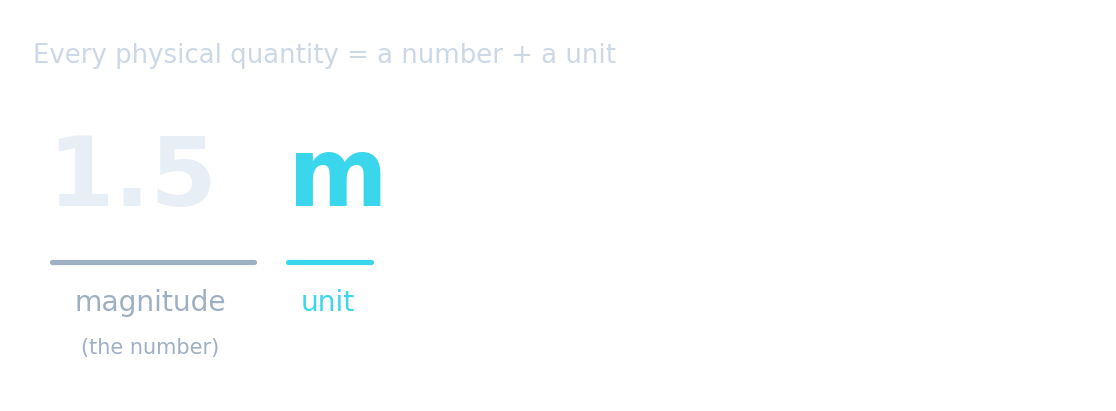
Every physical quantity has two parts: a number (its ____) and a unit. · Toda magnitud física tiene dos partes: un número (su ____) y una unidad.
The two parts are the magnitude (the number) and the unit. · Las dos partes son la magnitud (el número) y la unidad.
Match each term to the definition the examiner marks. · Asocia cada término con la definición que marca el evaluador.
Both halves of the first one score. A number with no unit is not a physical quantity, which is exactly how the Mars orbiter was lost. · Ambas mitades del primer par puntúan. Un número sin unidad no es una magnitud física, exactamente como ocurrió en la pérdida del orbitador de Marte.
A number alone means nothing
- "The speed is 90" — 90 what?
- $90\ \dfrac{\text{km}}{\text{h}}$, $90\ \dfrac{\text{m}}{\text{s}}$ and 90 mph are all different.
- Always write the unit too.
Un número solo no significa nada
- "La velocidad es 90" — 90 ¿qué?
- $90\ \dfrac{\text{km}}{\text{h}}$, $90\ \dfrac{\text{m}}{\text{s}}$ y 90 mph son todas diferentes.
- Escribe siempre la unidad también.
Saying "the speed is 90" — with no unit — gives a complete physical quantity. · Decir "la velocidad es 90" —sin unidad— da una magnitud física completa.
Without a unit the number is ambiguous. "$90\ \dfrac{\text{km}}{\text{h}}$" is complete; "90" is not. · Sin una unidad, el número es ambiguo. "$90\ \dfrac{\text{km}}{\text{h}}$" es completo; "90" no lo es.
An answer of "5" to a question asking for a length is complete as long as the working is shown. · Una respuesta de "5" a una pregunta que pide una longitud es completa siempre que se muestre el procedimiento.
A physical quantity is a magnitude AND a unit. 5 metres, 5 centimetres and 5 kilometres are three different lengths, and the mark scheme asks for the unit. · Una magnitud física es una magnitud Y una unidad. 5 metros, 5 centímetros y 5 kilómetros son tres longitudes diferentes, y la rúbrica de evaluación exige la unidad.
"$90\ \dfrac{\text{km}}{\text{h}}$" is a complete quantity. "90" on its own is not.
"$90\ \dfrac{\text{km}}{\text{h}}$" es una magnitud completa. "90" solo no lo es.
Which statement gives a complete · completo physical quantity? · ¿Qué afirmación proporciona una magnitud física completa?
A physical quantity needs both · ambas a magnitude (the number, 70) and · y a unit (kg). A number alone, or a unit alone, is not enough. · Una magnitud física necesita ambas cosas: una magnitud (el número, 70) y una unidad (kg). Un número solo, o una unidad sola, no es suficiente.
Estimate 估算 everyday sizes
- You should know roughly how big common things are.
- Learn these standard values by heart.
Estimar tamaños cotidianos
- Debes saber aproximadamente cuánto miden las cosas comunes.
- Aprende estos valores estándar de memoria.
Select all · todos the estimates that are about right. · Selecciona todas las estimaciones que sean aproximadamente correctas.
All are right except the speed of sound: in air it is about $340\ \dfrac{\text{m}}{\text{s}}$. $3 \times 10^{8}\ \dfrac{\text{m}}{\text{s}}$ is the speed of light · luz. · Todas son correctas excepto la velocidad del sonido: en el aire es aproximadamente $340\ \dfrac{\text{m}}{\text{s}}$. $3 \times 10^{8}\ \dfrac{\text{m}}{\text{s}}$ es la velocidad de la luz.
Put the method for an order-of-magnitude estimate in order. · Ordena el método para una estimación del orden de magnitud.
An order-of-magnitude answer is only claiming the right power of ten, so carrying three significant figures through it is wasted work. · Una respuesta del orden de magnitud solo afirma tener el exponente correcto, por lo que llevar tres cifras significativas es trabajo innecesario.
How to estimate
- Compare with something you know (a person $\approx 70\ \text{kg}$).
- Round to one figure — a car is about $1000\ \text{kg}$, not $1043$.
- Getting the power of ten right matters most.
Cómo estimar
- Compara con algo que conozcas (una persona $\approx 70\ \text{kg}$).
- Redondea a una cifra significativa — un coche mide unos $1000\ \text{kg}$, no $1043$.
- Acertar la potencia de diez es lo más importante.
Estimate the acceleration of free fall $g$ near the Earth's surface. · Estima la aceleración de la caída libre $g$ cerca de la superficie de la Tierra.
Near the Earth's surface $g \approx 9.81\ \dfrac{\text{m}}{\text{s}^2}$ — roughly $10\ \dfrac{\text{m}}{\text{s}^2}$. · Cerca de la superficie de la Tierra $g \approx 9.81\ \dfrac{\text{m}}{\text{s}^2}$ —aproximadamente $10\ \dfrac{\text{m}}{\text{s}^2}$—.
A human hair is about 0.1 mm across. What is the order of magnitude of that width in metres, as a power of ten? (Give the exponent, e.g. -3) · El diámetro de un cabello humano es de aproximadamente 0,1 mm. ¿Cuál es el orden de magnitud de ese ancho en metros, expresado como potencia de diez? (Indica el exponente, ej. -3)
0.1 mm = 1e-4 m. Convert the prefix before taking the power of ten; treating 0.1 mm as 0.1 is the standard slip. · 0,1 mm = 1e-4 m. Convierte el prefijo antes de tomar la potencia de diez; tratar 0,1 mm como 0,1 es el error estándar.
Order of magnitude 数量级
- A good estimate has the right power of ten.
- $70\ \text{kg}$ ✓ · $7\ \text{kg}$ ✗
Orden de magnitud 数量级
- Una buena estimación tiene la potencia de diez correcta.
- $70\ \text{kg}$ ✓ · $7\ \text{kg}$ ✗
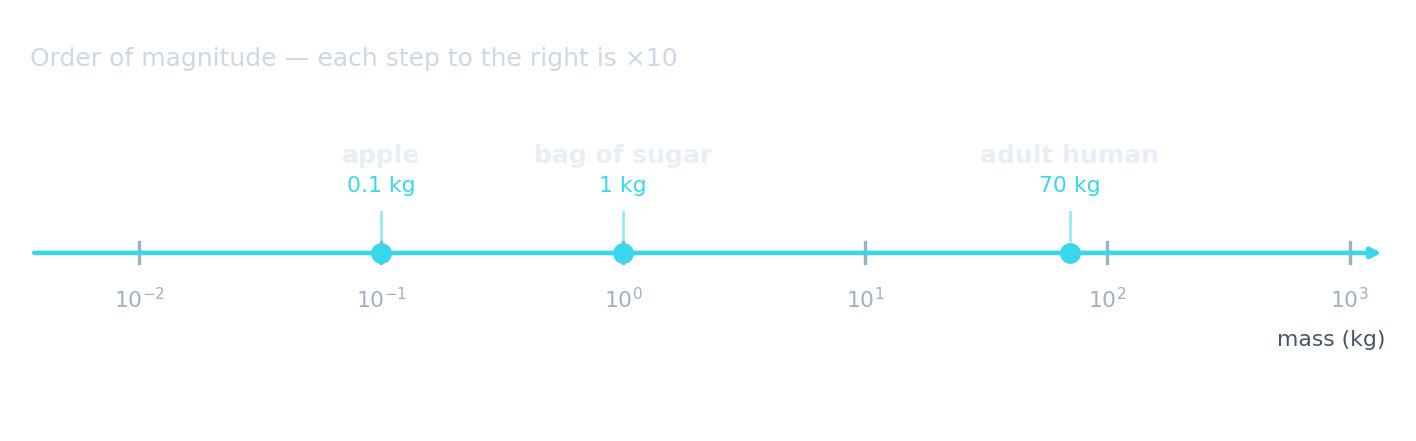
Put these masses in order, smallest first. · Ordena estas masas, de menor a mayor.
Ordering by size checks your sense of order of magnitude: $0.1\ \text{kg}$, then $1\ \text{kg}$, then $70\ \text{kg}$. · Ordenar por tamaño verifica tu intuición sobre el orden de magnitud: $0.1\ \text{kg}$, luego $1\ \text{kg}$, luego $70\ \text{kg}$.
The scale of the universe
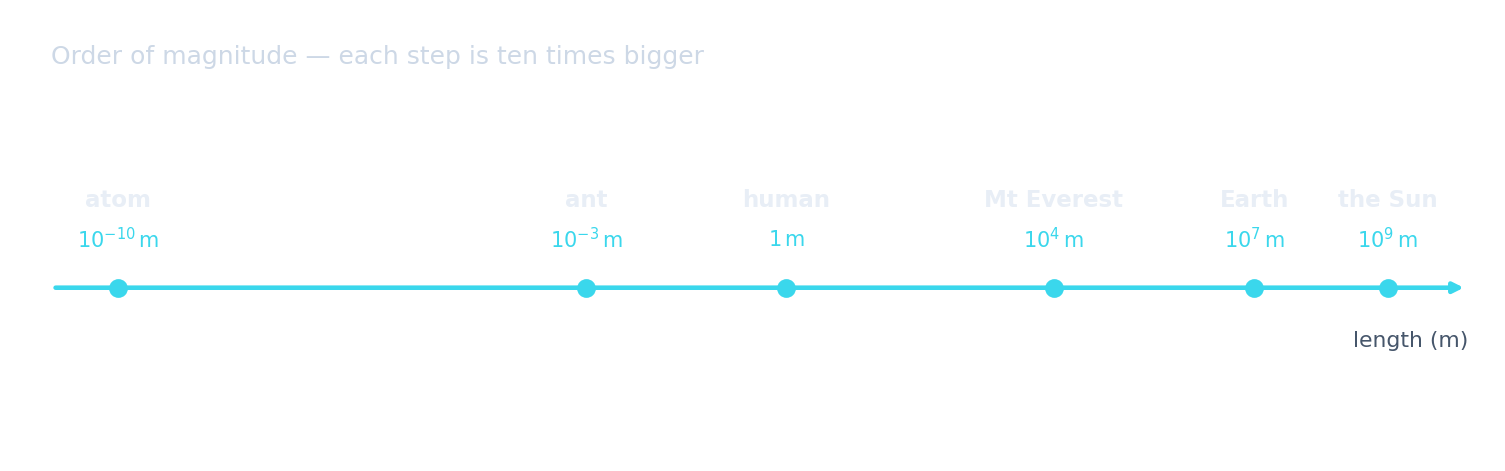
- The same idea runs from an atom to the Sun.
- Each step along the line is ten times bigger.
La escala del universo
- La misma idea abarca desde un átomo hasta el Sol.
- Cada paso a lo largo de la línea es diez veces más grande.
You've got it
- a physical quantity = a magnitude + a unit
- learn the standard estimates (human, apple, sound, light, $g$)
- a good estimate has the right order of magnitude
Next — the SI units these are all built from.
Lo has entendido
- una magnitud física = una magnitud numérica + una unidad
- aprende las estimaciones estándar (humano, manzana, sonido, luz, $g$)
- una buena estimación tiene el orden de magnitud correcto
Siguiente — las unidades SI, de las cuales todas están construidas.