SI units · Unidades SI
| English | Español |
|---|---|
| SI system/ˌes ˈaɪ ˈsɪstəm/ | sistema SI |
| base unit/beɪs ˈjuːnɪt/ | unidad base |
| derived unit/dɪˈraɪvd ˈjuːnɪt/ | unidad derivada |
| homogeneous/ˌhɒməˈdʒiːniəs/ | homogénea |
| prefix/ˈpriːfɪks/ | prefijo |
One language for science
- Long ago every place used its own units — feet, cubits, pounds.
- Science and trade were a mess of conversions.
- The SI system 国际单位制 fixes this: one shared set of units for everyone.
Un idioma para la ciencia
- En el pasado, cada lugar utilizaba sus propias unidades — pies, codos, libras.
- La ciencia y el comercio eran un caos de conversiones.
- El sistema SI 国际单位制 soluciona esto: un conjunto compartido de unidades para todos.
SI unit lab · Laboratorio de unidades SI
Match common quantities to the correct SI unit family. · Asociar cantidades comunes con la familia correcta de unidades SI.
The five base units 基本单位
- Every unit in physics is built from just five base units.
- Learn these first, then build the rest.
Las cinco unidades base 基本单位
- Cada unidad en física se construye a partir de solo cinco unidades base.
- Aprende estas primero, luego construye las demás.
Select all · todos the SI base units. · Seleccione todas las unidades SI fundamentales.
The five SI base units are the kilogram, metre, second, ampere and kelvin. The newton and joule are derived units, built from the base units. · Las cinco unidades SI fundamentales son el kilogramo, el metro, el segundo, el amperio y el kelvin. El newton y el joule son unidades derivadas, construidas a partir de las unidades fundamentales.
Which of these are SI base units? Select all · todos that apply. · ¿Cuáles de estas son unidades SI fundamentales? Seleccione todas las que correspondan.
The newton is derived: kg m s^-2, straight from F = ma. The five you need are the metre, kilogram, second, ampere and kelvin. · El newton es derivado: kg m s^-2, directamente de F = ma. Las cinco que necesita son el metro, el kilogramo, el segundo, el amperio y el kelvin.
Fun fact: the kilogram
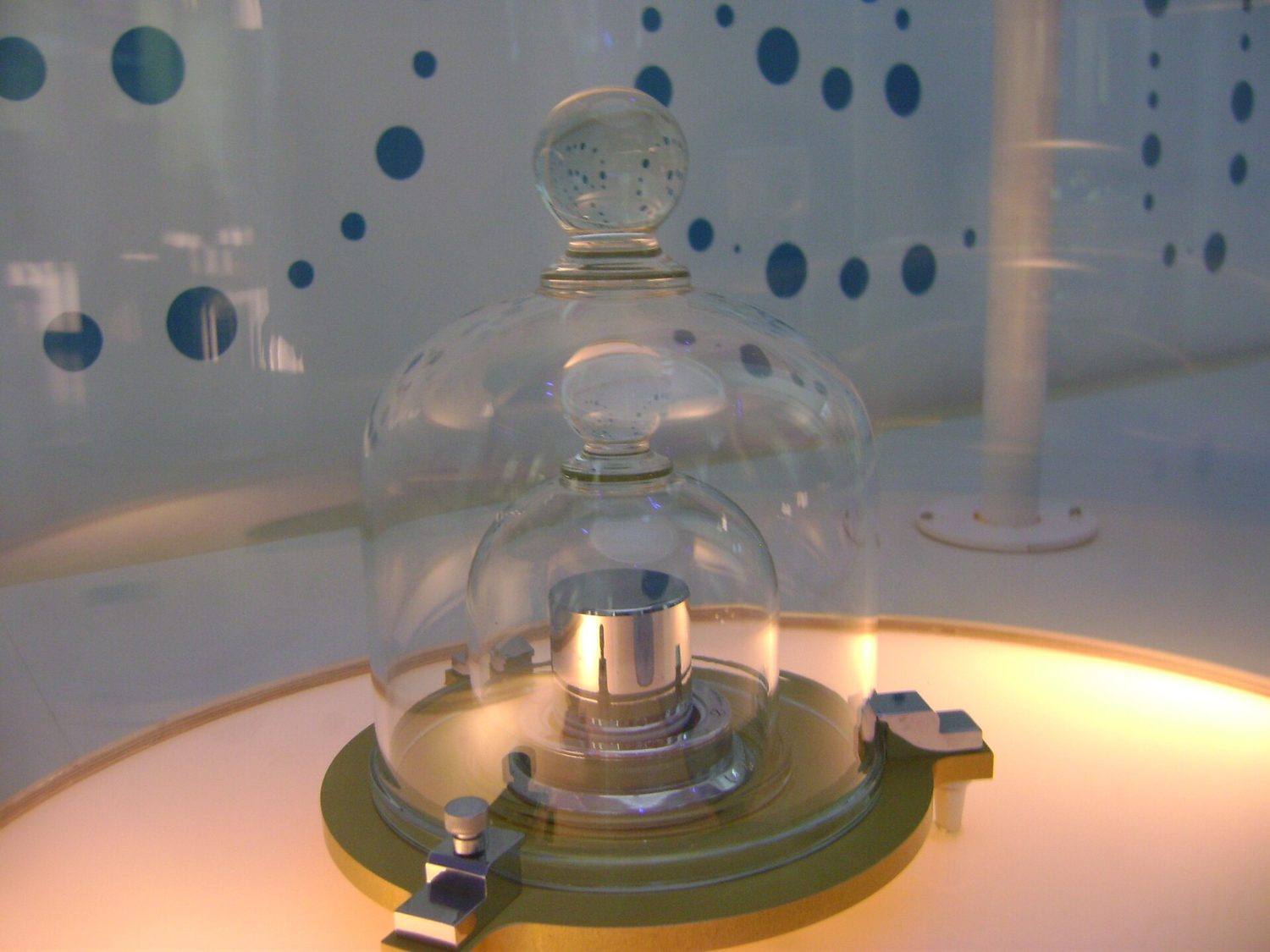
- Until 2019 the kilogram was a real metal cylinder kept in Paris.
- Now it is fixed by a constant of nature instead.
Dato curioso: el kilogramo
- Hasta 2019, el kilogramo era un cilindro real de metal guardado en París.
- Ahora está definido por una constante de la naturaleza.
Build a derived unit 导出单位 from its equation
- A derived unit is base units multiplied or divided.
- Build it from the equation that defines the quantity.
- Simple ones: speed $= \dfrac{\text{m}}{\text{s}}$, acceleration $= \dfrac{\text{m}}{\text{s}^2}$.
Construye una unidad derivada 导出单位 a partir de su ecuación
- Una unidad derivada son unidades base multiplicadas o divididas.
- Constrúyela a partir de la ecuación que define la magnitud.
- Ejemplos simples: velocidad $= \dfrac{\text{m}}{\text{s}}$, aceleración $= \dfrac{\text{m}}{\text{s}^2}$.
Match each derived unit to its form in SI base units. · Asocie cada unidad derivada con su forma en unidades SI fundamentales.
Each comes from its defining equation: force gives the newton, energy the joule, power the watt, and pressure the pascal. · Cada una proviene de su ecuación definitoria: la fuerza da el newton, la energía el joule, la potencia el watt y la presión el pascal.
Put the method for finding a derived unit in base units in order. · Coloque el método para encontrar una unidad derivada en unidades fundamentales en orden.
This is why the equation matters more than memorising: the watt comes out of P = E/t and the joule out of W = Fd, every time. · Por eso la ecuación importa más que memorizarla: el watt sale de P = E/t y el joule de W = Fd, cada vez.
Worked example: the watt in base units
- power = energy ÷ time, so $\text{W} = \dfrac{\text{J}}{\text{s}}$.
- Put in the joule: $\dfrac{1}{\text{s}} \times \dfrac{\text{kg}\cdot\text{m}^2}{\text{s}^2}$.
- Simplify: $\dfrac{\text{kg}\cdot\text{m}^2}{\text{s}^3}$.
Ejemplo resuelto: el watt en unidades base
- potencia = energía ÷ tiempo, así que $\text{W} = \dfrac{\text{J}}{\text{s}}$.
- Sustituye el joule: $\dfrac{1}{\text{s}} \times \dfrac{\text{kg}\cdot\text{m}^2}{\text{s}^2}$.
- Simplifica: $\dfrac{\text{kg}\cdot\text{m}^2}{\text{s}^3}$.
Checking equations: homogeneity
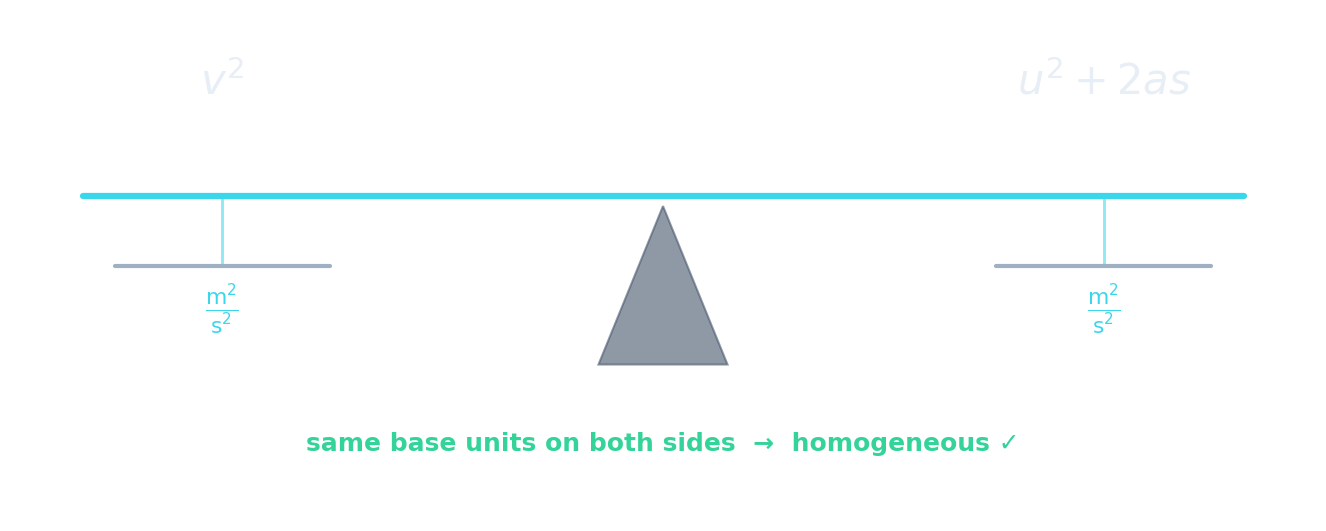
- An equation is homogeneous 量纲一致 when both sides have the same base units.
- In $v^{2} = u^{2} + 2as$, every term works out to $\dfrac{\text{m}^2}{\text{s}^2}$ — so it balances.
Verificar ecuaciones: homogeneidad
- Una ecuación es homogénea 量 dimensionalmente when both sides have the same base units.
- En $v^{2} = u^{2} + 2as$, cada término resulta en $\dfrac{\text{m}^2}{\text{s}^2}$ — así que se equilibra.
Is the equation $v = u + at$ homogeneous? · ¿Es la ecuación $v = u + at$ homogénea?
Yes — every term is a speed. $v$ and · y $u$ are $\dfrac{\text{m}}{\text{s}}$, and $at = \dfrac{\text{m}}{\text{s}^2} \times \text{s} = \dfrac{\text{m}}{\text{s}}$. · Sí — cada término es una velocidad. $v$ y $u$ son $\dfrac{\text{m}}{\text{s}}$, y $at = \dfrac{\text{m}}{\text{s}^2} \times \text{s} = \dfrac{\text{m}}{\text{s}}$.
An equation is homogeneous when every term has the same ____ units. · Una ecuación es homogénea cuando cada término tiene las mismas ____ unidades.
A homogeneous equation may still be wrong, because a missing factor of one half carries no units. But a non-homogeneous equation is certainly wrong. · Una ecuación homogénea aún puede ser incorrecta, porque un factor faltante de medio no lleva unidades. Pero una ecuación no homogénea es certainly incorrecta.
Matching units do not prove an equation is right — the number could still be wrong. But if the units don't match, it is wrong for sure.
Que las unidades coincidan no demuestra que una ecuación sea correcta — el número podría seguir siendo erróneo. Pero si las unidades no coinciden, definitivamente está mal.
Using base units, which equation is not · no homogeneous (so must be wrong)? · Usando unidades fundamentales, ¿cuál ecuación no es homogénea (por lo tanto debe estar mal)?
In $v = u + a$, $a$ is $\dfrac{\text{m}}{\text{s}^2}$ but $u$ is $\dfrac{\text{m}}{\text{s}}$ — the units do not match, so it cannot be right. The other three are homogeneous. · En $v = u + a$, $a$ es $\dfrac{\text{m}}{\text{s}^2}$ pero $u$ es $\dfrac{\text{m}}{\text{s}}$ — las unidades no coinciden, así que no puede ser correcta. Las otras tres son homogéneas.
Prefixes 词头
- A prefix scales a unit by a power of ten.
- You must know the ten in the syllabus, from pico to tera.
Prefijos 词头
- Un prefijo escala una unidad por una potencia de diez.
- Debes conocer los diez del programa, desde pico hasta tera.
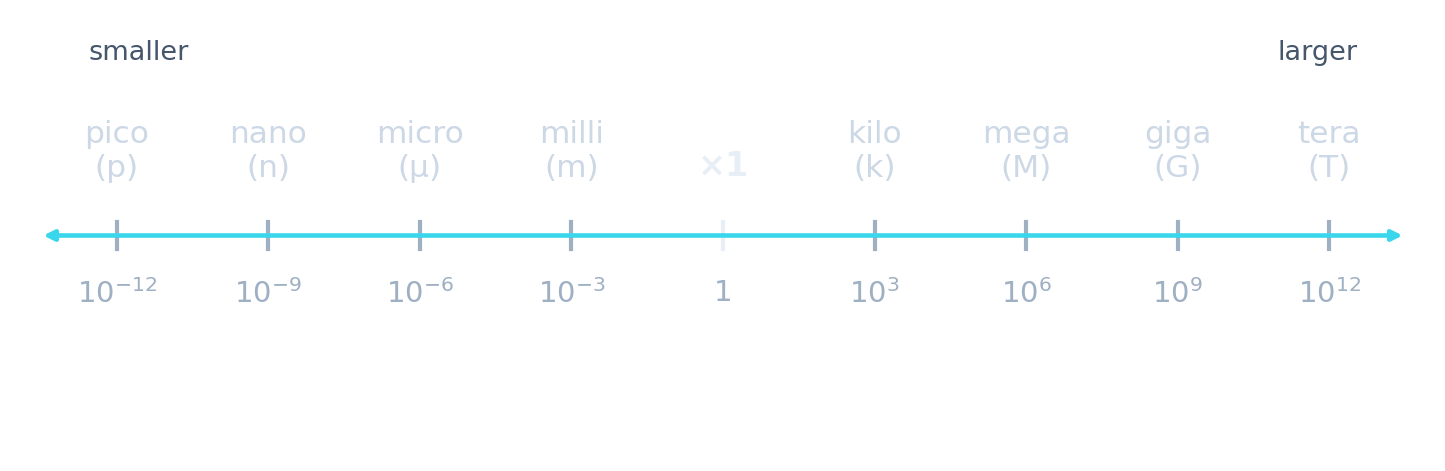
Put these prefixes in order, smallest factor first. · Coloque estos prefijos en orden, factor más pequeño primero.
In order of size: nano, micro, milli, then kilo, mega. Each step up this list is a larger power of ten. · En orden de magnitud: nano, micro, mili, luego kilo, mega. Cada paso hacia arriba en esta lista es una potencia mayor de diez.
A square has sides of 5.0 cm. What is its area in square metres, in units of 1e-3 m^2? · Un cuadrado tiene lados de 5.0 cm. ¿Cuál es su área en metros cuadrados, en unidades de 1e-3 m^2?
0.050 m squared is 2.5e-3 m^2. Converting after squaring, or dividing by 100 instead of 10000, is the classic area-prefix error. · 0.050 m al cuadrado es 2.5e-3 m^2. Convertir después de elevar al cuadrado, o dividir por 100 en lugar de 10000, es el error clásico de prefijo de área.
Converting a prefixed unit
- Replace each prefix with its power of ten, then simplify.
- kilo $=10^{3}$, so $2\ \text{kN} = 2 \times 10^{3}\ \text{N} = 2000\ \text{N}$.
Convertir una unidad con prefijo
- Reemplaza cada prefijo por su potencia de diez, luego simplifica.
- kilo $=10^{3}$, así que $2\ \text{kN} = 2 \times 10^{3}\ \text{N} = 2000\ \text{N}$.
A force is $2\ \text{kN}$. How many newtons is that? · Una fuerza es $2\ \text{kN}$. ¿Cuántos newtons es eso?
kilo means $\times 10^{3}$, so $2\ \text{kN} = 2 \times 10^{3}\ \text{N} = 2000\ \text{N}$. · kilo significa $\times 10^{3}$, así que $2\ \text{kN} = 2 \times 10^{3}\ \text{N} = 2000\ \text{N}$.
Watch the squares
- For a squared unit like $\text{mm}^2$, square the factor too.
Cuidado con los cuadrados
- Para una unidad al cuadrado como $\text{mm}^2$, eleva al cuadrado también el factor.
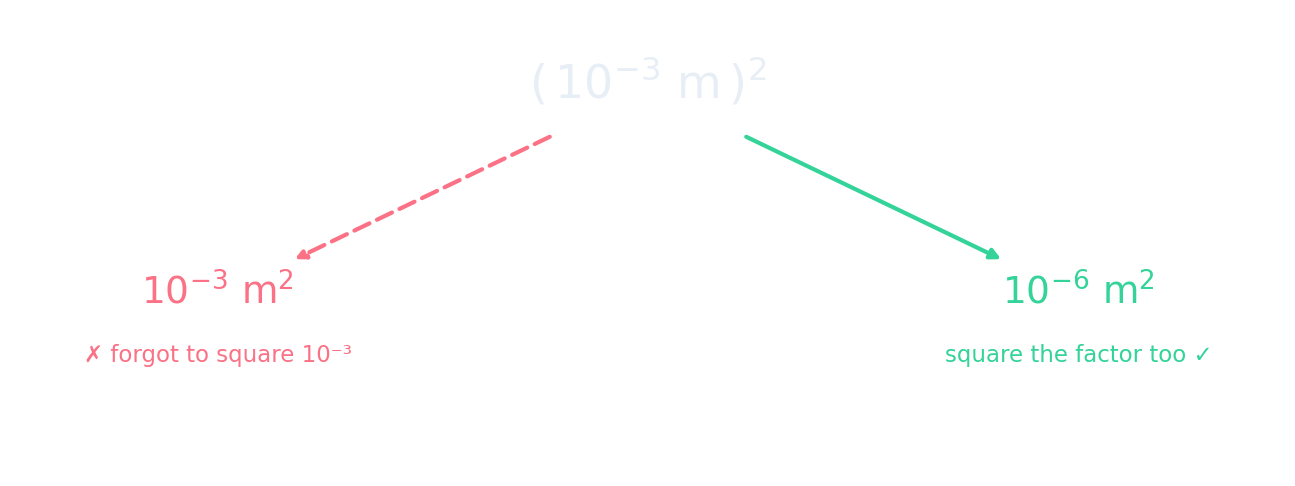
$(10^{-3}\ \text{m})^{2} = 10^{-6}\ \text{m}^{2}$, not $10^{-3}\ \text{m}^{2}$.
$(10^{-3}\ \text{m})^{2} = 10^{-6}\ \text{m}^{2}$, no $10^{-3}\ \text{m}^{2}$.
What is $(10^{-3}\ \text{m})^{2}$, written in $\text{m}^2$? · ¿Qué es $(10^{-3}\ \text{m})^{2}$, escrito en $\text{m}^2$?
Square the factor too: $(10^{-3})^{2} = 10^{-6}$, so $(10^{-3}\ \text{m})^{2} = 10^{-6}\ \text{m}^2$ — not $10^{-3}$. · Eleve al cuadrado también el factor: $(10^{-3})^{2} = 10^{-6}$, así que $(10^{-3}\ \text{m})^{2} = 10^{-6}\ \text{m}^2$ — no $10^{-3}$.
You've got it
- every unit is built from the five base units: kg, m, s, A, K
- a derived unit comes from the equation that defines it
- check an equation with homogeneity — and when a prefix is squared, square its factor too
Ya lo dominas
- toda unidad se construye a partir de las cinco unidades base: kg, m, s, A, K
- una unidad derivada proviene de la ecuación que la define
- verifica una ecuación usando la homogeneidad — y cuando un prefijo esté al cuadrado, eleva su factor también al cuadrado