Errors and uncertainties · Errores e incertidumbres
| English | Español |
|---|---|
| uncertainty/ʌnˈsɜːtənti/ | incertidumbre |
| micrometer/maɪˈkrɒmɪtə/ | micrómetro |
| vernier calipers/ˈvɜːnɪə ˈkælɪpəz/ | calibrador vernier |
| systematic error/ˌsɪstəˈmætɪk ˈerə/ | error sistemático |
| zero error/ˈzɪərəʊ ˈerə/ | error cero |
| calibration/ˌkælɪˈbreɪʃn/ | calibración |
| parallax/ˈpærəlæks/ | paralaje |
| random error/ˈrændəm ˈerə/ | error aleatorio |
| precision/prɪˈsɪʒn/ | precisión |
| accuracy/ˈækjʊrəsi/ | exactitud |
| absolute uncertainty/ˈæbsəluːt ʌnˈsɜːtənti/ | incertidumbre absoluta |
| significant figures/sɪɡˈnɪfɪkənt ˈfɪɡəz/ | cifras significativas |
How sure are you?
- Measure a wire twice and you might get $5.77\ \text{mm}$, then $5.79\ \text{mm}$.
- Neither is "wrong" — every measurement has some uncertainty 不确定度.
- Good physics means knowing how much you are unsure.
¿Qué tan seguro estás?
- Mide un alambre dos veces y podrías obtener $5.77\ \text{mm}$, luego $5.79\ \text{mm}$.
- Ninguna está "mal" — toda medición tiene alguna incertidumbre.
- La buena física significa saber cuánto estás inseguro.
Uncertainty lab · Laboratorio de incertidumbre
Classify measurement problems by how they affect data. · Clasificar problemas de medición según cómo afectan a los datos.
Reading an instrument
- Every scale can only be read so finely.
- A micrometer 螺旋测微器 reads to $0.01\ \text{mm}$; vernier calipers 游标卡尺 to $0.1\ \text{mm}$.
- The smallest step the instrument shows sets a limit on your reading.
A vernier caliper measures length precisely, with a small uncertainty
Read the whole millimetres from the main scale, then add the tenths where the sliding scale lines up
Leer un instrumento
- Cada escala solo se puede leer con cierto grado de finura.
- Un micrómetro lee hasta $0.01\ \text{mm}$; los calibradores vernier hasta $0.1\ \text{mm}$.
- El paso más pequeño que muestra el instrumento establece un límite a tu lectura.

Un calibrador vernier mide longitud con precisión y una pequeña incertidumbre
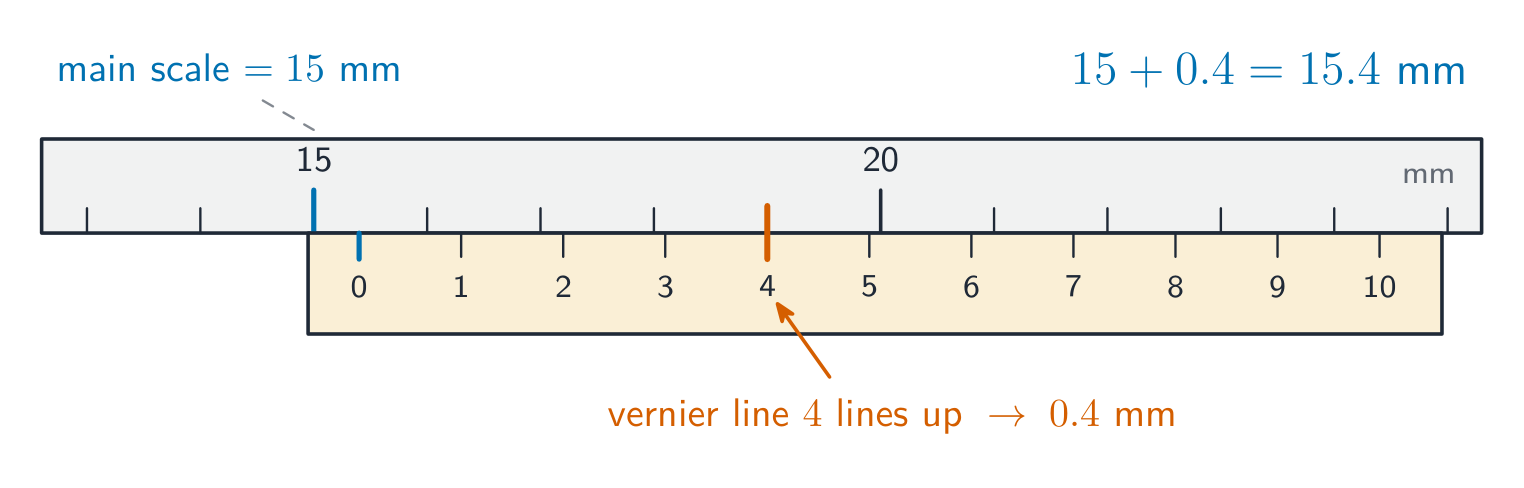
Lee los milímetros enteros en la escala principal, luego añade los décimos donde las líneas de la escala deslizante se alinean
A careful enough measurement can be exactly correct, with zero uncertainty. · Una medición lo suficientemente cuidadosa puede ser exactamente correcta, con cero incertidumbre.
No real measurement is exact — every reading has some uncertainty. The skill is estimating how big it is. · Ninguna medición real es exacta; cada lectura tiene alguna incertidumbre. La habilidad consiste en estimar qué tan grande es.
Systematic errors 系统误差
- A systematic error shifts every reading by the same amount, the same way.
- Causes: a zero error 零点误差, a wrong calibration 校准, or parallax 视差 (reading from the side).
- Repeating the measurement does not remove it.
A micrometer screw gauge measures to the nearest 0.01 mm
Parallax: viewing a scale from an angle shifts the reading — a systematic error
Errores sistemáticos
- Un error sistemático desplaza todas las lecturas por la misma cantidad, de la misma manera.
- Causas: un error de cero, una calibración incorrecta o la paralaje (leer desde el costado).
- Repetir la medición no lo elimina.

Un micrómetro mide hasta el décimo de 0.01 mm más cercano
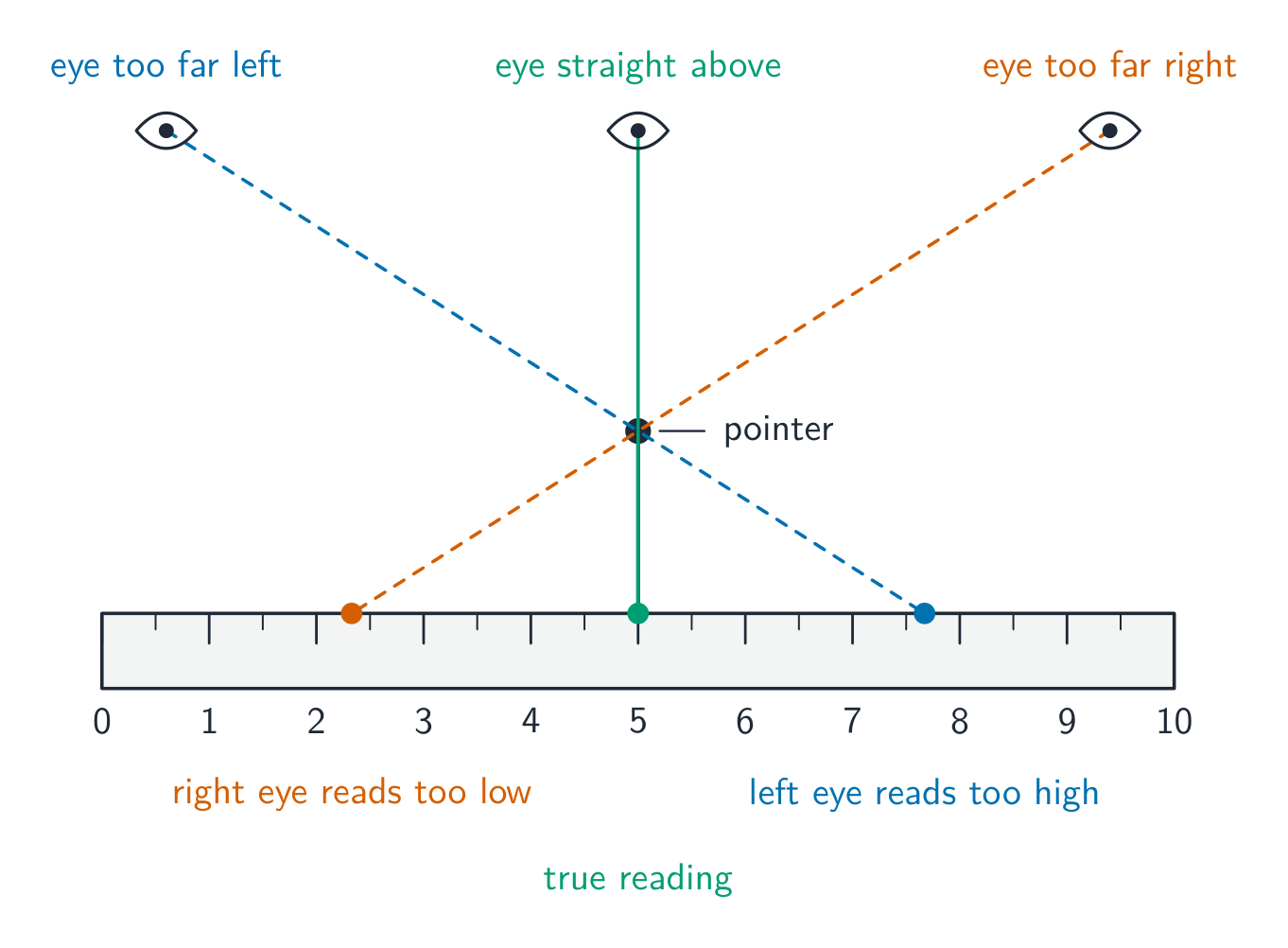
Paralaje: ver una escala en ángulo desplaza la lectura — un error sistemático
Which of these is a systematic error? · ¿Cuál de estos es un error sistemático?
A zero error shifts every reading by the same amount in the same direction — that is systematic. The others vary randomly from reading to reading. · Un error de cero desplaza cada lectura la misma cantidad en la misma dirección — eso es sistemático. Los otros varían aleatoriamente de una lectura a otra.
Random errors 随机误差
- A random error makes readings jump above and below, with no pattern.
- Repeat the measurement many times and take the mean — the scatter partly cancels.
Precision 精密度: how narrow the distribution is around the true value T
Errores aleatorios
- Un error aleatorio hace que las lecturas salten arriba y abajo, sin patrón.
- Repite la medición muchas veces y toma la media — la dispersión se cancela parcialmente.
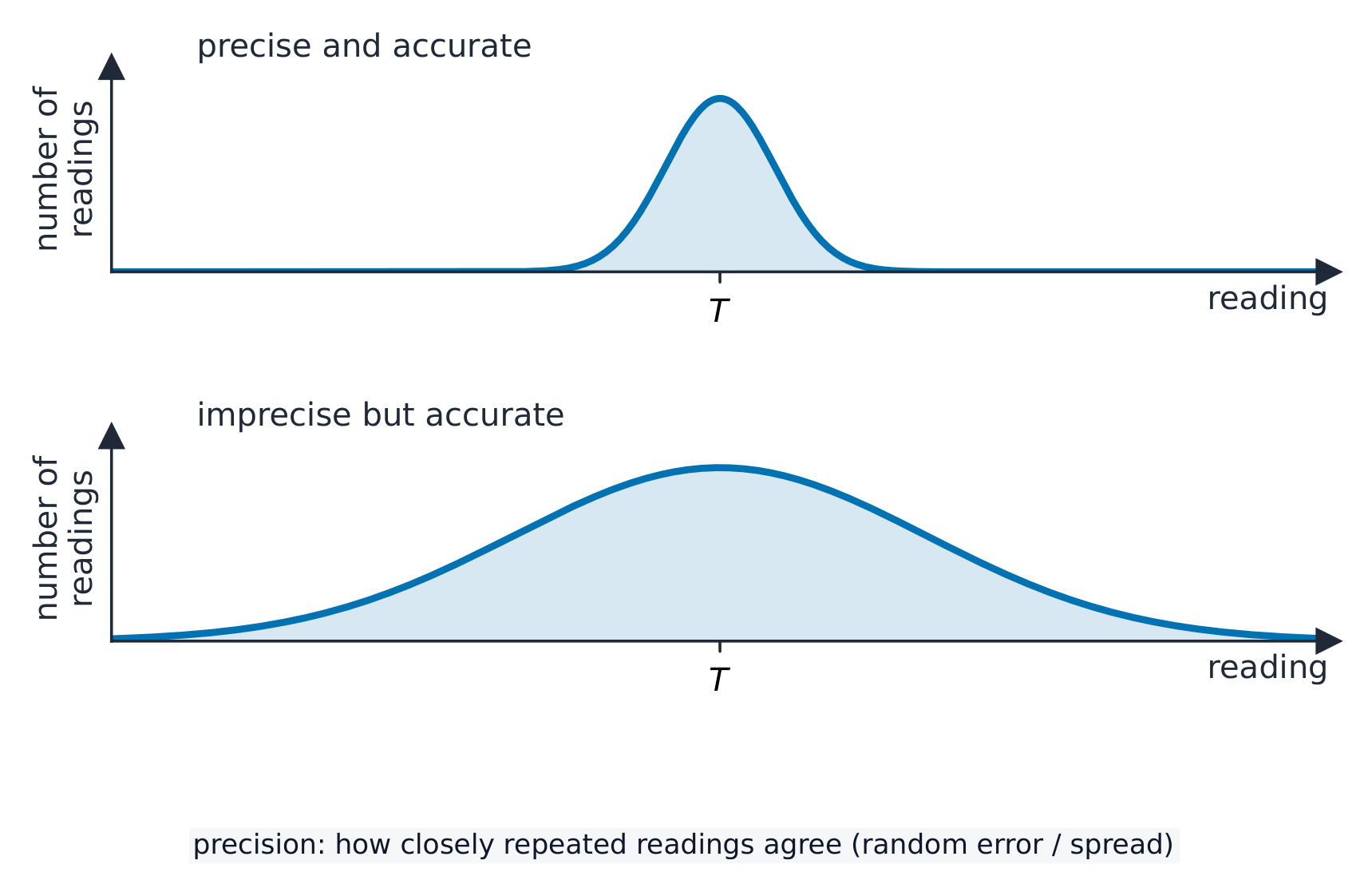
Precisión: qué tan estrecha es la distribución alrededor del valor verdadero T
To reduce a random error, repeat the measurement and take the ____. · Para reducir un error aleatorio, repita la medición y tome el ____.
Random errors scatter both ways, so the mean · media of many repeats partly cancels them. (A systematic error survives averaging.) · Los errores aleatorios se dispersan en ambas direcciones, por lo que la media de muchas repeticiones los cancela parcialmente. (Un error sistemático sobrevive al promediado).
Precision vs accuracy 准确度
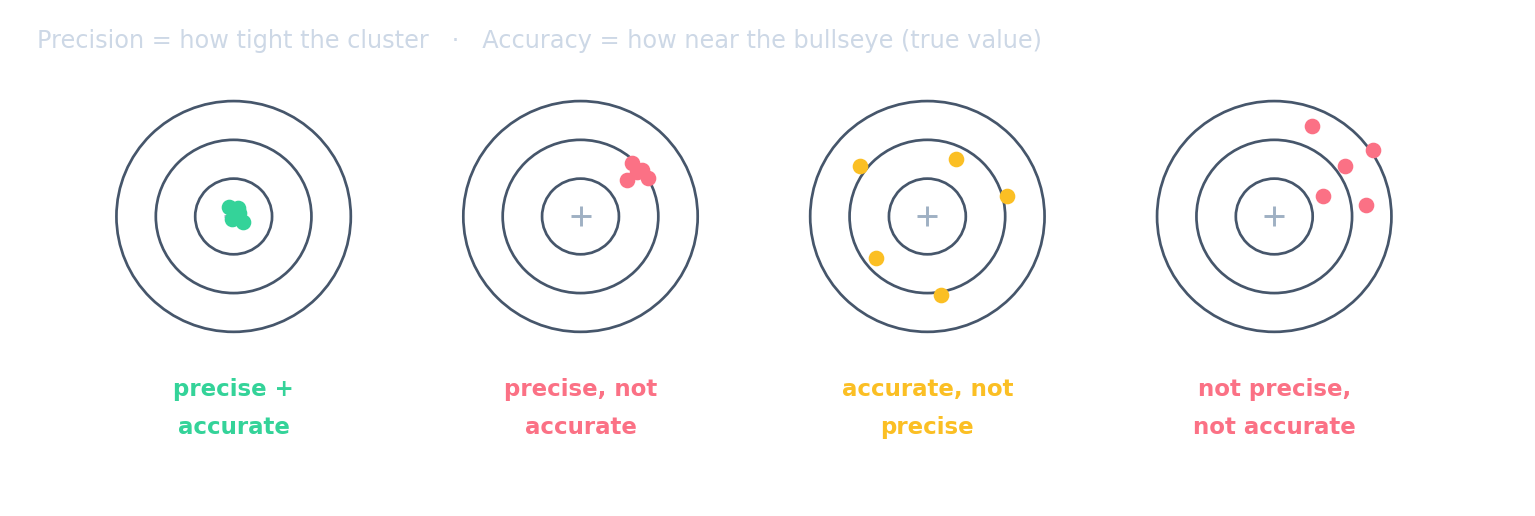
- Precision = how tightly repeated readings cluster.
- Accuracy = how close they are to the true value.
Precisión vs exactitud
- Precisión = qué tan apretadamente se agrupan las repeticiones de la lectura.
- Exactitud = qué tan cerca están de su valor verdadero.
Match each term to the definition the examiner marks. · Empareje cada término con la definición que marca el examinador.
Repeating fixes only the random half. A zero error makes readings precise and wrong, which is why the two words are not interchangeable. · Repetir solo corrige la mitad aleatoria. Un error de cero hace que las lecturas sean precisas pero incorrectas, por eso las dos palabras no son intercambiables.
Which error hurts which?
- A systematic error moves the whole cluster off-target → worse accuracy.
- A random error spreads the cluster out → worse precision.
¿Qué error afecta a qué?
- Un error sistemático mueve todo el grupo fuera del objetivo → empeora la exactitud.
- Un error aleatorio expande el grupo → empeora la precisión.
Match each pattern of repeated readings to its description. · Empareje cada patrón de lecturas repetidas con su descripción.
Precision is how tight the cluster is; accuracy is how near the true value (the bullseye) it sits. · La precisión es qué tan apretado es el grupo; la exactitud es qué tan cerca está del valor verdadero (el objetivo).
Writing an uncertainty
- We write a result as $x \pm \Delta x$, where $\Delta x$ is the absolute uncertainty 绝对不确定度.
- The percentage uncertainty is $\dfrac{\Delta x}{|x|} \times 100\%$.
Escribir una incertidumbre
- Escribimos un resultado como $x \pm \Delta x$, donde $\Delta x$ es la incertidumbre absoluta.
- La incertidumbre porcentual es $\dfrac{\Delta x}{|x|} \times 100\%$.
A length is $(20.0 \pm 0.5)\ \text{cm}$. What is its percentage uncertainty? · Una longitud es $(20.0 \pm 0.5)\ \text{cm}$. ¿Cuál es su incertidumbre porcentual?
$\dfrac{\Delta x}{|x|} \times 100\% = \dfrac{0.5}{20.0} \times 100\% = 2.5\%$.
Combining: add or subtract
- If $y = a + b$ or $y = a - b$, add the absolute uncertainties.
- $\Delta y = \Delta a + \Delta b$.
Combinar: sumar o restar
- Si $y = a + b$ o $y = a - b$, suma las incertidumbres absolutas.
- $\Delta y = \Delta a + \Delta b$.
Combining: multiply or divide
- If $y = \dfrac{a \cdot b}{c}$, add the percentage uncertainties.
- $\dfrac{\Delta y}{|y|} = \dfrac{\Delta a}{|a|} + \dfrac{\Delta b}{|b|} + \dfrac{\Delta c}{|c|}$.
Combinar: multiplicar o dividir
- Si $y = \dfrac{a \cdot b}{c}$, suma las incertidumbres porcentuales.
- $\dfrac{\Delta y}{|y|} = \dfrac{\Delta a}{|a|} + \dfrac{\Delta b}{|b|} + \dfrac{\Delta c}{|c|}$.
For · A favor $y = \dfrac{a \cdot b}{c}$, how do you combine the uncertainties? · Para $y = \dfrac{a \cdot b}{c}$, ¿cómo se combinan las incertidumbres?
For multiplying and dividing, add the percentage uncertainties: $\dfrac{\Delta y}{|y|} = \dfrac{\Delta a}{|a|} + \dfrac{\Delta b}{|b|} + \dfrac{\Delta c}{|c|}$. · Para multiplicar y dividir, sumar las incertidumbres porcentuales: $\dfrac{\Delta y}{|y|} = \dfrac{\Delta a}{|a|} + \dfrac{\Delta b}{|b|} + \dfrac{\Delta c}{|c|}$.
Which rules for combining uncertainties are correct? Select all · todos that apply. · ¿Cuáles reglas para combinar incertidumbres son correctas? Seleccione todas las que correspondan.
Uncertainties never cancel. Subtracting two similar values keeps the sum of their uncertainties over a much smaller result, which is why such a difference is so imprecise. · Las incertidumbres nunca se cancelan. Restar dos valores similares mantiene la suma de sus incertidumbres sobre un resultado mucho más pequeño, por lo que esa diferencia es tan imprecisa.
Combining: powers
- If $y = a^{n}$, multiply the percentage uncertainty by the power.
- $\dfrac{\Delta y}{|y|} = |n| \cdot \dfrac{\Delta a}{|a|}$.
Combinar: potencias
- Si $y = a^{n}$, multiplica la incertidumbre porcentual por el exponente.
- $\dfrac{\Delta y}{|y|} = |n| \cdot \dfrac{\Delta a}{|a|}$.
A radius is measured with a $0.4\%$ uncertainty. A circle's area is $A = \pi r^{2}$. What is the percentage uncertainty in $A$? · Un radio se mide con una incertidumbre del $0.4\%$. El área de un círculo es $A = \pi r^{2}$. ¿Cuál es la incertidumbre porcentual en $A$?
For a power, multiply by the power: $A \propto r^{2}$, so the % uncertainty is $2 \times 0.4\% = 0.8\%$. · Para una potencia, multiplicar por la potencia: $A \propto r^{2}$, por lo que la % incertidumbre es $2 \times 0.4\% = 0.8\%$.
A period T is measured with a 2.0% uncertainty. What is the percentage uncertainty in T squared? · Un periodo T se mide con una incertidumbre del 2.0%. ¿Cuál es la incertidumbre porcentual en T cuadrado?
Squaring doubles the percentage uncertainty; a square root halves it. Quoting 2.0% for T^2 is one of the commonest errors in this topic. · Elevar al cuadrado duplica la incertidumbre porcentual; una raíz cuadrada la divide a la mitad. Citar 2.0% para T^2 es uno de los errores más comunes en este tema.
Worked example: volume of a ball
- Diameter $d = (5.26 \pm 0.02)\ \text{cm}$, and volume $V \propto d^{3}$.
- % uncertainty in $d$: $\dfrac{0.02}{5.26} \times 100\% \approx 0.38\%$.
- Power rule: % uncertainty in $V = 3 \times 0.38\% \approx 1.1\%$.
- So $V = (76.2 \pm 0.9)\ \text{cm}^{3}$.
Ejemplo resuelto: volumen de una esfera
- Diámetro $d = (5.26 \pm 0.02)\ \text{cm}$, y volumen $V \propto d^{3}$.
- % incertidumbre en $d$: $\dfrac{0.02}{5.26} \times 100\% \approx 0.38\%$.
- Regla de la potencia: % incertidumbre en $V = 3 \times 0.38\% \approx 1.1\%$.
- Entonces $V = (76.2 \pm 0.9)\ \text{cm}^{3}$.
Significant figures 有效数字
- Give an answer the same significant figures as the least precise measurement.
- Usually 2 or 3 in this course — too many makes it look more exact than it is.
Cifras significativas
- Da una respuesta con las mismas cifras significativas que la medición menos precisa.
- Generalmente 2 o 3 en este curso — tener muchas hace que parezca más exacto de lo que es.
You've got it
- systematic error → shifts every reading (worse accuracy); random → scatter (worse precision)
- repeat and take the mean to beat random error
- combine uncertainties: add absolute for $+\,-$, add % for $\times\,\div$, × the power for $a^{n}$
Ya lo tienes
- error sistemático → desplaza cada lectura (peor exactitud); aleatorio → dispersión (peor precisión)
- repite y toma la media para vencer el error aleatorio
- combina incertidumbres: suma absolutas para $+\,-$, suma % para $\times\,\div$, × el exponente para $a^{n}$