Integration · Integración
| English | Español |
|---|---|
| integration/ˌɪntɪˈɡreɪʃn/ | integración |
| constant of integration/ˈkɒnstənt ɒv ˌɪntɪˈɡreɪʃn/ | constante de integración |
| definite integral/ˈdefɪnət ˈɪntɪɡrəl/ | integral definida |
| volume of revolution/ˈvɒljuːm ɒv ˌrevəˈluːʃn/ | volumen de revolución |
The area under the curve
- How much fuel does a rocket burn if its thrust varies over time? How much land does a curved field cover?
- Integration 积分 answers these questions — it finds the total accumulated quantity from a rate of change.
El área bajo la curva
- ¿Cuánto combustible consume un cohete si su empuje varía con el tiempo? ¿Cuánta tierra cubre un campo de forma curva?
- La integración 积分 responde a estas preguntas: encuentra la cantidad total acumulada a partir de una tasa de cambio.
Indefinite integration
- Integration reverses differentiation:
- The $+\,C$ is the constant of integration 积分常数 — find it from a known point.
Worked example. $\int 3x^2\,dx = x^3 + C$. If the curve passes through $(1, 5)$: $1^3 + C = 5$, so $C = 4$ and $y = x^3 + 4$.
A definite integral 定积分 measures the shaded area between the curve and the x-axis
Integración indefinida
- La integración invierte a la derivación:
- La $+\,C$ es la constante de integración 积分常数 — se obtiene a partir de un punto conocido.
Ejemplo resuelto. $\int 3x^2\,dx = x^3 + C$. Si la curva pasa por $(1, 5)$: $1^3 + C = 5$, entonces $C = 4$ y $y = x^3 + 4$.
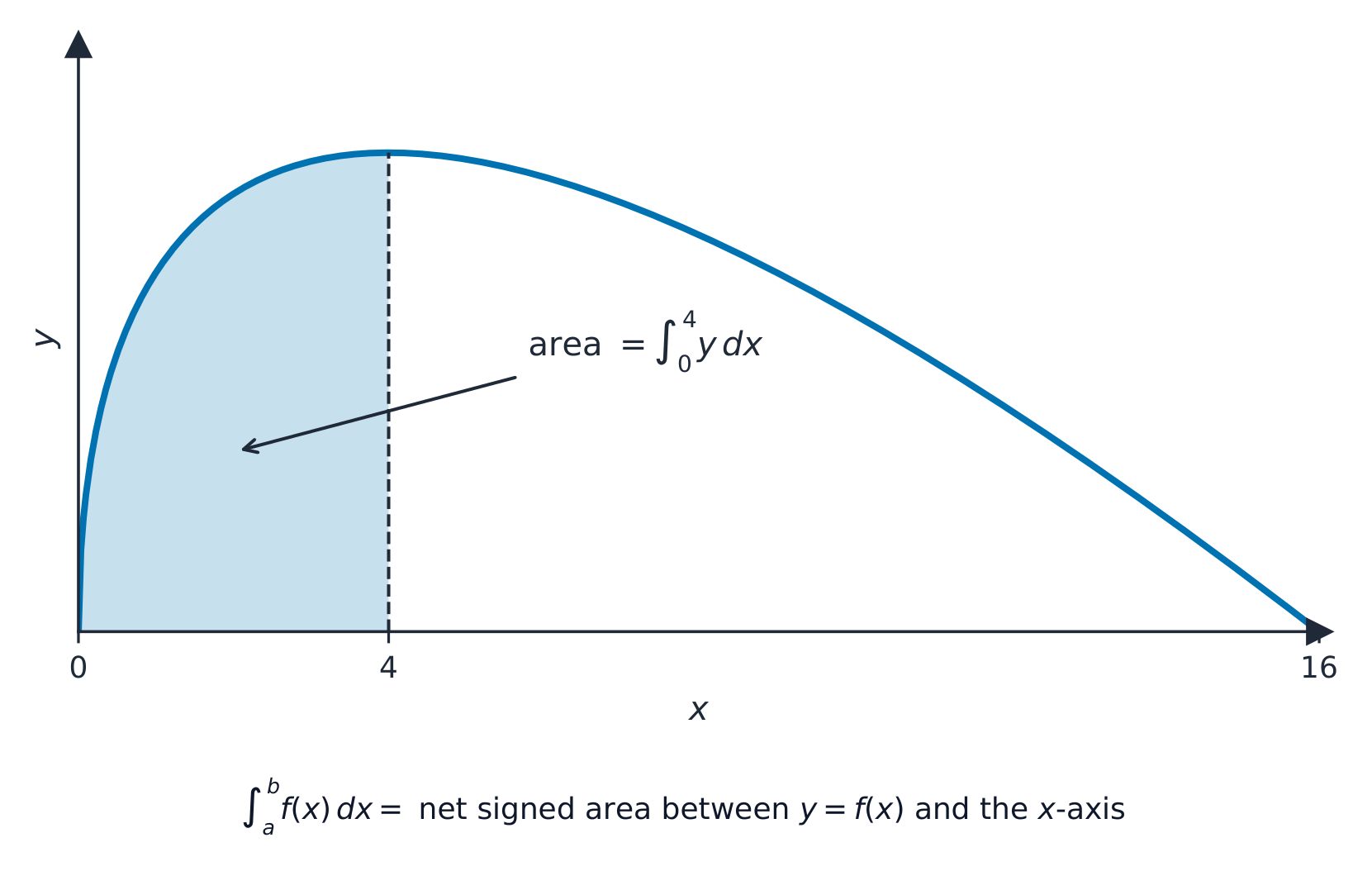
Una integral definida 定积分 mide el área sombreada entre la curva y el eje x
The area under the curve · El área bajo la curva
area = ∫ f(x) dx · área = ∫ f(x) dx
Drag the limits a and b — the shaded area · área between the curve and the x-axis is the definite integral. · Arrastra los límites a y b — el área sombreada entre la curva y el eje x es la integral definida.
Why does an indefinite integral include "+ C"? · ¿Por qué una integral indefinida incluye "+ C"?
Differentiating a constant gives 0, so the original could have had any constant — hence + C. · La derivada de una constante es 0, por lo que la función original podría haber tenido cualquier constante — de ahí + C.
If dy/dx = 4x and the curve passes through (1, 7), what is C in y = 2x² + C? · Si dy/dx = 4x y la curva pasa por (1, 7), ¿cuál es C en y = 2x² + C?
y = 2x² + C. At (1, 7): 7 = 2(1)² + C → C = 5. · y = 2x² + C. En (1, 7): 7 = 2(1)² + C → C = 5.
Definite integrals
- A definite integral gives a number: $\displaystyle\int_p^q f(x)\,dx = F(q) - F(p)$.
- The area under a curve from $p$ to $q$ is $\displaystyle\int_p^q y\,dx$ (for two curves, integrate top − bottom).
The definite integral $\int_0^3 x^2\,dx = \left[\dfrac{x^3}{3}\right]_0^3 = 9 - 0 = 9$. The shaded area is $9$ square units.
Area below the x-axis is negative. If the curve dips below the axis, the integral gives a negative value. To find the total area, split at the roots and take the absolute value of each part.
Integrales definidas
- Una integral definida da como resultado un número: $\displaystyle\int_p^q f(x)\,dx = F(q) - F(p)$.
- El área bajo una curva desde $p$ hasta $q$ es $\displaystyle\int_p^q y\,dx$ (para dos curvas, integra la superior menos la inferior).

La integral definida $\int_0^3 x^2\,dx = \left[\dfrac{x^3}{3}\right]_0^3 = 9 - 0 = 9$. El área sombreada es de $9$ unidades cuadradas.
El área debajo del eje x es negativa. Si la curva desciende bajo el eje, la integral arroja un valor negativo. Para hallar el área total, divide en las raíces y toma el valor absoluto de cada parte.
Evaluate the definite integral of 2x from 0 to 3 (∫₀³ 2x dx). · Evalúa la integral definida de 2x de 0 a 3 (∫₀³ 2x dx).
∫2x dx = x², so [x²]₀³ = 9 − 0 = 9. · ∫2x dx = x², entonces [x²]₀³ = 9 − 0 = 9.
Evaluate ∫₀² 3x² dx. · Evalúa ∫₀² 3x² dx.
∫3x² dx = x³, so [x³]₀² = 8 − 0 = 8. · ∫3x² dx = x³, entonces [x³]₀² = 8 − 0 = 8.
If a curve is below the x-axis, the definite integral gives a negative value. · Si una curva está por debajo del eje x, la integral definida da un valor negativo.
Area below the x-axis contributes negatively to the integral. Take the absolute value to find the actual area. · El área por debajo del eje x contribuye negativamente a la integral. Toma el valor absoluto para encontrar el área real.
Volume of revolution 旋转体体积
- Volume of revolution about the $x$-axis: $V = \pi\displaystyle\int_p^q y^2\,dx$.
- Think of it as stacking infinitely thin discs of radius $y$ and thickness $dx$.
Rotating the region under a curve around the x-axis sweeps out a solid, summed as thin discs
Volumen de revolución 旋转体体积
- Volumen de revolución respecto al eje $x$: $V = \pi\displaystyle\int_p^q y^2\,dx$.
- Piénsalo como apilar discos infinitamente finos de radio $y$ y espesor $dx$.

Al girar la región bajo una curva alrededor del eje x se genera un sólido, que se suma mediante discos finos
The volume of revolution of y = x about the x-axis from 0 to 2 is π∫₀² x² dx. Find the value (without π). · El volumen de revolución de y = x respecto al eje x de 0 a 2 es π∫₀² x² dx. Encuentra el valor (sin π).
∫₀² x² dx = [x³/3]₀² = 8/3 ≈ 2.67.
Worked example
- Find the area under $y = x^2$ from $x = 0$ to $x = 3$:
- $\displaystyle\int_0^3 x^2\,dx = \left[\dfrac{x^3}{3}\right]_0^3 = \dfrac{27}{3} - 0 = 9$.
- An improper integral has an infinite limit or an unbounded integrand.
Ejemplo resuelto
- Encuentra el área bajo $y = x^2$ desde $x = 0$ hasta $x = 3$:
- $\displaystyle\int_0^3 x^2\,dx = \left[\dfrac{x^3}{3}\right]_0^3 = \dfrac{27}{3} - 0 = 9$.
- Una integral impropia tiene un límite infinito o un integrando no acotado.
You've got it
- integration reverses differentiation; remember the $+\,C$
- a definite integral $\int_p^q f(x)\,dx = F(q) - F(p)$ = the area under the curve
- volume of revolution about the $x$-axis $= \pi\int y^2\,dx$
- area below the axis is negative — split and take absolute values for total area
Lo has entendido
- la integración revierte la diferenciación; recuerda el $+\,C$
- una integral definida $\int_p^q f(x)\,dx = F(q) - F(p)$ = el área bajo la curva
- volumen de revolución respecto al eje $x$ $= \pi\int y^2\,dx$
- el área por debajo del eje es negativa — separa y toma valores absolutos para el área total