Trigonometry · Trigonometría
| English | Español |
|---|---|
| trigonometric/ˌtrɪɡənəʊˈmetrɪk/ | trigonométrico |
| asymptotes/ˈæsɪmptəʊts/ | asíntotas |
| identities/aɪˈdentɪtiz/ | identidades |
The mathematics of cycles
- Tides, sound waves, alternating current, planetary orbits — all described by trigonometric 三角的 functions.
- The sine and cosine waves are the building blocks of periodic motion. Master them and you can model anything that repeats.
La matemática de los ciclos
- Mareas, ondas sonoras, corriente alterna, órbitas planetarias: todo se describe mediante funciones trigonométricas.
- Las ondas senoidal y cosenoidal son los bloques de construcción del movimiento periódico. Domínalas y podrás modelar cualquier cosa que se repita.
Graphs of sin, cos and tan
- $\sin$ and $\cos$ wave between $-1$ and $1$ and repeat every $360^\circ$ (or $2\pi$ radians).
- $\tan$ repeats every $180^\circ$ (or $\pi$ radians) and has vertical asymptotes 渐近线 at $90^\circ$ and $270^\circ$.
The unit circle: $\cos\theta$ is the $x$-coordinate, $\sin\theta$ is the $y$-coordinate. Since $x^2 + y^2 = 1$, we get $\cos^2\theta + \sin^2\theta \equiv 1$.
Gráficas de sin, cos y tan
- $\sin$ y $\cos$ oscilan entre $-1$ y $1$ y se repiten cada $360^\circ$ (o $2\pi$ radianes).
- $\tan$ se repite cada $180^\circ$ (o $\pi$ radianes) y tiene asíntotas verticales en $90^\circ$ y $270^\circ$.
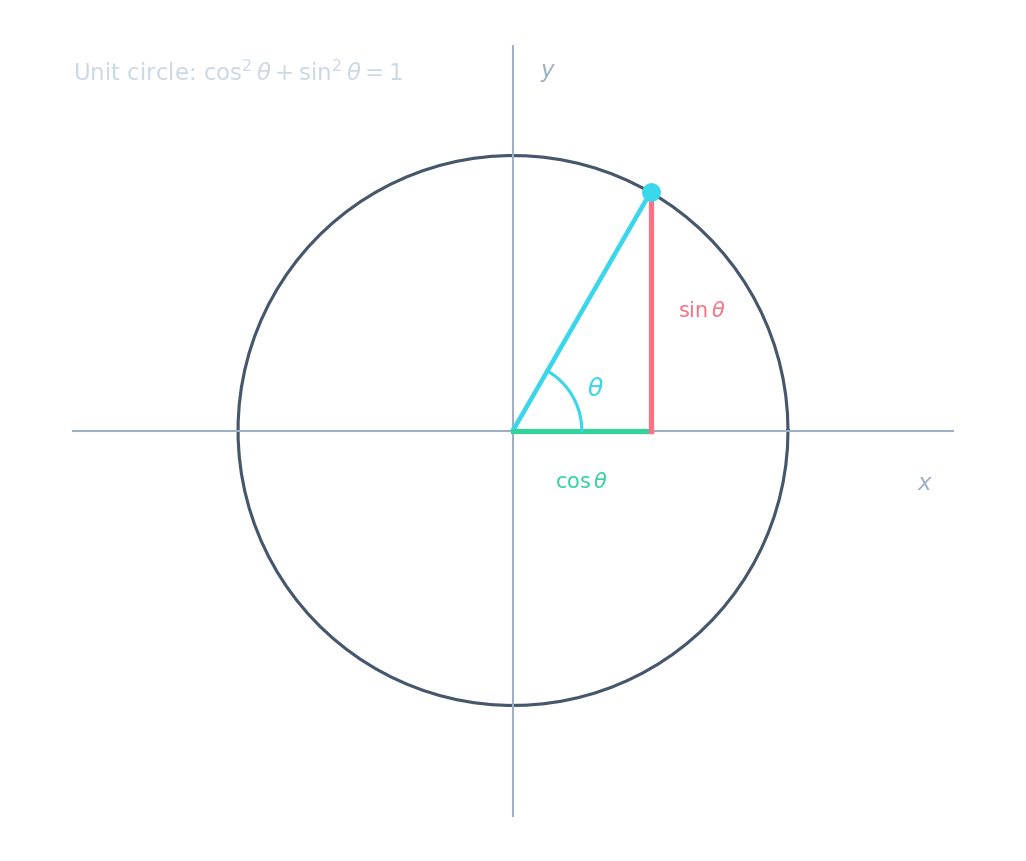
El círculo unitario: $\cos\theta$ es la coordenada $x$, $\sin\theta$ es la coordenada $y$. Dado que $x^2 + y^2 = 1$, obtenemos $\cos^2\theta + \sin^2\theta \equiv 1$.
The unit circle · Círculo unitario
(cos θ, sin θ)
Spin the angle θ around the circle: the horizontal leg is cos θ and the vertical leg is sin θ. · Gira el ángulo θ alrededor del círculo: el cateto horizontal es cos θ y el cateto vertical es sin θ.
Exact values
- Learn these without a calculator:
| $\theta$ | $0^\circ$ | $30^\circ$ | $45^\circ$ | $60^\circ$ | $90^\circ$ |
|---|---|---|---|---|---|
| $\sin$ | $0$ | $\tfrac12$ | $\tfrac{1}{\sqrt2}$ | $\tfrac{\sqrt3}{2}$ | $1$ |
| $\cos$ | $1$ | $\tfrac{\sqrt3}{2}$ | $\tfrac{1}{\sqrt2}$ | $\tfrac12$ | $0$ |
| $\tan$ | $0$ | $\tfrac{1}{\sqrt3}$ | $1$ | $\sqrt3$ | undefined |
Memory trick. The sine values follow the pattern $\dfrac{\sqrt{0}}{2}, \dfrac{\sqrt{1}}{2}, \dfrac{\sqrt{2}}{2}, \dfrac{\sqrt{3}}{2}, \dfrac{\sqrt{4}}{2}$ for $0°, 30°, 45°, 60°, 90°$. Cosine is the reverse.
A Ferris wheel: a point on the rim moves up and down like a sine curve
Valores exactos
- Apréndelos sin calculadora:
| $\theta$ | $0^\circ$ | $30^\circ$ | $45^\circ$ | $60^\circ$ | $90^\circ$ |
|---|---|---|---|---|---|
| $\sin$ | $0$ | $\tfrac12$ | $\tfrac{1}{\sqrt2}$ | $\tfrac{\sqrt3}{2}$ | $1$ |
| $\cos$ | $1$ | $\tfrac{\sqrt3}{2}$ | $\tfrac{1}{\sqrt2}$ | $\tfrac12$ | $0$ |
| $\tan$ | $0$ | $\tfrac{1}{\sqrt3}$ | $1$ | $\sqrt3$ | indefinido |
Truco mnemotécnico. Los valores del seno siguen el patrón $\dfrac{\sqrt{0}}{2}, \dfrac{\sqrt{1}}{2}, \dfrac{\sqrt{2}}{2}, \dfrac{\sqrt{3}}{2}, \dfrac{\sqrt{4}}{2}$ para $0°, 30°, 45°, 60°, 90°$. El coseno es el inverso.

Una noria: un punto en el borde se mueve hacia arriba y hacia abajo como una curva del seno
Sine & cosine graphs · Gráficas de seno y coseno
Drag the amplitude, period and shifts of y = a·sin(bx + c) + d and watch the curve change against the base wave. · Arrastra la amplitud, el periodo y los desplazamientos de y = a·sin(bx + c) + d y observa cómo cambia la curva respecto a la onda base.
What is the exact value of sin 30°? · ¿Cuál es el valor exacto de sin 30°?
sin 30° = 1/2 = 0.5.
What is the value of tan 45°? · ¿Cuál es el valor de tan 45°?
tan 45° = 1.
What is the exact value of cos 60°? · ¿Cuál es el valor exacto de cos 60°?
cos 60° = 1/2 = 0.5.
Key identities 恒等式
- The two fundamental identities: $\tan\theta \equiv \dfrac{\sin\theta}{\cos\theta}$ and $\sin^2\theta + \cos^2\theta \equiv 1$.
- These let you convert between functions and simplify expressions.
$\sin^2\theta + \cos^2\theta \equiv 1$, not $(\sin\theta + \cos\theta)^2 = 1$. The identity is about the sum of the squares, not the square of the sum. This is a common exam mistake.
sin and cos wave between -1 and 1; tan breaks at 90 and 270 degrees
Identidades clave
- Las dos identidades fundamentales: $\tan\theta \equiv \dfrac{\sin\theta}{\cos\theta}$ y $\sin^2\theta + \cos^2\theta \equiv 1$.
- Estas te permiten convertir entre funciones y simplificar expresiones.
$\sin^2\theta + \cos^2\theta \equiv 1$, no $(\sin\theta + \cos\theta)^2 = 1$. La identidad trata sobre la suma de los cuadrados, no el cuadrado de la suma. Este es un error común en exámenes.

Ondas de sin y cos entre -1 y 1; tan se interrumpe en 90 y 270 grados
For any angle θ, what does sin²θ + cos²θ equal? · Para cualquier ángulo θ, ¿a qué equivale sin²θ + cos²θ?
This is the identity sin²θ + cos²θ ≡ 1. · Esta es la identidad sin²θ + cos²θ ≡ 1.
Which identity is correct? · ¿Qué identidad es correcta?
tan θ ≡ sin θ / cos θ; and sin²θ + cos²θ ≡ 1. · tan θ ≡ sin θ / cos θ; y sin²θ + cos²θ ≡ 1.
Solving trig equations
- To solve a trig equation: reduce it to one function (often a quadratic in $\sin$ or $\cos$), then find every solution in the given interval.
- Use the graph's symmetry: if $\sin\theta = k$ has solution $\theta = \alpha$, then $\theta = 180^\circ - \alpha$ is also a solution.
- Solve trigonometrical equations; use the inverse functions $\sin^{-1},\cos^{-1},\tan^{-1}$ (inverse trigonometric relations), which give principal values.
Resolución de ecuaciones trigonométricas
- Para resolver una ecuación trigonométrica: redúcela a una sola función (a menudo una cuadrática en $\sin$ o $\cos$), luego encuentra todas las soluciones en el intervalo dado.
- Usa la simetría de la gráfica: si $\sin\theta = k$ tiene solución $\theta = \alpha$, entonces $\theta = 180^\circ - \alpha$ también es una solución.
- Resuelve ecuaciones trigonométricas; usa las funciones inversas $\sin^{-1},\cos^{-1},\tan^{-1}$ (relaciones trigonométricas inversas), que proporcionan valores principales.
If sin θ = 0.5 and 0° ≤ θ ≤ 360°, then θ = 30° is the only solution. · Si sin θ = 0.5 y 0° ≤ θ ≤ 360°, entonces θ = 30° es la única solución.
sin θ = 0.5 also has solution θ = 180° − 30° = 150° in the given range. · sin θ = 0.5 también tiene como solución θ = 180° − 30° = 150° en el rango dado.
You've got it
- $\sin, \cos$ stay in $[-1, 1]$, repeat every $360^\circ$; know the $30/45/60$ exact values
- identities: $\tan\theta \equiv \dfrac{\sin\theta}{\cos\theta}$, $\sin^2\theta + \cos^2\theta \equiv 1$
- solve by reducing to one trig function, then finding all solutions in the interval
Lo has logrado
- $\sin, \cos$ permanecen en $[-1, 1]$, se repiten cada $360^\circ$; conoce los valores exactos de $30/45/60$
- identidades: $\tan\theta \equiv \dfrac{\sin\theta}{\cos\theta}$, $\sin^2\theta + \cos^2\theta \equiv 1$
- resuelve reduciendo a una sola función trigonométrica, luego encontrando todas las soluciones en el intervalo