Circular measure · Medida circular
| English | Español |
|---|---|
| radians/ˈreɪdɪənz/ | radianes |
| arc length/ɑːk leŋθ/ | longitud de arco |
| sector area/ˈsektə ˈeərɪə/ | área del sector |
| segment/ˈseɡmənt/ | segmento |
Why radians 弧度?
- Engineers measure angles in degrees. Mathematicians prefer radians — and for good reason.
- A radian is the natural unit: it's the angle that cuts off an arc equal to the radius.
- With radians, the formulas for arc length 弧长 and sector area 扇形面积 become beautifully simple.
¿Por qué radianes 弧度?
- Los ingenieros miden ángulos en grados. Los matemáticos prefieren los radianes — y por una buena razón.
- Un radián es la unidad natural: es el ángulo que recorta un arco igual al radio.
- Con radianes, las fórmulas para longitud de arco 弧长 y área de sector 扇形面积 se vuelven bellamente simples.
What is a radian?
- A radian is the angle that cuts off an arc equal to the radius.
- The link: $\pi \text{ radians} = 180^\circ$.
- degrees → radians: multiply by $\dfrac{\pi}{180}$; radians → degrees: multiply by $\dfrac{180}{\pi}$.
Common conversions. $90^\circ = \dfrac{\pi}{2}$ rad; $\;60^\circ = \dfrac{\pi}{3}$ rad; $\;45^\circ = \dfrac{\pi}{4}$ rad; $\;30^\circ = \dfrac{\pi}{6}$ rad.
¿Qué es un radián?
- Un radián es el ángulo que recorta un arco igual al radio.
- La relación: $\pi \text{ radians} = 180^\circ$.
- grados → radianes: multiplicar por $\dfrac{\pi}{180}$; radianes → grados: multiplicar por $\dfrac{180}{\pi}$.
Conversiones comunes. $90^\circ = \dfrac{\pi}{2}$ rad; $\;60^\circ = \dfrac{\pi}{3}$ rad; $\;45^\circ = \dfrac{\pi}{4}$ rad; $\;30^\circ = \dfrac{\pi}{6}$ rad.
π radians equals how many degrees? · π radianes equivalen a cuántos grados?
By definition, π radians = 180°. · Por definición, π radianes = 180°.
60° in radians is: · 60° en radianes es:
60° × π/180 = 60π/180 = π/3.
Arc length and sector area
- For a sector with radius $r$ and angle $\theta$ in radians:
- arc length $s = r\theta$,
- sector area $A = \tfrac12 r^2 \theta$.
The elegance of radians: arc length $= r\theta$ and sector area $= \tfrac{1}{2}r^2\theta$. No messy $\dfrac{\theta}{360}$ fractions needed.
Radians only. The formulas $s = r\theta$ and $A = \tfrac{1}{2}r^2\theta$ work only when $\theta$ is in radians. If your angle is in degrees, convert first.
Longitud de arco y área del sector
- Para un sector con radio $r$ y ángulo $\theta$ en radianes:
- longitud de arco $s = r\theta$,
- área del sector $A = \tfrac12 r^2 \theta$.
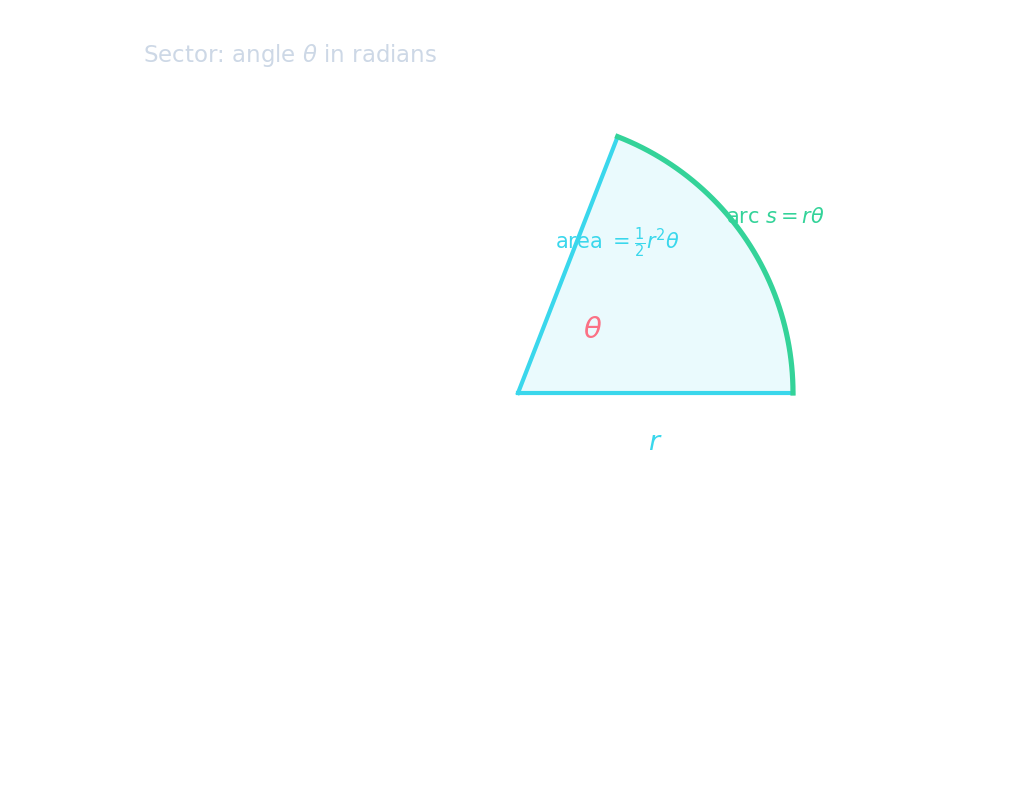
La elegancia de los radianes: longitud de arco $= r\theta$ y área del sector $= \tfrac{1}{2}r^2\theta$. No se necesitan fracciones complicadas como $\dfrac{\theta}{360}$.
Solo radianes. Las fórmulas $s = r\theta$ y $A = \tfrac{1}{2}r^2\theta$ funcionan solo cuando $\theta$ está en radianes. Si tu ángulo está en grados, conviértelo primero.
The sector · El sector
s = rθ · A = ½r²θ
Drag the angle · ángulo θ (in radians) and the radius · radio r — the arc length and · y sector area follow. · Arrastra el ángulo θ (en radianes) y el radio r — la longitud de arco y el área del sector se actualizan.
A sector has radius 5 and angle 2 radians. What is the arc length (s = rθ)? · Un sector tiene radio 5 y ángulo 2 radianes. ¿Cuál es la longitud de arco (s = rθ)?
s = rθ = 5 × 2 = 10.
A sector has radius 4 and angle 0.5 radians. What is its area (A = ½r²θ)? · Un sector tiene radio 4 y ángulo 0.5 radianes. ¿Cuál es su área (A = ½r²θ)?
A = ½ × 4² × 0.5 = ½ × 16 × 0.5 = 4.
The formula s = rθ works when θ is measured in degrees. · La fórmula s = rθ funciona cuando θ se mide en grados.
s = rθ only works when θ is in radians. Convert degrees to radians first. · s = rθ solo funciona cuando θ está en radianes. Convierte los grados a radianes primero.
Segment 弓形 area
- A segment is the region between a chord and the arc.
- Segment area = sector − triangle = $\tfrac12 r^2(\theta - \sin\theta)$.
- The triangle area is $\tfrac{1}{2}r^2\sin\theta$ (using the sine rule for area).
A tangent meets the circle once and is perpendicular to the radius there
Área del segmento 弓形
- Un segmento es la región entre una cuerda y el arco.
- Área del segmento = sector − triángulo = $\tfrac12 r^2(\theta - \sin\theta)$.
- El área del triángulo es $\tfrac{1}{2}r^2\sin\theta$ (usando la regla del seno para el área).

Una tangente toca el círculo una sola vez y es perpendicular al radio en ese punto
A segment has r = 6 and θ = π/3 radians. The segment area is ½r²(θ − sin θ). Find it (2 dp). · Un segmento tiene r = 6 y θ = π/3 radianes. El área del segmento es ½r²(θ − sin θ). Encuentra el valor (2 decimales).
½ × 36 × (π/3 − sin(π/3)) = 18 × (1.0472 − 0.8660) = 18 × 0.1812 = 3.26.
Worked example
- Sector: $r = 5$, $\theta = 2$ rad.
- Arc length $= 5 \times 2 = 10$.
- Sector area $= \tfrac{1}{2}(5^2)(2) = 25$.
- Segment area $= \tfrac{1}{2}(25)(2 - \sin 2) = 12.5(2 - 0.909) = 13.6$.
Ejemplo resuelto
- Sector: $r = 5$, $\theta = 2$ rad.
- Longitud de arco $= 5 \times 2 = 10$.
- Área del sector $= \tfrac{1}{2}(5^2)(2) = 25$.
- Área del segmento $= \tfrac{1}{2}(25)(2 - \sin 2) = 12.5(2 - 0.909) = 13.6$.
You've got it
- $\pi$ radians $= 180^\circ$; convert by $\times\dfrac{\pi}{180}$ or $\times\dfrac{180}{\pi}$
- arc length $s = r\theta$; sector area $A = \tfrac12 r^2\theta$ ($\theta$ in radians)
- segment $= \tfrac12 r^2(\theta - \sin\theta)$
Lo has entendido
- $\pi$ radianes $= 180^\circ$; convierte mediante $\times\dfrac{\pi}{180}$ o $\times\dfrac{180}{\pi}$
- longitud de arco $s = r\theta$; área del sector $A = \tfrac12 r^2\theta$ ($\theta$ en radianes)
- segmento $= \tfrac12 r^2(\theta - \sin\theta)$