The circular flow and the multiplier · El flujo circular y el multiplicador
| English | Español |
|---|---|
| injection/ɪnˈdʒekʃn/ | inyección |
| multiplier/ˌmʌltɪˈplaɪə/ | multiplicador |
| national income/ˈnæʃənl ˈɪŋkʌm/ | renta nacional |
| withdrawals/wɪθˈdrɔːlz/ | retiros |
| marginal propensity to consume/ˈmɑːdʒɪnl prəˈpensɪti tə kənˈsjuːm/ | propensión marginal al consumo |
How one dollar becomes many
- Spend a dollar at a shop; the shopkeeper spends part of it; the next person spends part of that. One injection 注入 ripples through the economy.
- This multiplier 乘数 effect means a change in spending raises national income 国民收入 by more than the original amount.
Cómo un dólar se convierte en muchos
- Gasta un dólar en una tienda; el comerciante gasta parte de ese dinero; la siguiente persona gasta parte de esa cantidad. Una inyección 注入 ripples through the economy.
- Este efecto multiplier 乘数 significa que un cambio en el gasto eleva la renta nacional 国民收入 en una cantidad mayor que la original.
The circular flow, revisited
- Income circulates between households and firms, with injections (I, G, X) adding in and withdrawals 漏出 (S, T, M) leaking out.
Injections (investment, government spending, exports) feed the loop; withdrawals (saving, taxes, imports) drain it.
Income circulates between households and firms, with injections and leakages
El flujo circular, revisado
- La renta circula entre los hogares y las empresas, con las inyecciones (I, G, X) que entran y las fugas 漏出 (A, T, M) que salen.

Las inyecciones (inversión, gasto público, exportaciones) alimentan el ciclo; las fugas (ahorro, impuestos, importaciones) lo drenan.

La renta circula entre hogares y empresas, con inyecciones y fugas
The circular flow and the multiplier · El flujo circular y el multiplicador
Income circles between households and firms. An injection (e.g. investment) is re-spent again and again — the multiplier effect. · Círculos de ingresos entre hogares y empresas. Una inyección (p. ej., inversión) se vuelve a gastar repetidamente: el efecto multiplicador.
Which is an injection into the circular flow? · ¿Cuál es una inyección en el flujo circular?
Injections are I, G, X; saving, taxes and imports are withdrawals. · Las inyecciones son I, G, X; el ahorro, los impuestos y las importaciones son fugas.
The multiplier
- Each round of re-spending depends on the marginal propensity to consume 边际消费倾向 (MPC):
Worked example. If MPC = 0.75, the multiplier $= \dfrac{1}{1 - 0.75} = \dfrac{1}{0.25} = 4$ — so £1bn of extra spending raises national income by £4bn.
One injection multiplies into a larger rise in income
El multiplicador
- Cada ronda de re-gasto depende de la propensión marginal al consumo 边际消费倾向 (MPC):
Ejemplo resuelto. Si MPC = 0,75, el multiplicador $= \dfrac{1}{1 - 0.75} = \dfrac{1}{0.25} = 4$ — por lo tanto, £1 mil millones de gasto adicional elevan la renta nacional en £4 mil millones.
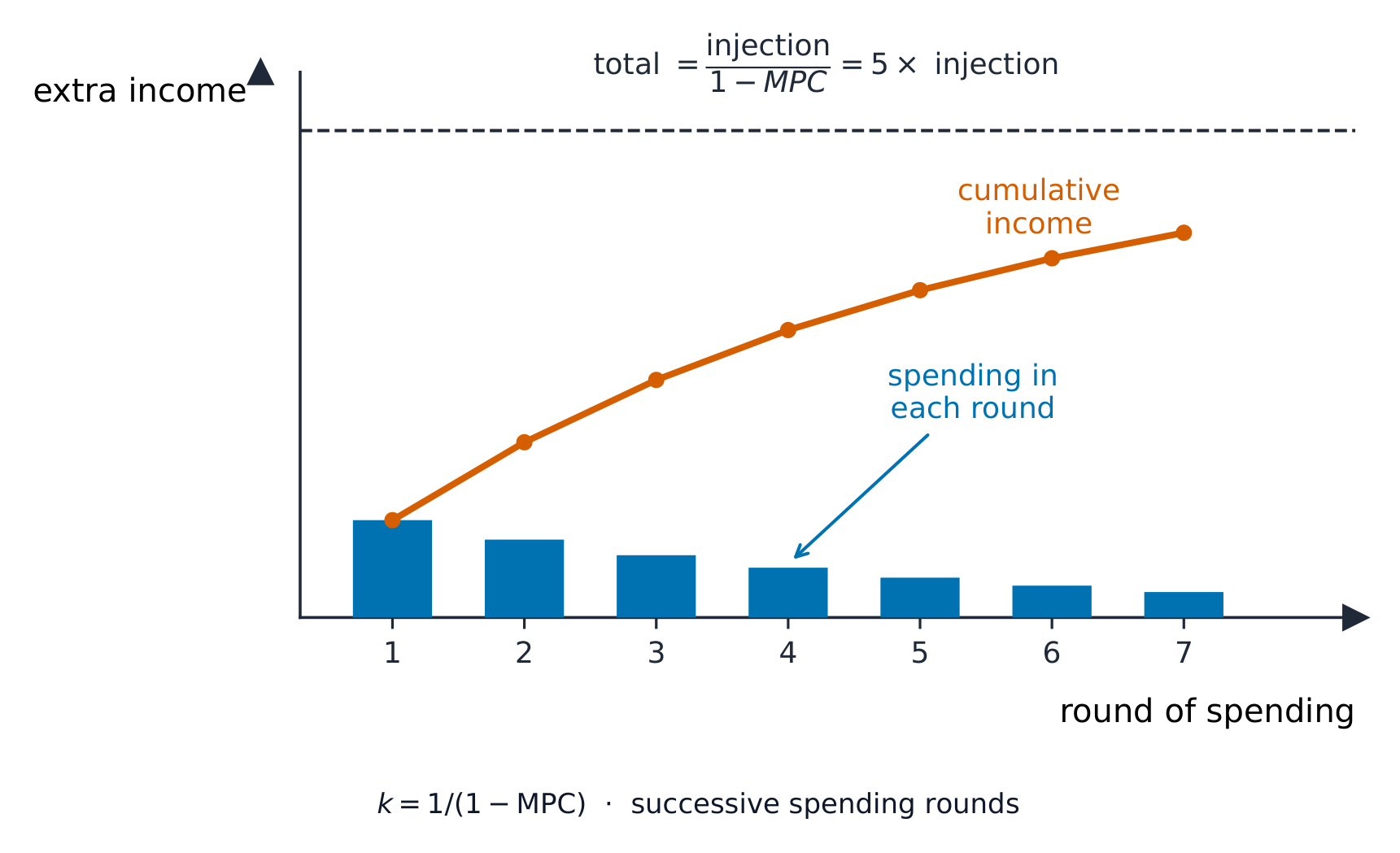
Una inyección se multiplica en un aumento mayor de la renta
The multiplier, round by round · El multiplicador, ronda por ronda
Drag the injection and the MPC, then press Play — each spending round is MPC times the last, and the total settles at k × the injection. Bigger leaks, smaller ripple. · Arrastra la inyección y la MPC, luego presiona Reproducir: cada ronda de gasto es MPC veces la anterior, y el total se estabiliza en k × la inyección. Fugas mayores, menor impacto.
If the marginal propensity to consume is 0.75, what is the multiplier = 1/(1 − MPC)? · Si la propensión marginal al consumo es 0,75, ¿cuál es el multiplicador = 1/(1 − MPC)?
1 / (1 − 0.75) = 1 / 0.25 = 4. · 1 / (1 − 0,75) = 1 / 0,25 = 4.
With a multiplier of 4, by how much does national income rise if spending increases by 2 billion? · Con un multiplicador de 4, ¿en cuánto aumenta el ingreso nacional si el gasto aumenta en 2 mil millones?
4 × 2 billion = 8 billion. · 4 × 2 mil millones = 8 mil millones.
The multiplier equals 1 / (1 − ______). · El multiplicador iguala a 1 / (1 − ______).
Multiplier = 1/(1 − MPC). · Multiplicador = 1/(1 − MPC).
What weakens the multiplier
- The bigger the withdrawals (high saving, taxes, or import spending), the smaller the multiplier — more leaks out each round.
Actual output around its potential, showing output gaps
Lo que debilita el multiplicador
- Cuanto mayores sean las fugas (alto ahorro, impuestos o gasto en importaciones), menor será el multiplicador — más dinero se escapa en cada ronda.

Producción real alrededor de su potencial, mostrando brechas de producción
A higher rate of saving or imports reduces the size of the multiplier. · Una tasa mayor de ahorro o importaciones reduce el tamaño del multiplicador.
More leaks out of the flow each round, so re-spending — and the multiplier — is smaller. · Más fugas fuera del flujo en cada ronda, por lo que el re-gasto —y el multiplicador— son menores.
You've got it
- an injection ripples through re-spending — the multiplier effect
- multiplier $= \dfrac{1}{1 - MPC}$ (MPC 0.75 → multiplier 4)
- bigger withdrawals (saving, tax, imports) → smaller multiplier
Ya lo dominas
- una inyección genera ondas a través de la re-gastabilidad: el efecto multiplicador
- multiplicador $= \dfrac{1}{1 - MPC}$ (MPC 0,75 → multiplicador 4)
- mayores fugas (ahorro, impuestos, importaciones) → multiplicador menor