Revenue and profit · Ingresos y beneficios
| English | Español |
|---|---|
| profit/ˈprɒfɪt/ | ganancia |
| marginal revenue/ˈmɑːdʒɪnl ˈrevənjuː/ | ingreso marginal |
| total revenue/ˈtəʊtl ˈrevənjuː/ | ingreso total |
| average revenue/ˈævrɪdʒ ˈrevənjuː/ | ingreso medio |
| normal profit/ˈnɔːml ˈprɒfɪt/ | beneficio normal |
| supernormal profit/ˈsuːpənɔːml ˈprɒfɪt/ | beneficios extraordinarios |
| profit-maximising/ˈprɒfɪt ˈmæksɪmaɪzɪŋ/ | maximización de beneficios |
Revenue isn't profit 利润
- A firm selling a million units can still go bust. What matters isn't how much money comes in, but how much is left after costs.
- Understanding revenue, then subtracting cost, gives profit — and the rule for maximising it.
Los ingresos no son beneficios
- Una empresa que vende un millón de unidades puede quebrar. Lo que importa no es cuánto dinero entra, sino cuánto queda después de los costes.
- Entender los ingresos, restar luego el coste, nos da la beneficio — y la regla para maximizarlo.
A firm sells 30 units at a price of 5. What is total revenue (TR = P x Q)? · Una empresa vende 30 unidades a un precio de 5. ¿Cuál es el ingreso total (TR = P x Q)?
TR = 5 x 30 = 150.
Average revenue (TR divided by quantity) is the same as the ______. · El ingreso promedio (TR dividido por la cantidad) es lo mismo que el ______.
AR = TR/Q = P.
Total, average and marginal revenue 边际收益
- Total revenue 总收益 (TR) = price × quantity.
- Average revenue 平均收益 (AR) = TR ÷ Q = the price.
- Marginal revenue (MR) = the revenue from one more unit.
For a price-maker, AR is the demand curve and MR lies below it; for a price-taker both are horizontal.
Worked example. Sell 30 units at a price of 5. TR = 5 × 30 = 150. If total cost is 100, profit = 150 − 100 = 50.
Ingresos totales, medios y marginales
- Ingreso total (IT) = precio × cantidad.
- Ingreso medio (IM) = IT ÷ Q = el precio.
- Ingreso marginal (Im) = el ingreso obtenido por vender una unidad adicional.
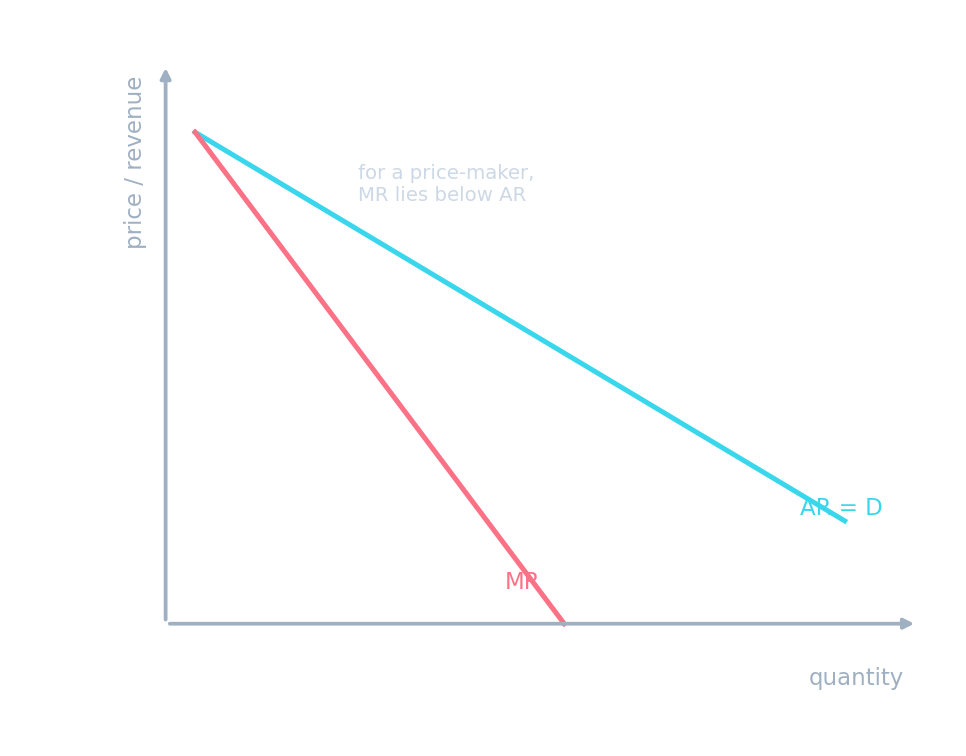
Para un fijador de precios, la IM es la curva de demanda y la Im se sitúa por debajo; para un tomador de precios ambas son horizontales.
Ejemplo resuelto. Vende 30 unidades a un precio de 5. IT = 5 × 30 = 150. Si el coste total es 100, el beneficio = 150 − 100 = 50.
Revenue & profit · Ingresos y beneficios
y = ax² + bx + c
Total revenue · Ingreso total rises then falls as price changes. · El ingreso total aumenta luego disminuye a medida que cambia el precio.
Total revenue is 150 and total cost is 100. What is the profit? · El ingreso total es 150 y el costo total es 100. ¿Cuál es el beneficio?
Profit = TR - TC = 150 - 100 = 50. · Beneficio = TR - TC = 150 - 100 = 50.
Normal profit is the minimum needed to keep a firm in the industry. · El beneficio normal es el mínimo necesario para mantener a una empresa en la industria.
It covers opportunity cost; anything above is supernormal profit. · Cubre el costo de oportunidad; cualquier exceso es beneficio supernormal.
Profit and its types
- Profit = total revenue − total cost.
- Normal profit 正常利润: just enough to keep the firm in the industry (covers opportunity cost).
- Supernormal (abnormal) profit: anything above normal.
A monopoly maximises profit at MC = MR and earns supernormal profit 超常利润
Beneficio y sus tipos
- Beneficio = ingreso total − coste total.
- Beneficio normal: justo lo suficiente para mantener a la empresa en la industria (cubre el coste de oportunidad).
- Beneficio extraordinario (anormal): cualquier cantidad por encima del beneficio normal.
Un monopolio maximiza el beneficio en MC = MR y obtiene beneficio extraordinario
A firm maximises profit where: · Una empresa maximiza sus beneficios cuando:
MR = MC: before it each unit adds net profit, beyond it each unit loses money. · MR = MC: antes de este punto, cada unidad añade beneficio neto; después de este punto, cada unidad genera pérdidas.
The profit-maximising 利润最大化 rule
- A firm maximises profit where marginal revenue = marginal cost (MR = MC).
- Before that point, an extra unit adds more revenue than cost (make it); beyond it, the reverse.
La regla de maximización de beneficios
- Una empresa maximiza su beneficio donde ingreso marginal = coste marginal (Im = Cm).
- Antes de ese punto, una unidad adicional genera más ingreso que coste (producela); más allá de él, ocurre lo contrario.
You've got it
- TR = P × Q; AR = price; MR = revenue from one more unit
- profit = TR − TC; normal profit keeps the firm in; supernormal is extra
- maximise profit where MR = MC
Ya lo has entendido
- IT = P × Q; IM = precio; Im = ingreso de una unidad adicional
- beneficio = IT − CT; el beneficio normal mantiene a la empresa activa; el extraordinario es el excedente
- maximiza el beneficio donde Im = Cm