Programación declarativa: hechos, reglas y objetivos
Introducido| English | Significado |
|---|---|
| fact/fækt/ | hecho |
| declarative programming/dɪˈklærətɪv ˈprəʊɡræmɪŋ/ | programación declarativa |
| rule/ruːl/ | regla |
| goal/ɡəʊl/ | objetivo |
| backtrack/ˈbæktræk/ | retroceso |
| unification/ˌjuːnɪfɪˈkeɪʃn/ | unificación |
Ask who can borrow a camera
- A media club keeps facts about its members and completed training. It wants to ask who can borrow a camera without writing a new loop for every question.
- Declarative programming 声明式编程 describes facts, rules and a goal 目标. A logic engine searches for values that make the goal true. The programmer still has to write correct rules; the engine does not read minds or club noticeboards.
Facts state what is known
- A fact 事实 is an assertion in the knowledge base. In
member(aya)., the predicatememberrelates one person to club membership.trained(aya, camera).relates a person to a piece of equipment. - This lesson uses Prolog-style notation: lowercase names are constants or predicates; uppercase names are variables. A full stop ends each fact or rule.
member(aya).
member(ben).
member(chen).
trained(aya, camera).
trained(chen, camera).
trained(ben, audio).
Dadas las premisas member(ben). y trained(ben, audio)., ¿cuál de las siguientes afirmaciones es una premisa proporcionada?
Dificultad 1/5 · 100 monedas + un pequeño bono en el primer intento de hoy
member(ben). se da directamente. La base de conocimientos no incluye entrenamiento en cámaras para Ben, y can_borrow es un objetivo que una regla debe demostrar.
A rule combines conditions
- A rule 规则 states when a conclusion holds. Read
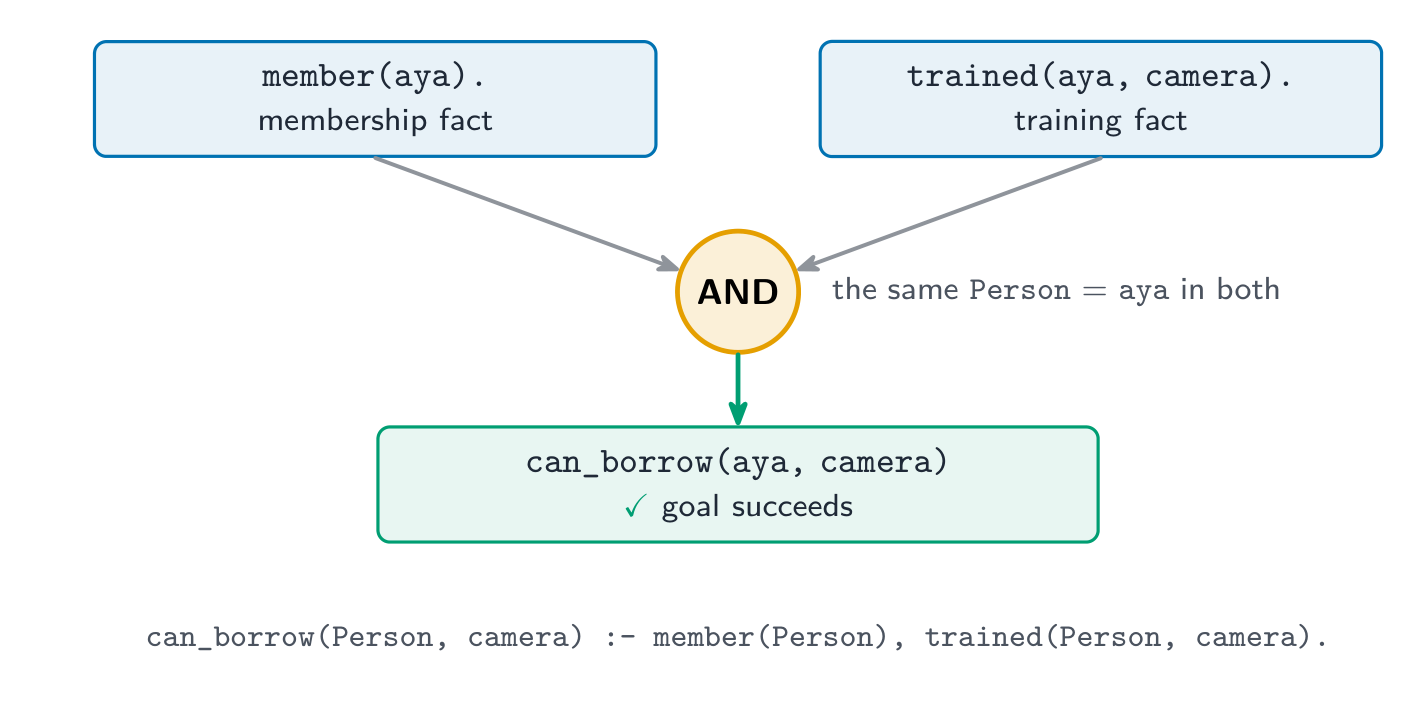
:-as “if” and the comma as AND: a person may borrow a camera if they are a member and have camera training. Personnames the same variable in all three places. The engine must find one value that satisfies both conditions, not one member and a different trained person.
can_borrow(Person, camera) :- member(Person), trained(Person, camera).
En la regla can_borrow(Person, camera) :- member(Person), trained(Person, camera)., la coma entre las dos condiciones significa ____.
Dificultad 1/5 · 100 monedas + un pequeño bono en el primer intento de hoy
Tanto la membresía como el entrenamiento en cámara deben cumplirse para la misma Persona.
A goal asks a question
- The goal
?- can_borrow(aya, camera).asks for a yes/no result. The engine matches the rule and checksmember(aya)andtrained(aya, camera): both facts exist, so the goal succeeds. - The goal
?- can_borrow(Person, camera).asks for bindings of the variable. With this knowledge base, the answers arePerson = ayaandPerson = chen. These are goals to reason about; the displayed blocks are notation, not a runnable playground.
Los miembros del club son Aya, Ben y Chen. Aya y Chen están capacitados en cámaras; Ben está capacitado solo en audio. La regla can_borrow(Person, camera) requiere tanto membresía como capacitación en cámaras. ¿Quién satisface can_borrow(Person, camera)?
Dificultad 2/5 · 140 monedas + un pequeño bono en el primer intento de hoy
Aya y Chen tienen ambos los hechos requeridos. Ben solo tiene capacitación en audio.
La variable Person en member(Person) puede tener un valor diferente al de Person en trained(Person, camera) durante una demostración.
Dificultad 1/5 · 100 monedas + un pequeño bono en el primer intento de hoy
Todas las ocurrencias de la misma variable deben mantener el mismo enlace en dicha demostración.
Worked example: trace a failed candidate
- Start with
Person = ben.member(ben)succeeds.trained(ben, camera)fails: the available training fact is for audio, which does not match camera. - The engine backtracks 回溯 to try another candidate,
Person = chen. Both conditions succeed. If more answers are requested, it continues searching; if no candidates remain, there are no more answers.
One binding must satisfy both conditions
Trace a fixed two-condition rule through supplied facts. A failed candidate can lead to another binding; a missing fact leaves a goal unproved.
Rastree la búsqueda restante después de que Aya ya haya sido devuelta.
Dificultad 3/5 · 200 monedas + un pequeño bono en el primer intento de hoy
Ben es miembro pero carece de un hecho coincidente de capacitación en cámara; luego el motor intenta con Chen.
Matching shares values across a rule
- Unification 合一 matches terms while consistently binding variables. Matching
trained(Person, camera)withtrained(chen, camera)bindsPersontochen; matching it withtrained(ben, audio)fails because the equipment differs. - A failed goal means it cannot be proved from these facts and rules. It does not prove that Ben has never used a camera in real life; the knowledge base may simply be incomplete.
Emparejar trained(Person, camera) con trained(chen, camera) asigna Person a ____.
Dificultad 1/5 · 100 monedas + un pequeño bono en el primer intento de hoy
El equipo coincide y el primer argumento proporciona el enlace chen.
Worked example: write a new rule
- Requirement: a mentor can help someone only when the mentor has camera training and the learner is a member. Add the rule below, then ask
?- can_help(aya, ben).. trained(aya, camera)andmember(ben)both exist, so the goal succeeds. This rule allows Aya to help herself too. If self-help must be excluded, the requirement needs another condition; do not invent it silently.
can_help(Mentor, Learner) :- trained(Mentor, camera), member(Learner).
Dadas trained(aya, camera). y member(ben)., y la regla can_help(Mentor, Learner) :- trained(Mentor, camera), member(Learner)., ¿tiene éxito can_help(aya, ben)?
Dificultad 1/5 · 100 monedas + un pequeño bono en el primer intento de hoy
Aya tiene capacitación en cámara y Ben es miembro; Ben no necesita tener capacitación en cámara para ser un aprendiz.
Marks that slip away
- A fact states something known; a rule derives a conclusion when its conditions hold; a goal asks whether a conclusion can be proved or which values make it true.
- Keep repeated variables consistent.
member(X), trained(Y, camera)would let an untrained member qualify because someone else has training. Changing a variable name can change the rule's meaning.
From a requirement to a proof
- Write facts, translate each requirement into a rule, and pose a goal. Trace each variable binding through every condition and try alternatives when a candidate fails.
- Here only Aya and Chen may borrow a camera. Ben's audio training is not camera training. Results follow from the supplied knowledge base, not a guess about real people.
El club añade la premisa trained(ben, camera). a la base de conocimientos. Ahora, ¿cuántas personas satisfacen can_borrow(Person, camera)?
Dificultad 2/5 · 140 monedas + un pequeño bono en el primer intento de hoy
Ben ya era miembro y ahora tiene capacitación en cámaras, por lo que el objetivo tiene tres soluciones: Aya, Ben y Chen. La regla no cambió; un nuevo dato alteró las respuestas.
Un objetivo fallido demuestra que el evento correspondiente nunca ocurrió fuera de esta base de conocimiento.
Dificultad 1/5 · 100 monedas + un pequeño bono en el primer intento de hoy
El fracaso significa que el objetivo no puede demostrarse a partir de los hechos y reglas disponibles.