Physical properties from structure
Introducido| English | Significado |
|---|---|
| conductivity/kɒndəkˈtɪvɪti/ | conductividad |
| solubility/ˌsɒljuːˈbɪlɪti/ | solubilidad |
| molten/ˈməʊltn/ | azul |
| soluble/ˈsɒljuːbl/ | soluble |
| insoluble/ɪnˈsɒljuːbl/ | insoluble |
Structure decides everything
- CO₂ and SiO₂ have similar formulas. One is a gas you breathe out; the other is sand, which melts at about 1700 °C. The difference is structure, not formula.
- The structure decides melting point, conductivity 电导率 and solubility 溶解度. You can also work backwards from properties to identify an unknown.
Structure-property lab
Link a material property to the structure that causes it.
Simple molecular substances have low melting points because their covalent bonds are weak.
Dificultad 1/5 · 100 monedas + un pequeño bono en el primer intento de hoy
False. The covalent bonds inside the molecules are strong. Melting only overcomes the weak forces between molecules, which is why the melting point is low.
Melting and boiling points
- High when strong forces must be broken: ionic bonds, covalent bonds in a giant lattice, or metallic bonds.
- Low when only weak intermolecular forces must be overcome (simple molecular). Melting CO₂ breaks no covalent bonds; melting SiO₂ breaks many.

A substance has a high melting point when:
Dificultad 1/5 · 100 monedas + un pequeño bono en el primer intento de hoy
Breaking strong bonds needs lots of energy, giving a high melting/boiling point; weak forces give a low one.
Match each structure to its properties.
Dificultad 2/5 · 140 monedas + un pequeño bono en el primer intento de hoy
Properties come from structure: strong giant lattices melt high; simple molecules melt low.
When iodine, I₂, melts, what is overcome?
Dificultad 1/5 · 100 monedas + un pequeño bono en el primer intento de hoy
Iodine is simple molecular. The I–I bonds stay intact; only intermolecular forces are overcome.
Conductivity and solubility
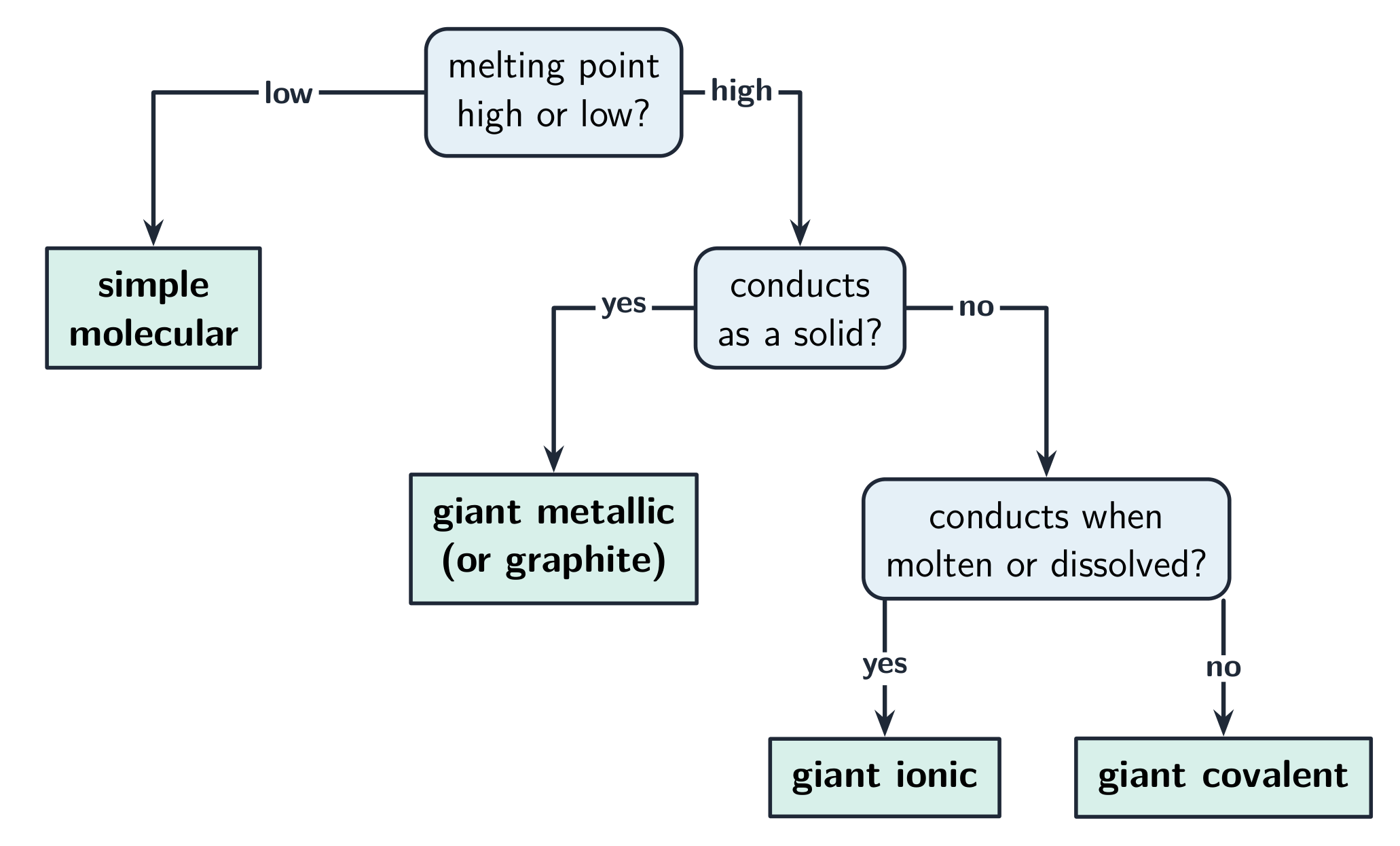
- Conductivity needs charged particles that can move. Ionic solids conduct only when molten 熔融 or dissolved (ions free to move). Metals and graphite conduct as solids (delocalised electrons).
- Solubility: ionic solids are usually soluble 可溶 in water; giant covalent solids are insoluble 不溶. Simple molecules are usually insoluble, unless they can hydrogen-bond with water (ethanol, sugar).
An ionic solid conducts electricity:
Dificultad 1/5 · 100 monedas + un pequeño bono en el primer intento de hoy
The ions are fixed in the solid lattice; only when molten or dissolved can they move and carry charge.
Graphite conducts electricity because:
Dificultad 1/5 · 100 monedas + un pequeño bono en el primer intento de hoy
Graphite has delocalised electrons between its layers, so it conducts even though it is a non-metal.
Worked example: identify four unknowns
| Substance | Melting point | Conducts? | In water | Structure |
|---|---|---|---|---|
| A | 801 °C | only molten or dissolved | soluble | giant ionic |
| B | 1610 °C | never | insoluble | giant covalent |
| C | −7 °C | never | insoluble | simple molecular |
| D | 1085 °C | as a solid and molten | insoluble | giant metallic |
- Start with the melting point: only C is low, so only C has just weak intermolecular forces to overcome.
- Then use conductivity to split the high-melting ones: A needs its ions freed, D conducts as a solid (delocalised electrons), and B never conducts.
A solid with a very high melting point that does not conduct and is insoluble is most likely:
Dificultad 1/5 · 100 monedas + un pequeño bono en el primer intento de hoy
Very high mp + no conductivity (not graphite) + insoluble points to a giant covalent network like diamond or SiO₂.
A black solid melts above 3500 °C, conducts electricity as a solid and is insoluble in water. What is its structure?
Dificultad 1/5 · 100 monedas + un pequeño bono en el primer intento de hoy
Graphite conducts as a solid, but its very high melting point comes from strong covalent bonds within the layers. A giant ionic solid would not conduct as a solid, and a simple molecular solid would melt at a low temperature.
Substance Z melts at 1414 °C, does not conduct as a solid or as a liquid, and is insoluble in water. Its structure is:
Dificultad 1/5 · 100 monedas + un pequeño bono en el primer intento de hoy
High melting point, and it never conducts: giant covalent (this is silicon).
Explain the data. Magnesium oxide melts at 2852 °C; sodium chloride at 801 °C. Both are giant ionic. Explain the difference.
- Mg²⁺ and O²⁻ carry double charges, and the ions are smaller than Na⁺ and Cl⁻.
- So the electrostatic attraction between the ions is much stronger, and more energy is needed to separate them.
Why does CaO have a higher melting point than KCl?
Dificultad 1/5 · 100 monedas + un pequeño bono en el primer intento de hoy
Ca²⁺ and O²⁻ carry twice the charge of K⁺ and Cl⁻, so the ionic attraction is much stronger.
- Melting a simple molecular substance breaks intermolecular forces, not covalent bonds. Writing "covalent bonds break" loses the mark.
- Solid ionic compounds do not conduct: the ions are fixed in the lattice. Electrons do not move through an ionic solution either; the ions do.
- Graphite is the giant covalent exception that conducts. Diamond and SiO₂ do not.
You've got it
- high mp/bp = strong forces (ionic/covalent/metallic); low = weak intermolecular (simple molecular)
- conduct: ionic only when molten/dissolved; metals + graphite always
- ionic usually soluble; molecular & giant covalent insoluble
- use mp + conductivity + solubility to identify the structure