Enthalpy change and reaction pathways · Cambio de entalpía y trayectorias de reacción
| English | Español |
|---|---|
| enthalpy change/enˈθælpi tʃeɪndʒ/ | cambio de entalpía |
| exothermic/eɡzəˈðɜːmɪk/ | exotérmica |
| endothermic/ˌendəʊˈθɜːmɪk/ | endotérmica |
| activation energy/ˌæktɪˈveɪʃn ˈenədʒi/ | energía de activación |
| standard conditions/ˈstændəd kənˈdɪʃnz/ | condiciones estándar |
| combustion/kəmˈbʌstʃn/ | combustión |
| neutralisation/ˌnjuːtrəlaɪˈzeɪʃn/ | neutralización |
Enthalpy change 焓变, ΔH
- Every reaction takes in or gives out energy.
- That energy change (at constant pressure) is the enthalpy change, $\Delta H$.
- Its sign tells you the direction of energy flow.
Cambio de entalpía 焓变, ΔH
- Toda reacción absorbe o libera energía.
- Ese cambio de energía (a presión constante) es el cambio de entalpía, $\Delta H$.
- Su signo indica la dirección del flujo de energía.
A reaction that releases heat to the surroundings has a negative value of ______. · Una reacción que libera calor al entorno tiene un valor negativo de ______.
Exothermic reactions have ΔH < 0. · Las reacciones exotérmicas tienen ΔH < 0.
Exothermic 放热 vs endothermic 吸热
- Exothermic: gives out heat → products lower than reactants → $\Delta H < 0$.
- Endothermic: takes in heat → products higher → $\Delta H > 0$.
- The "hill" between them is the activation energy 活化能 — the least energy needed to react.
Exotérmico 放热 vs endotérmico 吸热
- Exotérmico: libera calor → productos más bajos que reactivos → $\Delta H < 0$.
- Endotérmico: absorbe calor → productos más altos → $\Delta H > 0$.
- La "colina" entre ellos es la energía de activación 活化能 — la mínima energía necesaria para que ocurra la reacción.
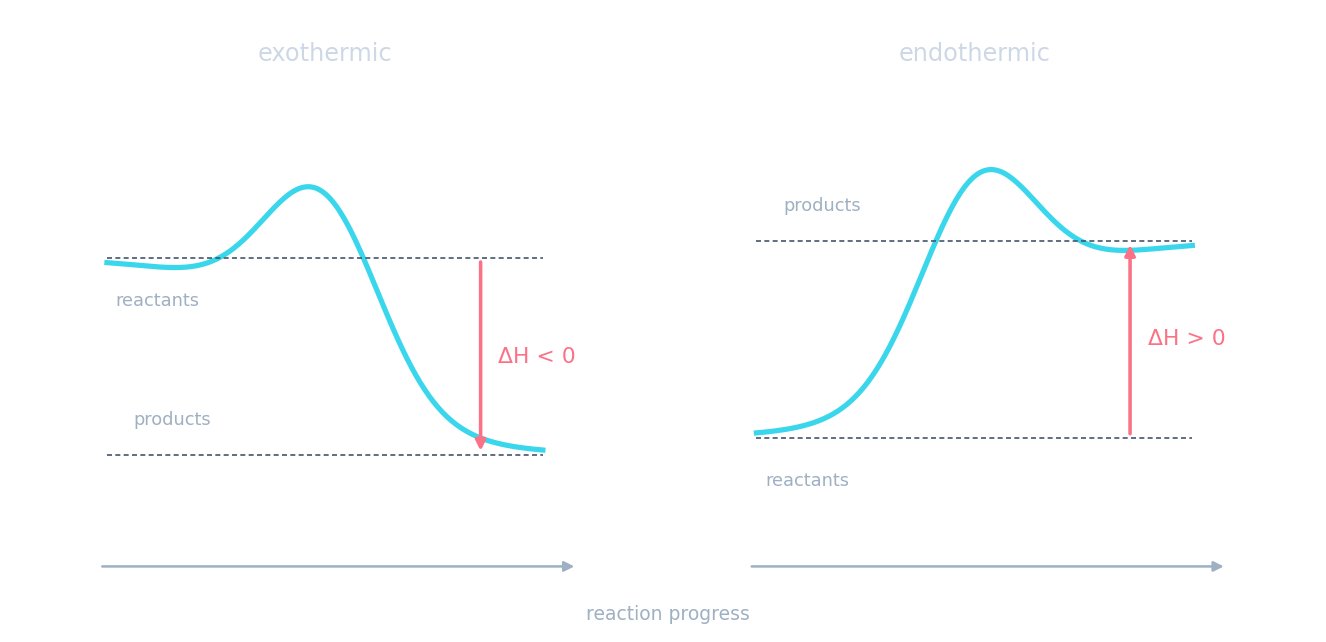
Reaction energy profiles · Perfiles de energía de reacción
Ea = barrier · ΔH = products − reactants · Ea = barrera · ΔH = productos − reactivos
The hump is the activation energy; whether products sit below or above reactants sets ΔH. · El pico es la energía de activación; si los productos están por debajo o por encima de los reactivos determina ΔH.
In an exothermic reaction: · En una reacción exotérmica:
Exothermic reactions release heat; products sit below reactants, so ΔH is negative. · Las reacciones exotérmicas liberan calor; los productos se sitúan por debajo de los reactivos, por lo que ΔH es negativo.
The activation energy is: · La energía de activación es:
Activation energy is the height of the "hill" — the minimum energy needed to start the reaction. · La energía de activación es la altura de la "colina" — la energía mínima necesaria para iniciar la reacción.
Standard conditions 标准条件 and types
- Values are compared under standard conditions ($298\ \text{K}$, $101\ \text{kPa}$), shown by $^{\ominus}$.
| Symbol | Enthalpy change of |
|---|---|
| $\Delta H_f^{\ominus}$ | formation — 1 mole of compound from its elements |
| $\Delta H_c^{\ominus}$ | combustion 燃烧 — 1 mole burns completely in oxygen |
| $\Delta H_{\text{neut}}^{\ominus}$ | neutralisation 中和 — 1 mole of water from acid + alkali |
An instant cold pack uses an endothermic reaction that takes in heat
Condiciones estándar 标准条件 y tipos
- Los valores se comparan bajo condiciones estándar ($298\ \text{K}$, $101\ \text{kPa}$), indicadas por $^{\ominus}$.
| Símbolo | Cambio de entalpía de |
|---|---|
| $\Delta H_f^{\ominus}$ | formación — 1 mol de compuesto a partir de sus elementos |
| $\Delta H_c^{\ominus}$ | combustión 燃烧 — 1 mol se quema completamente en oxígeno |
| $\Delta H_{\text{neut}}^{\ominus}$ | neutralización 中和 — 1 mol de agua a partir de ácido + base |

Una bolsa de frío instantánea utiliza una reacción endotérmica que absorbe calor
The standard enthalpy change of combustion is for: · El cambio estándar de entalpía de combustión corresponde a:
ΔHc is per mole of substance burned completely; ΔHf is formation from elements; ΔH_neut makes one mole of water. · ΔHc es por mol de sustancia quemada completamente; ΔHf es formación a partir de elementos; ΔH_neut forma un mol de agua.
Standard conditions for enthalpy values are: · Las condiciones estándar para valores de entalpía son:
Standard conditions are 298 K and 101 kPa, with each substance in its normal state (symbol ⊖). · Las condiciones estándar son 298 K y 101 kPa, con cada sustancia en su estado normal (símbolo ⊖).
Mind the sign of ΔH
- Exothermic reactions release heat and have a negative ΔH; endothermic are positive.
- ΔH is measured per mole and quoted under standard conditions.
Exothermic reactions release energy; endothermic reactions take it in
Presta atención al signo de ΔH
- Las reacciones exotérmicas liberan calor y tienen un ΔH negativo; las endotérmicas son positivas.
- ΔH se mide por mol y se cita bajo condiciones estándar.

Las reacciones exotérmicas liberan energía; las endotérmicas la absorben
Match each enthalpy term to its meaning. · Asocia cada término de entalpía con su significado.
Each item links the term to its correct meaning. · Cada elemento vincula el término con su significado correcto.
You've got it
- exothermic $\Delta H < 0$ (products lower); endothermic $\Delta H > 0$ (products higher)
- activation energy = the energy hill, the least needed to react
- standard conditions: 298 K, 101 kPa ($^{\ominus}$)
- types: formation ($\Delta H_f$), combustion ($\Delta H_c$), neutralisation ($\Delta H_{\text{neut}}$)
Lo has entendido
- exotérmico $\Delta H < 0$ (productos más bajos); endotérmico $\Delta H > 0$ (productos más altos)
- energía de activación = la colina de energía, la mínima necesaria para reaccionar
- condiciones estándar: 298 K, 101 kPa ($^{\ominus}$)
- tipos: formación ($\Delta H_f$), combustión ($\Delta H_c$), neutralización ($\Delta H_{\text{neut}}$)