Dot-and-cross diagrams
Introducido| English | Significado |
|---|---|
| dot-and-cross diagram/dɒt ænd krɒs ˈdaɪəɡræm/ | diagrama punto y cruz |
| expanded octet/ekˈspændɪd ɒkˈtet/ | octeto expandido |
| bonding pair/ˈbɒndɪŋ peə/ | verde |
| lone pair/ləʊn peə/ | verde |
| triple bond/ˈtrɪpl bɒnd/ | rojo |
Drawing the electrons
- A dot-and-cross diagram 点叉图 shows the outer electrons of each atom: dots for one atom, crosses for the other.
- Because the symbols differ, you can see where each bonding electron came from. That is what tells ionic, covalent and coordinate bonds apart.
A dot-and-cross diagram uses dots and crosses to:
Dificultad 1/5 · 100 monedas + un pequeño bono en el primer intento de hoy
Different symbols (dots/crosses) track which atom each outer electron came from.
A dot-and-cross diagram shows the outer electrons of each atom in a bond.
Dificultad 1/5 · 100 monedas + un pequeño bono en el primer intento de hoy
Dots and crosses distinguish the atoms' electrons.
What they can show
- Ionic: the electron moves completely; draw each ion in square brackets with its charge. Coordinate: both electrons of one bond come from the same atom, so the pair is two dots (or two crosses).
- They also handle an expanded octet 扩展八隅 (more than 8 outer electrons, possible from Period 3 onwards) and molecules with an odd number of electrons.
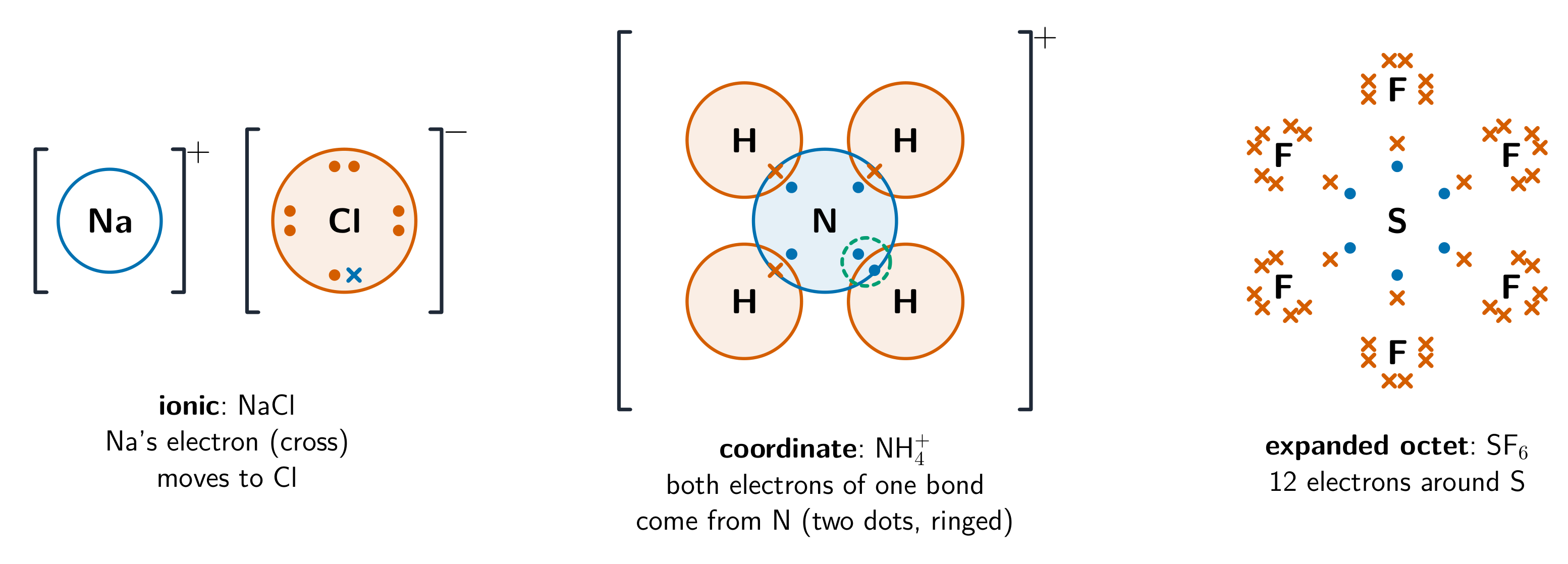
Dot-and-cross diagrams can be drawn for:
Dificultad 1/5 · 100 monedas + un pequeño bono en el primer intento de hoy
They work for all three, including expanded-octet and odd-electron species.
Match each dot-and-cross term to its meaning.
Dificultad 2/5 · 140 monedas + un pequeño bono en el primer intento de hoy
Dots and crosses track which atom each electron came from; lone pairs shape the molecule.
Worked examples
- Water: oxygen has two bonding pairs 成键电子对 and two lone pairs 孤对电子.
- Nitrogen ($\text{N}_2$): the atoms share three pairs (a triple bond 三键), with a lone pair on each.
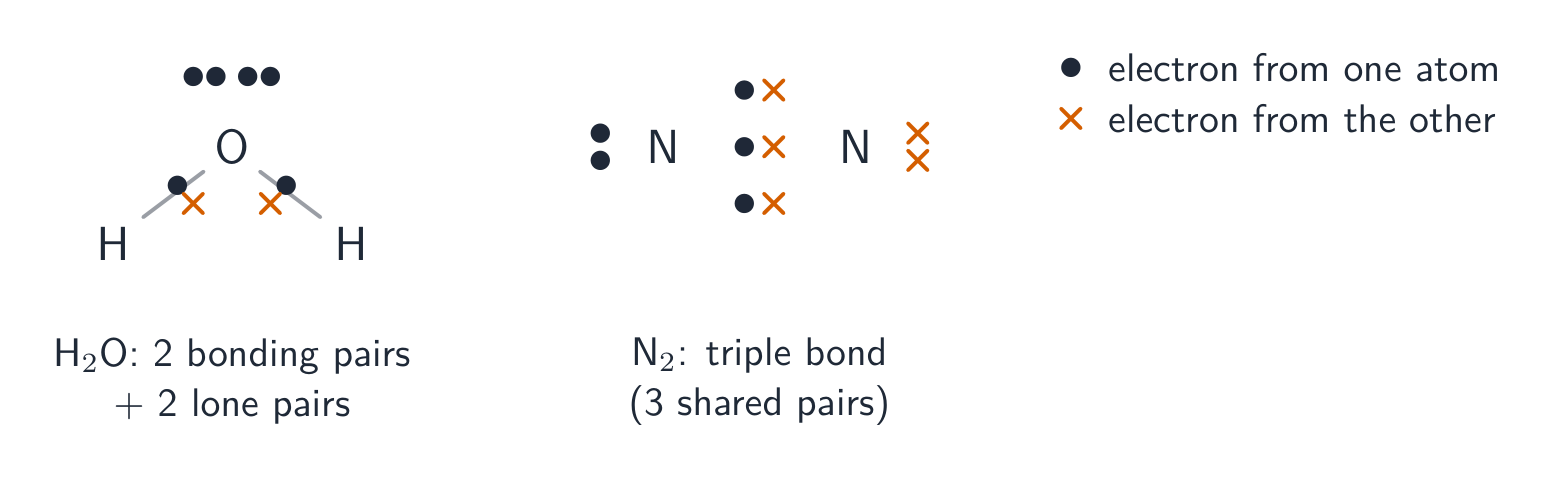
Shape from bonding and lone pairs
Count the bonding pairs and lone pairs around the central atom; they repel into the shape with least strain. Three bonds and one lone pair give a pyramid, like ammonia (NH3).
In the dot-and-cross diagram of water, the oxygen atom has:
Dificultad 1/5 · 100 monedas + un pequeño bono en el primer intento de hoy
Oxygen forms two O–H bonds (two bonding pairs) and keeps two lone pairs.
The dot-and-cross diagram of N₂ shows:
Dificultad 1/5 · 100 monedas + un pequeño bono en el primer intento de hoy
Nitrogen molecules share three pairs of electrons (a triple bond) plus a lone pair on each atom.
Worked example: carbon dioxide, step by step
Draw a dot-and-cross diagram for $\text{CO}_2$ (outer electrons only).
- Count: C has 4 outer electrons (crosses), each O has 6 (dots), 16 in all. C needs 4 more and each O needs 2 more, so C shares two pairs with each O: two C=O double bonds.
- Check: C now has 8 around it; each O has 2 shared pairs + 2 lone pairs = 8. So 16 electrons = 4 bonding pairs + 4 lone pairs. Common slips: drawing inner-shell electrons, or forgetting the lone pairs on O.
In a dot-and-cross diagram of HCN, how are the electrons arranged?
Dificultad 1/5 · 100 monedas + un pequeño bono en el primer intento de hoy
C (4) shares 1 pair with H and 3 with N; N (5) uses 3 in the triple bond and keeps 1 lone pair.
Coordinate bond: NH₃BF₃. Ammonia and boron trifluoride join into one molecule. Describe the new bond.
- In BF₃, B has only 6 outer electrons (3 shared pairs): it is electron-deficient. N in NH₃ has a lone pair.
- N donates its lone pair into B's empty space: a coordinate bond, drawn as two dots (both from N) between N and B. Now B has 8.
In a dot-and-cross diagram of H₃O⁺, how is the coordinate bond drawn?
Dificultad 1/5 · 100 monedas + un pequeño bono en el primer intento de hoy
Both electrons of a coordinate bond come from O, so they carry the same symbol.
Expanded octet and odd electrons. Count the outer electrons around the central atom in SF₆, and the total in ClO₂.
- SF₆: S shares one pair with each of 6 F, so 12 electrons around S. S can do this because it is in Period 3 and has empty 3d orbitals.
- ClO₂: Cl has 7 and each O has 6 outer electrons, 19 in total. An odd total means one electron must be unpaired: ClO₂ is a radical.
Nitrogen monoxide, NO, has 11 outer electrons in total, so one electron must be unpaired.
Dificultad 1/5 · 100 monedas + un pequeño bono en el primer intento de hoy
N has 5 and O has 6; an odd total cannot all be in pairs, so NO is a radical.
How many electrons are in the outer shell of P in PCl₅?
Dificultad 2/5 · 140 monedas + un pequeño bono en el primer intento de hoy
P shares one pair with each of 5 Cl: $5\times2=10$ electrons, an expanded octet.
Every molecule with an odd number of outer electrons breaks the octet rule for at least one atom.
Dificultad 1/5 · 100 monedas + un pequeño bono en el primer intento de hoy
With an odd total, the electrons cannot all be paired, so at least one atom has an unpaired electron and cannot have a full octet of pairs.
- Draw outer electrons only, and include every lone pair (each O in CO₂ has two).
- Ionic diagrams need square brackets and charges on both ions. Do not draw a shared pair between Na and Cl.
- A coordinate bond, once made, is the same as any other covalent bond. Only the diagram shows where the electrons came from.
You've got it
- dot-and-cross = outer electrons, dots for one atom and crosses for the other
- shows where each bonding electron came from; works for ionic, covalent and coordinate bonds
- water = 2 bonding + 2 lone pairs on O; $\text{N}_2$ = 3 shared pairs (triple bond)