Sigma and pi bonds · Enlaces sigma y pi
| English | Español |
|---|---|
| sigma/ˈsɪɡmə/ | sigma |
| pi/paɪ/ | pi |
| bond length/bɒnd leŋθ/ | longitud de enlace |
| hybridisation/ˌhaɪbrɪdaɪˈzeɪʃn/ | hibridación |
| bond energy/bɒnd ˈenədʒi/ | energía de enlace |
Two ways to overlap
- Covalent bonds form when orbitals overlap.
- The way they overlap gives a sigma σ键 or a pi π键 bond.
- Bond strength links to bond length 键长.
Dos formas de solapamiento
- Los enlaces covalentes se forman cuando los orbitales se solapan.
- La forma en que se solapan da lugar a un enlace sigma σ o un enlace pi π.
- La fuerza del enlace está relacionada con la longitud del enlace 键长.
A pi bond is formed by the sideways overlap of p orbitals. · Un enlace pi se forma por la superposición lateral de orbitales p.
Sigma bonds form by end-on overlap. · Los enlaces sigma se forman por superposición extremo a extremo.
Two kinds of overlap
- a sigma (σ) bond forms by head-on overlap between the two atoms.
- a pi (π) bond forms by the sideways overlap of two p orbitals (above and below).
- single = 1σ; double = 1σ + 1π; triple = 1σ + 2π.
Dos tipos de solapamiento
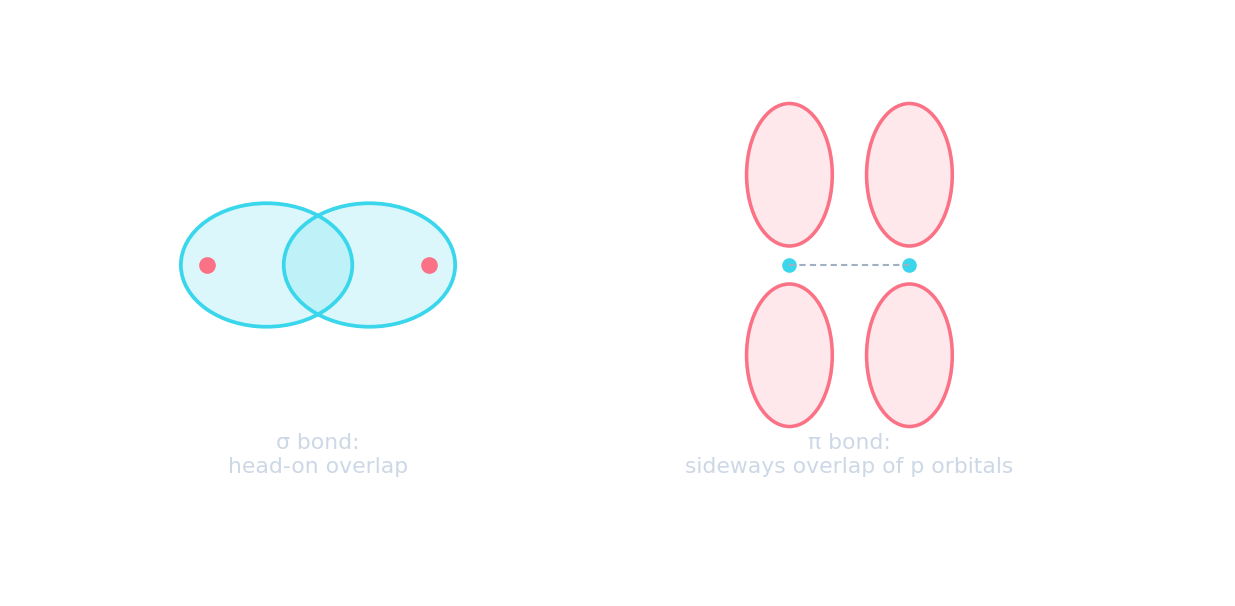
- Un enlace sigma (σ) se forma mediante un solapamiento frontal entre los dos átomos.
- Un enlace pi (π) se forma mediante el solapamiento lateral de dos orbitales p (por encima y por debajo).
- simple = 1σ; doble = 1σ + 1π; triple = 1σ + 2π.
Single, double and the shared pairs · Enlaces simples, dobles y pares compartidos
A single bond is one shared pair (a σ bond); switch to O₂ to see a double bond — a σ plus a second shared pair, the π bond. · Un enlace simple es un par compartido (un enlace σ); cambia a O₂ para ver un enlace doble: un σ más un segundo par compartido, el enlace π.
A pi (π) bond forms by: · Un enlace pi (π) se forma por:
A σ bond is head-on overlap; a π bond is the sideways overlap of p orbitals. · Un enlace σ es una superposición frontal; un enlace π es la superposición lateral de orbitales p.
A double bond consists of: · Un enlace doble consiste en:
A single bond is 1σ; a double is 1σ + 1π; a triple is 1σ + 2π. · Un enlace simple es 1σ; un doble es 1σ + 1π; un triple es 1σ + 2π.
Match each bond/overlap to what it is. · Empareja cada enlace/superposición con lo que es.
A single bond is one σ; a double bond is a σ plus a π (sideways p-orbital overlap). · Un enlace simple es un σ; un enlace doble es un σ más un π (superposición lateral de orbitales p).
Hybridisation 杂化
- Hybridisation mixes orbitals in a shell into new, equal ones:
- sp → 2 orbitals (linear),
- sp² → 3 orbitals (flat, e.g. $\text{C}_2\text{H}_4$),
- sp³ → 4 orbitals (e.g. $\text{CH}_4$).
Hibridación 杂化
- La hibridación mezcla los orbitales de una capa para formar nuevos orbitales equivalentes:
- sp → 2 orbitales (lineal),
- sp² → 3 orbitales (plano, ej. $\text{C}_2\text{H}_4$),
- sp³ → 4 orbitales (ej. $\text{CH}_4$).
Methane (CH₄) uses which hybridisation? · El metano (CH₄) usa qué hibridación?
CH₄ is tetrahedral with four equal bonds, from sp³ hybridisation. · CH₄ es tetraédrico con cuatro enlaces iguales, provenientes de la hibridación sp³.
Bond energy 键能 and length
- bond energy = energy to break one mole of a bond (gas state).
- bond length = distance between the two bonded nuclei.
- A shorter bond is usually stronger: triple > double > single.
Energía de enlace 键能 y longitud
- energía de enlace = energía necesaria para romper un mol de un enlace (estado gaseoso).
- longitud de enlace = distancia entre los dos núcleos enlazados.
- Un enlace más corto suele ser más fuerte: triple > doble > simple.
Which bond is the shortest and strongest? · ¿Qué enlace es el más corto y fuerte?
Shorter bonds are stronger: triple > double > single in both strength and shortness. · Los enlaces más cortos son más fuertes: triple > doble > simple tanto en fuerza como en longitud.
You've got it
- σ = head-on overlap; π = sideways p-orbital overlap
- single = 1σ; double = 1σ + 1π; triple = 1σ + 2π
- hybridisation: sp (linear), sp² (flat), sp³ (tetrahedral)
- shorter bond → stronger (triple > double > single)
Ya lo tienes
- σ = solapamiento frontal; π = solapamiento lateral de orbital p
- simple = 1σ; doble = 1σ + 1π; triple = 1σ + 2π
- hibridación: sp (lineal), sp² (plano), sp³ (tetraédrico)
- enlace más corto → más fuerte (triple > doble > simple)