Ionic bonding
Introducido| English | Significado |
|---|---|
| ionic bonding/aɪˈɒnɪk ˈbɒndɪŋ/ | enlace iónico |
| electrostatic attraction/ɪˌlektrəʊˈstætɪk əˈtrækʃn/ | atracción electrostática |
| cation/ˈkætaɪən/ | catión |
| anion/ˈænaɪən/ | anión |
| lattice/ˈlætɪs/ | roja |
| molten/ˈməʊltn/ | azul |
Giving electrons away
- Ionic bonding 离子键 is the electrostatic attraction 静电引力 between oppositely charged ions.
- Positive cations 阳离子 attract negative anions 阴离子.
- The ions pack into a giant lattice 晶格.
Ionic bonding is the electrostatic attraction between oppositely charged ions.
Dificultad 1/5 · 100 monedas + un pequeño bono en el primer intento de hoy
It forms by transferring electrons from a metal to a non-metal.
Ionic bonding is:
Dificultad 1/5 · 100 monedas + un pequeño bono en el primer intento de hoy
Ionic bonding is the attraction between positive cations and negative anions.
How it forms
- A metal gives electrons to a non-metal — e.g. $\text{NaCl}$, $\text{MgO}$, $\text{CaF}_2$.
- The ions form a regular giant lattice, held by attraction in every direction.
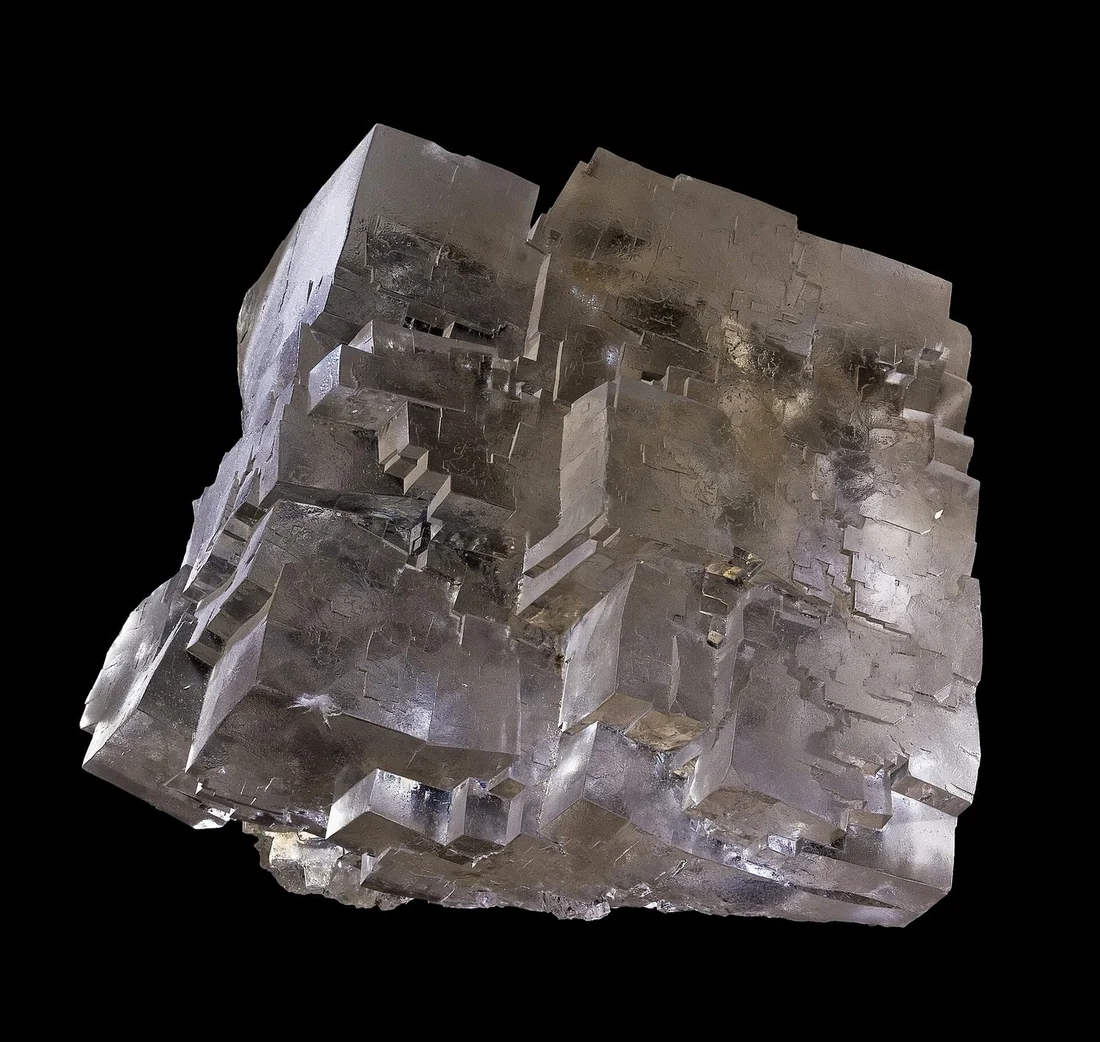
A salt crystal's cubic shape comes straight from the giant ionic lattice inside.
Formación de un enlace iónico (NaCl)
Step through it. A metal hands its outer electron to a non-metal; the oppositely charged ions then attract in a giant lattice.
Ionic bonding forms when:
Dificultad 1/5 · 100 monedas + un pequeño bono en el primer intento de hoy
A metal transfers electrons to a non-metal, making oppositely charged ions (e.g. NaCl).
In an ionic solid the ions are packed into a regular giant ______, held by attraction in every direction.
Dificultad 1/5 · 100 monedas + un pequeño bono en el primer intento de hoy
Each ion is surrounded by oppositely charged neighbours, so the structure is very strong.
In an ionic solid, the ions are arranged in:
Dificultad 1/5 · 100 monedas + un pequeño bono en el primer intento de hoy
Ions pack into a giant lattice, with each ion attracted to oppositely charged neighbours all around.
Dot-and-cross
- In $\text{NaCl}$, sodium transfers its single outer electron to chlorine.
- This gives $\text{Na}^{+}$ and a full-octet $\text{Cl}^{-}$, drawn with dots and crosses.
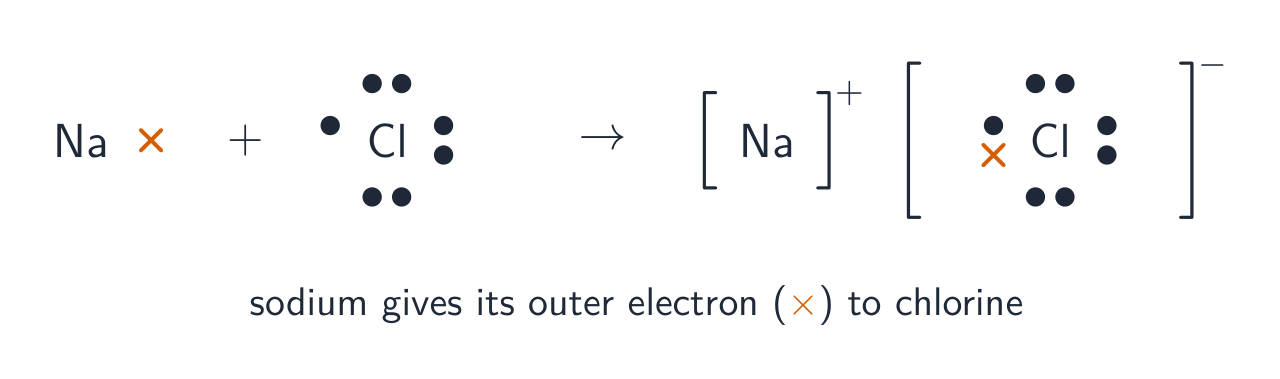
Sodium gives its single outer electron to chlorine, forming Na⁺ and a full-octet Cl⁻.
In the NaCl dot-and-cross diagram:
Dificultad 1/5 · 100 monedas + un pequeño bono en el primer intento de hoy
Sodium loses one electron to chlorine, forming Na⁺ and a full-octet Cl⁻.
Put the formation of an ionic bond in order.
Dificultad 3/5 · 200 monedas + un pequeño bono en el primer intento de hoy
Transfer the electron → make ions → they attract → giant lattice.
Worked example: magnesium oxide against sodium chloride
Describe the bonding in MgO, and explain why it melts at about 2850 °C while NaCl melts at 801 °C.
- Mg ($2,8,2$) gives two electrons to O ($2,6$): $\text{Mg}^{2+}$ and $\text{O}^{2-}$, both with the neon arrangement $2,8$. In the dot-and-cross diagram, $\text{O}^{2-}$ shows 6 dots and 2 crosses, in square brackets with the charge outside.
- Both are giant ionic lattices, but $\text{Mg}^{2+}$ and $\text{O}^{2-}$ carry double the charges of $\text{Na}^{+}$ and $\text{Cl}^{-}$ and are smaller, so the attraction between ions is much stronger and more energy is needed to separate them. Both conduct only when molten or dissolved.
Calcium ($2,8,8,2$) reacts with fluorine. What is the formula of the compound, and why?
Dificultad 1/5 · 100 monedas + un pequeño bono en el primer intento de hoy
Ca loses 2 electrons to form $\text{Ca}^{2+}$; each F gains only 1 to form $\text{F}^-$, so two F are needed.
Solid magnesium oxide conducts electricity, because it contains charged ions.
Dificultad 1/5 · 100 monedas + un pequeño bono en el primer intento de hoy
The ions are fixed in the lattice; it conducts only when molten, when the ions can move.
You've got it
- ionic bonding = electrostatic attraction between cations and anions
- forms when a metal transfers electrons to a non-metal ($\text{NaCl}$, $\text{MgO}$, $\text{CaF}_2$)
- the ions form a giant lattice held in every direction