Market research
Introducido| English | Significado |
|---|---|
| market research/ˈmɑːkɪt rɪˈsɜːtʃ/ | investigación de mercado |
| secondary research/ˈsekəndəri rɪˈsɜːtʃ/ | investigación secundaria |
| primary research/ˈpraɪməri rɪˈsɜːtʃ/ | investigación primaria |
| surveys/ˈsɜːveɪz/ | encuestas |
| focus groups/ˈfəʊkəs ɡruːps/ | grupos focales |
| qualitative/ˈkwɒlɪteɪtɪv/ | cualitativo |
| quantitative/ˈkwɒntɪteɪtɪv/ | cuantitativo |
| sampling/ˈsæmplɪŋ/ | muestreo |
| sample/ˈsæmpl/ | muestra |
| representative/ˌreprɪˈzentətɪv/ | representativo |
Asking before you act
- Launching a product on a hunch is gambling. Smart firms find out what customers want first.
- That is market research 市场调研 — turning guesses into evidence.
Market research cycle
Follow how a business turns customer data into a marketing decision.
Conducting a new customer survey is an example of:
Dificultad 1/5 · 100 monedas + un pequeño bono en el primer intento de hoy
Primary research collects new first-hand data.
Using existing government statistics is:
Dificultad 1/5 · 100 monedas + un pequeño bono en el primer intento de hoy
Secondary research uses data that already exists.
Primary vs secondary research 二手调研
- Primary research 一手调研: new data collected first-hand (surveys 问卷调查, interviews, focus groups 焦点小组). Specific but costly.
- Secondary research: existing data (reports, government stats, internal sales). Cheap and fast, but not tailored.
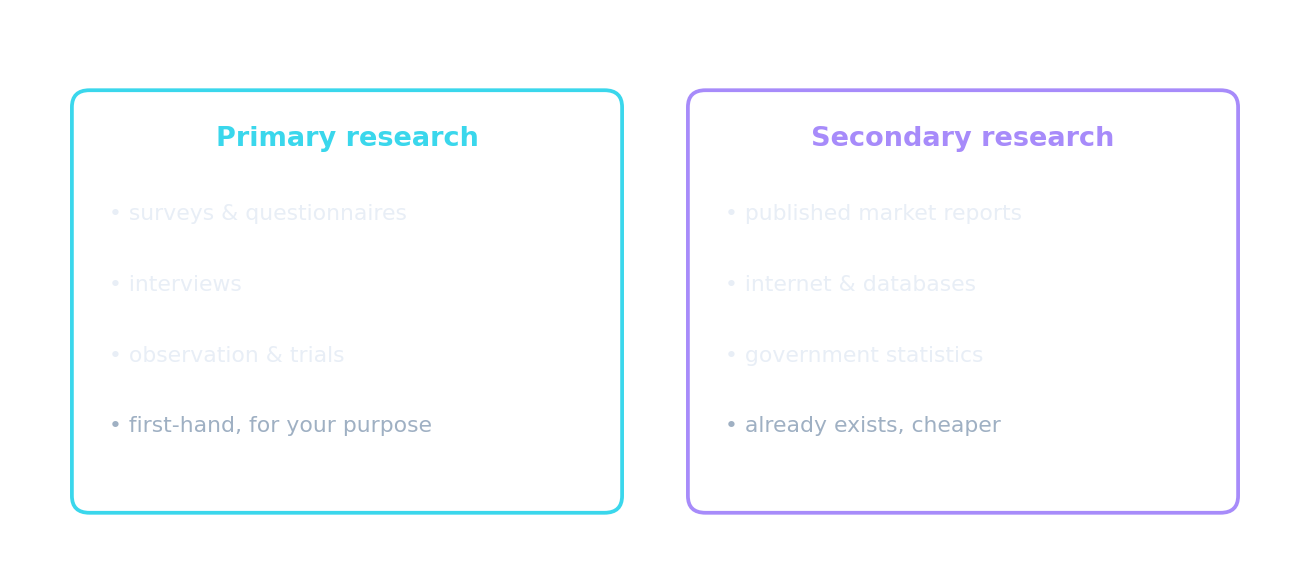
Market research: primary (first-hand) versus secondary (already exists)
Research that explores WHY customers feel as they do is:
Dificultad 1/5 · 100 monedas + un pequeño bono en el primer intento de hoy
Qualitative research captures opinions and reasons.
Qualitative 定性 vs quantitative 定量
- Quantitative: numbers — how many, how much (sales figures, survey counts).
- Qualitative: opinions and reasons — why customers behave as they do (interviews, focus groups).
A sample that is not representative can give misleading results, however large it is.
Dificultad 1/5 · 100 monedas + un pequeño bono en el primer intento de hoy
Representativeness matters as much as sample size.
A small group chosen to represent the whole market is a ______.
Dificultad 1/5 · 100 monedas + un pequeño bono en el primer intento de hoy
Sampling avoids the impossible task of asking everyone.
Sampling 抽样
- A sample 样本 is a small group chosen to represent the whole market — you can't ask everyone.
- A bigger, more representative 有代表性的 sample gives more reliable results, but costs more.
Bad sampling ruins good research. If the sample isn't representative (e.g. only asking existing customers), the results mislead — no matter how many people you ask. Sample design matters as much as sample size.
Worked example: researching a new protein bar
A food firm plans a protein bar for gym users. Design a research plan and evaluate it.
- Secondary: market reports on the size and growth of the sports-nutrition market, and rivals' prices. Primary: a questionnaire for 400 gym members across several cities (quantitative: how often they would buy, at what price), plus focus groups for taste and packaging (qualitative).
- Use a quota sample matching the gym population by age and gender, so results are more representative. Limits: people may say they will buy but not do so, and research costs time and money, so the firm should spend in proportion to the risk of the launch.
Which gives qualitative data?
Dificultad 1/5 · 100 monedas + un pequeño bono en el primer intento de hoy
It explores opinions and reasons.
A larger sample usually gives more reliable results but costs more to collect.
Dificultad 1/5 · 100 monedas + un pequeño bono en el primer intento de hoy
There is a trade-off between reliability and cost.
You've got it
- primary research = new first-hand data; secondary = existing data
- quantitative = numbers; qualitative = opinions and reasons (the "why")
- a representative sample stands in for the whole market — design beats size
Write from a sample of 50
- A firm interviews 50 people on one street and treats them as the whole city.
- Say what is wrong with that sample.
A firm collects new answers from 50 people who all live on one street, then treats those answers as the whole city's view. Why is that sample weak, even though the research is primary?
One street cannot stand for a whole city.
What is the main weakness of this survey?
Dificultad 1/5 · 100 monedas + un pequeño bono en el primer intento de hoy
Who is asked matters more than simply having 50 replies.