Antibiotics and antibiotic resistance
Introducido| English | Significado |
|---|---|
| antibiotic/ˌæntɪbaɪˈɒtɪk/ | antibiótico |
| resistant/rɪˈzɪstənt/ | resistente |
| penicillin/ˌpenɪˈsɪlɪn/ | penicilina |
| cell wall/sel wɔːl/ | pared celular |
| mutation/mjuːˈteɪʃn/ | mutación |
| natural selection/ˈnætʃərəl sɪˈlekʃn/ | selección natural |
The drugs that fight bacteria
- An antibiotic 抗生素 is a drug that kills bacteria or stops them growing.
- They have saved countless lives — but only against bacteria.
- And bacteria are fighting back, by becoming resistant 抗药.
How penicillin 青霉素 works
- Penicillin stops bacteria from building their cell walls 细胞壁.
- As the bacterium grows, its weak wall cannot hold it.
- So the cell takes in water and bursts.
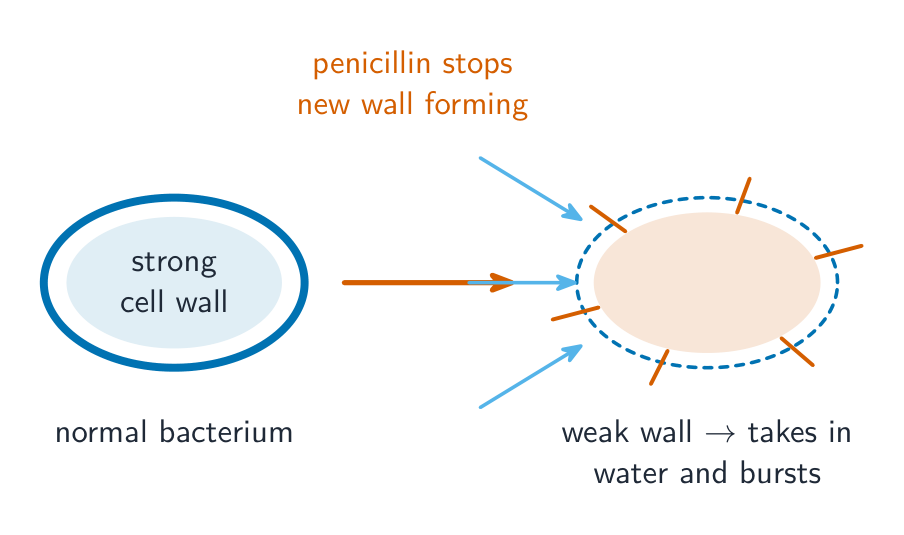
Penicillin stops bacteria building cell walls, so they burst
Penicillin kills bacteria by:
Dificultad 1/5 · 100 monedas + un pequeño bono en el primer intento de hoy
Penicillin prevents cell-wall synthesis; the growing cell cannot hold the water it absorbs, so it bursts.
Why antibiotics don't beat viruses
- A virus has no cell wall and no chemical reactions of its own to attack.
- It simply uses the machinery of the host cell.
- So there is no antibiotic target in a virus — antibiotics do not work against viral illnesses like colds.
Why do antibiotics not work against viruses?
Dificultad 1/5 · 100 monedas + un pequeño bono en el primer intento de hoy
Antibiotics target bacterial structures/processes; a virus has none of these, using the host cell instead.
Antibiotic resistance
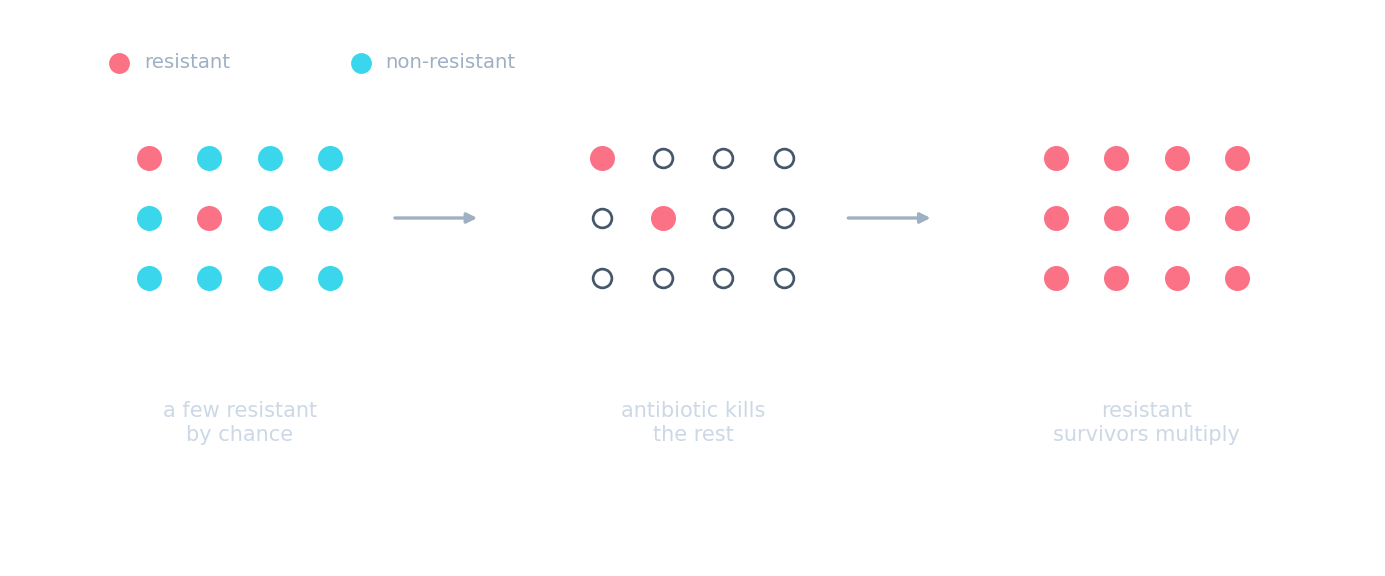
- A mutation 突变 can make a bacterium resistant — the antibiotic no longer kills it.
- By natural selection 自然选择, the non-resistant bacteria die, the resistant ones survive and multiply, and resistance spreads.
Slowing resistance: only use antibiotics when needed; always finish the full course; use the correct antibiotic; reduce heavy use in farming.
How resistance evolves
Step through natural selection in fast-forward. The antibiotic kills the rest, so only the resistant bacteria are left to breed.
Antibiotic resistance spreads because:
Dificultad 1/5 · 100 monedas + un pequeño bono en el primer intento de hoy
Resistant bacteria (from mutation) survive the antibiotic and reproduce, so resistance spreads by natural selection.
Put the evolution of antibiotic resistance in order.
Dificultad 3/5 · 200 monedas + un pequeño bono en el primer intento de hoy
Variation → the antibiotic selects → survivors breed → a resistant population. This is natural selection.
Antibiotic resistance spreads by natural ______ — resistant bacteria survive and reproduce.
Dificultad 1/5 · 100 monedas + un pequeño bono en el primer intento de hoy
The antibiotic is the selection pressure; only resistant bacteria survive to pass on their genes.
Which action helps slow antibiotic resistance?
Dificultad 1/5 · 100 monedas + un pequeño bono en el primer intento de hoy
Finishing the course leaves no survivors; avoiding unnecessary use reduces the selection pressure for resistance.
Antibiotics should be taken to treat a common cold.
Dificultad 1/5 · 100 monedas + un pequeño bono en el primer intento de hoy
Colds are caused by viruses, which antibiotics cannot kill — using them needlessly only drives resistance.
Worked example: how a resistant population grows
A patient with a bacterial infection stops taking antibiotics after 3 days instead of 7, and the infection returns, now resistant. Explain.
- In the population, a few bacteria may already carry a random mutation for resistance (for example, an enzyme that breaks down penicillin). The antibiotic kills the susceptible bacteria first, so the surviving bacteria include a higher proportion of resistant ones.
- Stopping early leaves these survivors alive. They reproduce, passing on the resistance allele, and may also pass plasmids to other bacteria. This is natural selection: the antibiotic is the selection pressure. Finishing the course and avoiding unnecessary antibiotics slow it.
Antibiotics will help a patient recover faster from a cold, which is caused by a virus.
Dificultad 1/5 · 100 monedas + un pequeño bono en el primer intento de hoy
Viruses have no cell wall or metabolism of their own for antibiotics to target.
Resistance genes can spread between different bacteria on:
Dificultad 1/5 · 100 monedas + un pequeño bono en el primer intento de hoy
Plasmids can be passed from one bacterium to another.
You've got it
- antibiotics kill bacteria — penicillin stops cell wall building, so the cell bursts
- they do not work on viruses (no cell wall, no target — uses host machinery)
- resistance: a mutation + natural selection → resistant bacteria spread
- slow it: only when needed, finish the course, correct drug, less farm use
Write from this case
- Penicillin blocks the building of a bacterial cell wall.
- A person has a viral infection and asks for the same drug.
Why will penicillin not cure the viral infection?
No bacterial cell wall means no penicillin target.
Why does penicillin fail against a virus?
Dificultad 1/5 · 100 monedas + un pequeño bono en el primer intento de hoy
The drug's target is absent.