Phagocytes and antigens
Introducido| English | Significado |
|---|---|
| immune system/ɪˈmjuːn ˈsɪstəm/ | sistema inmune |
| phagocyte/ˈfæɡəsaɪt/ | fagocito |
| macrophage/ˈmækrəfɪdʒ/ | macrófago |
| antigen/ˈæntɪdʒen/ | antígeno |
| phagocytosis/ˌfæɡəsɪˈtəʊsɪs/ | fagocitosis |
| histamine/ˈhɪstəmiːn/ | histamina |
| inflammation/ɪnflæˈmeɪʃn/ | inflamación |
The first line of defence
- A small cut lets thousands of bacteria into your skin. Within an hour, white blood cells are already killing them.
- The immune system 免疫系统 is the cells and chemicals that defend the body against pathogens 病原体. The first cells to act are phagocytes 吞噬细胞, which engulf and digest pathogens.
- Phagocytes are non-specific: they attack any foreign cell. They recognise it as foreign by its antigens 抗原.
A phagocyte engulfs and digests a pathogen in a process called ______.
Dificultad 1/5 · 100 monedas + un pequeño bono en el primer intento de hoy
Phagocytosis is part of the first line of internal defence — fast and non-specific.
Antigens: self and non-self
- An antigen is a molecule, usually a protein or glycoprotein on a cell surface, that the immune system can recognise. Each type has its own specific shape.
- Self antigens are on the body's own cells; the immune system does not attack them. Non-self antigens come from outside: on bacteria, viruses, toxins, transplanted organs or the wrong blood group. They trigger an immune response.
- This is why a transplanted kidney can be rejected: its cells carry non-self antigens.
Non-self antigens trigger an immune response because they:
Dificultad 1/5 · 100 monedas + un pequeño bono en el primer intento de hoy
Self antigens are ignored; non-self (foreign) antigens are recognised and trigger a response.
Phagocytes normally attack the body's own cells because they carry antigens.
Dificultad 1/5 · 100 monedas + un pequeño bono en el primer intento de hoy
Self antigens are recognised and ignored.
Where phagocytes come from
- All blood cells are made from stem cells in the bone marrow. There are two main types of phagocyte:
- Neutrophils 中性粒细胞 circulate in the blood. They squeeze out of the capillaries into infected tissue.
- Monocytes circulate in the blood, then move into tissues (such as the lungs, liver and lymph nodes) and grow into macrophages 巨噬细胞.
| Feature | Neutrophil | Macrophage |
|---|---|---|
| arrives | first, in large numbers | later |
| lives for | a few days | months |
| after killing | dies (dead neutrophils form pus) | displays antigens to lymphocytes |
Phagocytes such as macrophages and neutrophils are types of white blood cell.
Dificultad 1/5 · 100 monedas + un pequeño bono en el primer intento de hoy
Yes — phagocytes are white blood cells; they are the first cells to respond to a pathogen.
Match each description to the right phagocyte.
Dificultad 2/5 · 140 monedas + un pequeño bono en el primer intento de hoy
Neutrophils are the fast, short-lived first wave. Macrophages arrive later, last longer and present antigens.
Phagocytosis 吞噬作用 in five steps
- Attraction: chemicals released by pathogens and damaged cells attract the phagocyte, which moves towards them. This is chemotaxis 趋化作用.
- Binding: receptors on the phagocyte bind to non-self antigens on the pathogen (more easily if antibodies are already attached).
- Engulfing: the cell surface membrane flows around the pathogen and takes it in by endocytosis, forming a vesicle called a phagosome 吞噬体.
- Digestion: lysosomes fuse with the phagosome and release hydrolytic enzymes 水解酶 that digest the pathogen.
- Presentation (macrophages): the pathogen's antigens are placed on the macrophage's surface. It becomes an antigen-presenting cell, which activates lymphocytes (lesson 11.2).
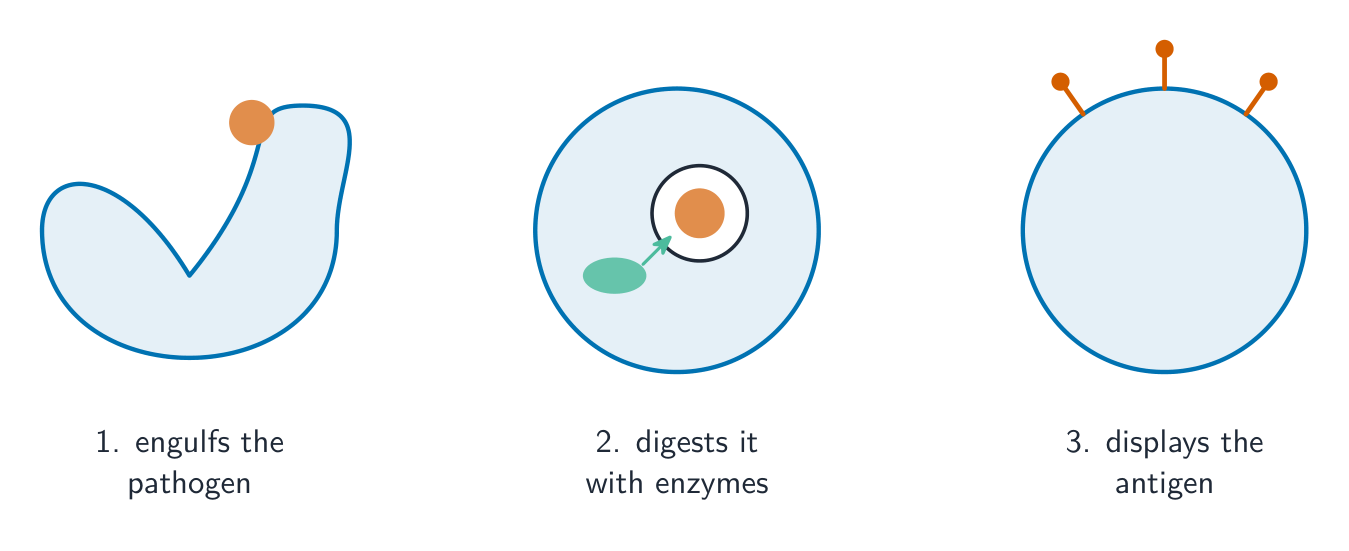
Fagocitosis
Step through how a phagocyte deals with a pathogen — engulf it, digest it, then display its antigen to call in the rest of the immune system.
In phagocytosis, a phagocyte:
Dificultad 1/5 · 100 monedas + un pequeño bono en el primer intento de hoy
A phagocyte engulfs the pathogen into a vesicle and digests it with enzymes.
Put the steps of phagocytosis in order.
Dificultad 3/5 · 200 monedas + un pequeño bono en el primer intento de hoy
Detect → engulf → digest → present the antigen to call in the specific immune response.
After digesting a pathogen, a macrophage:
Dificultad 1/5 · 100 monedas + un pequeño bono en el primer intento de hoy
The macrophage presents the antigen, which activates the next stage of the immune response.
A phagocyte moves towards chemicals released by a pathogen. This movement is called ______.
Dificultad 1/5 · 100 monedas + un pequeño bono en el primer intento de hoy
Chemotaxis is movement towards (or away from) a chemical.
Raising the alarm: inflammation
- Damaged cells release histamine 组胺. Nearby blood vessels widen and become leaky, so the area turns red, warm and swollen. This is inflammation 炎症.
- More blood flow brings more phagocytes, and leaky capillaries let them reach the tissue quickly.
A phagocyte chases a pathogen, wraps it in a vesicle and digests it with enzymes.
How does histamine help phagocytes reach an infection?
Dificultad 1/5 · 100 monedas + un pequeño bono en el primer intento de hoy
More blood flow brings more phagocytes, and leaky capillaries let them out into the tissue.
Spotting the cells in a blood smear
- Exam questions often show a photomicrograph of stained blood and ask you to name the cells. Look at the nucleus first.
- Red blood cells have no nucleus. Neutrophils have a nucleus in 2–5 lobes. Lymphocytes are small, with a large round nucleus that fills most of the cell. Monocytes are the largest, with a kidney- or horseshoe-shaped nucleus.

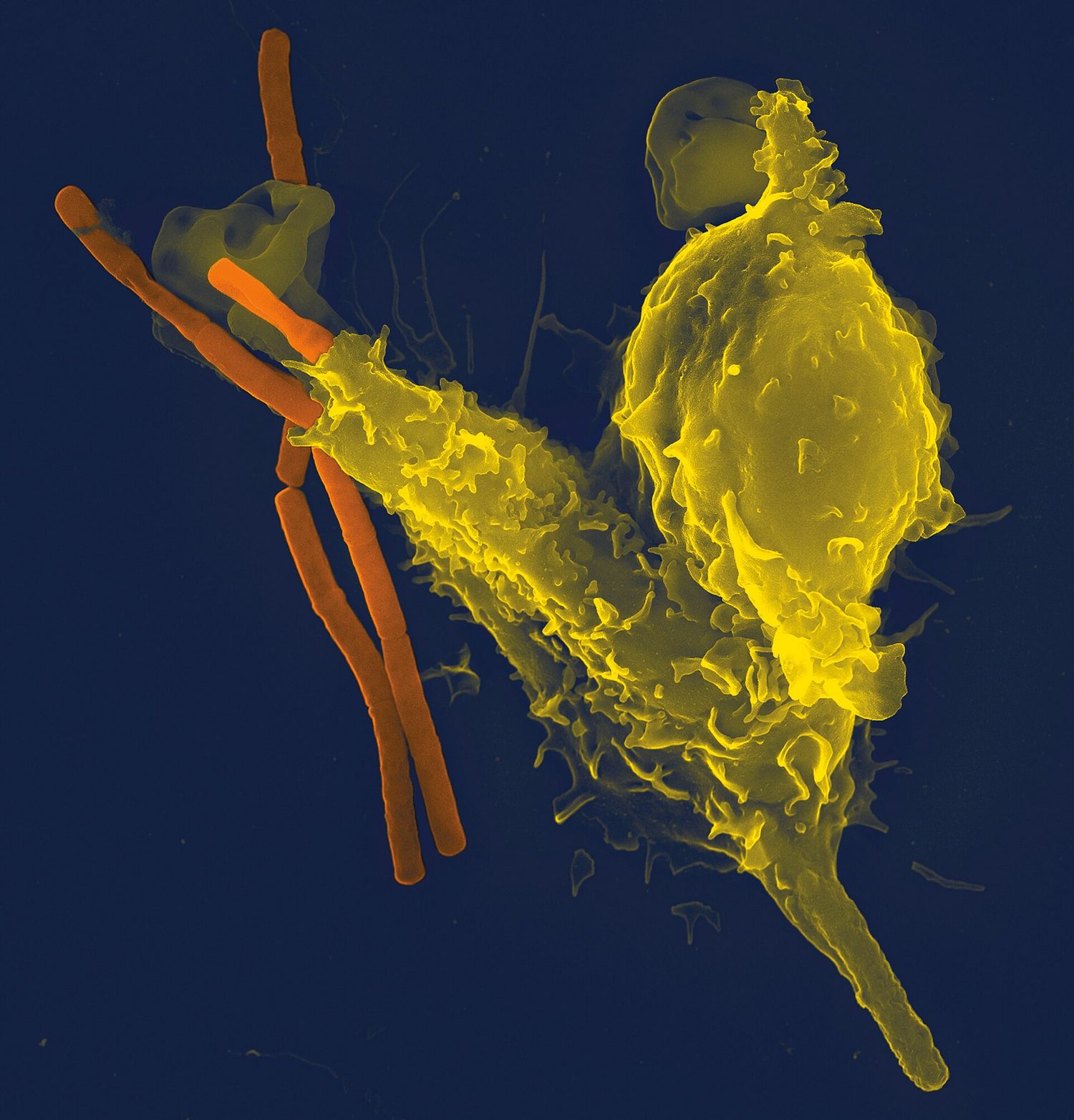
A real neutrophil (yellow) engulfing anthrax bacteria (orange), seen with an electron microscope.
In a stained blood smear, a cell has a nucleus with three lobes and grainy cytoplasm. What is it?
Dificultad 1/5 · 100 monedas + un pequeño bono en el primer intento de hoy
A lobed nucleus identifies a neutrophil. Lymphocytes have a large round nucleus; red blood cells have none.
Worked exam question: a splinter in the finger
Question (5 marks). A splinter carries bacteria into the skin. Describe how a neutrophil destroys one of these bacteria.
Model answer (one mark per point, up to 5):
- The neutrophil is attracted by chemicals released by the bacteria or damaged cells (chemotaxis).
- Receptors on the neutrophil bind to the non-self antigens on the bacterium.
- The bacterium is engulfed by endocytosis into a phagosome (vesicle).
- Lysosomes fuse with the phagosome.
- Hydrolytic enzymes (such as lysozyme or proteases) digest the bacterium.
- The products are absorbed; the neutrophil then dies.
Why answers lose marks: "the phagocyte eats the bacterium" scores nothing. Name endocytosis, the phagosome and the lysosome enzymes. Do not say a neutrophil "presents antigens"; that is the macrophage's job.
Without looking back: describe how a neutrophil destroys a bacterium (5 marks).
Each named stage earns a mark; "eats it" earns none.
Which organelle supplies the enzymes that digest an engulfed bacterium?
Dificultad 1/5 · 100 monedas + un pequeño bono en el primer intento de hoy
Lysosomes fuse with the phagosome and release hydrolytic enzymes.
Worked exam question: identify the cells
Question (2 marks). A photomicrograph shows cell P, with a nucleus in three lobes, and cell Q, with a round nucleus that almost fills the cell. Identify P and Q, giving one reason each.
- P is a neutrophil: its nucleus is lobed (1 mark).
- Q is a lymphocyte: its large round nucleus fills most of the cell, leaving only a thin rim of cytoplasm (1 mark).
Tip: give the visible feature as your reason, not the cell's function. "It kills bacteria" cannot be seen in a photograph.
You've got it
- antigen: a surface molecule with a specific shape; self antigens are tolerated, non-self antigens trigger a response
- phagocytes come from bone marrow: neutrophils (first, short-lived, die as pus) and macrophages (from monocytes, long-lived, present antigens)
- phagocytosis: chemotaxis → bind antigens → endocytosis into a phagosome → lysosomes fuse → hydrolytic enzymes digest
- inflammation: histamine widens blood vessels and makes them leaky, so more phagocytes arrive
- identify cells by the nucleus: none (red cell), lobed (neutrophil), large round (lymphocyte), kidney-shaped (monocyte)
What do phagocytes do to a bacterium?
Dificultad 1/5 · 100 monedas + un pequeño bono en el primer intento de hoy
The cell surrounds the bacterium and breaks it down.