Skip to content

IGCSE Physics · November 2024 · Paper 52 · Difficulty 3 · Standard

Question 3

3

In this experiment, you will investigate the image formed by a converging lens.

Refer to Fig. 3.1.

Fig. 3.1
(a)

• Switch on the lamp.

  • Place the lens at a distance $u = 20.0\text{ cm}$ from the illuminated object (the triangular hole in the card).
  • Adjust the position of the screen until a sharp image of the illuminated object is formed on the screen.

Measure, to the nearest $0.1\text{ cm}$, the image distance $v$ from the centre of the lens to the screen.

Record the image distance $v$ in the top row of Table 3.1.

Table 3.1

object distance $u$
/cm
image distance $v$
/ cm
20.0
25.0
35.0
45.0
55.0
60.0

[1]

(b)
(i)

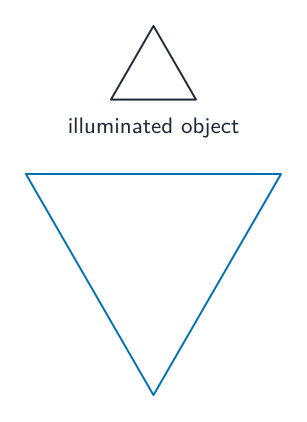
The diagram in Fig. 3.2 shows the illuminated object.

Fig. 3.2

In the space below the illuminated object, draw a diagram to show how the image that you observe on the screen compares with the object.[1]

(ii)

Calculate the magnification $m$ of the image using the equation shown.

$$m = \frac{v}{u}$$

$m =$ [1]

(c)

Repeat the procedure in (a) for values of $u = 25.0\text{ cm}$, $u = 35.0\text{ cm}$, $u = 45.0\text{ cm}$, $u = 55.0\text{ cm}$ and $u = 60.0\text{ cm}$.[1]

(d)

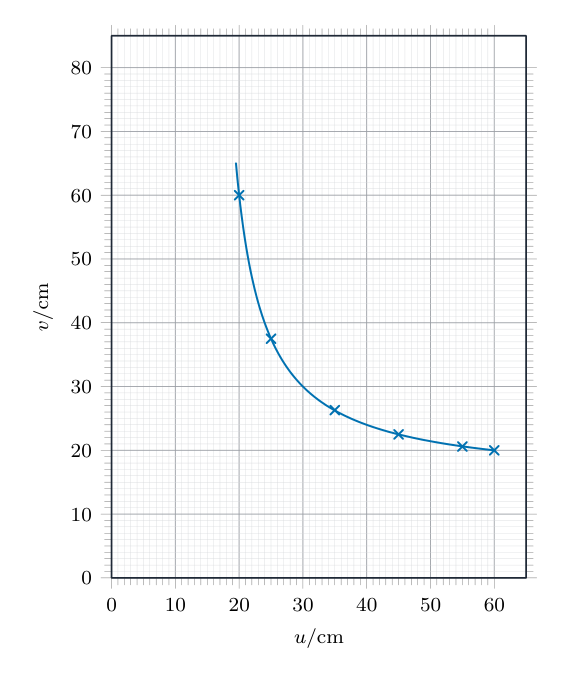
Plot a graph of $v/\text{cm}$ ($y$-axis) against $u/\text{cm}$ ($x$-axis).

Draw the best-fit curve.

[3]

(e)

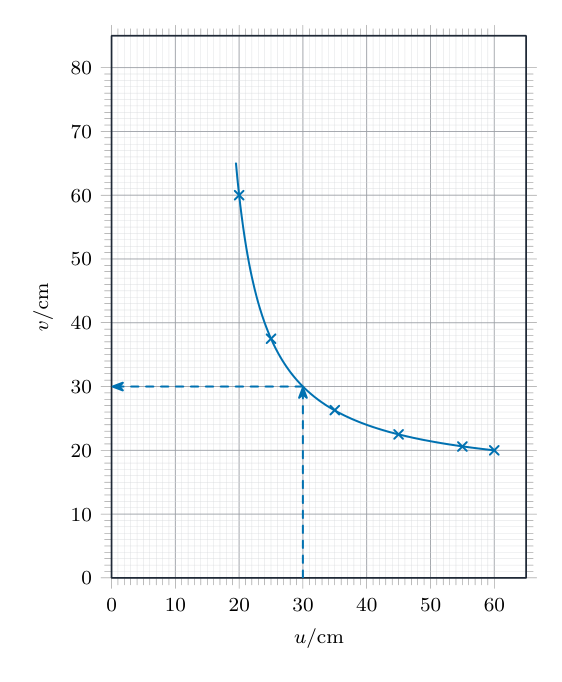
Use your graph to find the value of $v$ when $u = 30.0\text{ cm}$. Show clearly on the graph how you obtained the necessary information

$v =$ $\text{ cm}$[2]

(f)

The focal length $f$ of the lens can be found using the equation $f = \frac{uv}{(u + v)}$.

Use the values of $u$ and $v$ from (e) to calculate the focal length of the lens.

$f =$ $\text{ cm}$[1]

(g)

State one technique you use when doing the experiment to ensure that the image on the screen is as clearly focussed as possible.[1]

[Total: 11]
Show the mark scheme

These are the official mark-scheme rows. Each point that matches your answer earns a mark.

Tap the mark scheme to open it full size.

Show a worked answer

How to reach each mark, step by step. Try the question yourself first.

3(a)

  • Move the screen until the image is sharp, then measure from the centre of the lens to the screen. Record $v$ to the nearest $0.1\,\mathrm{cm}$.

3(b)(i)

  • The image is inverted and magnified, as shown below. Its exact size depends on your measured image distance.
Worked answer drawing

3(b)(ii)

  • Use $m = v/u$, with both distances in the same unit.
  • For $u = 20.0\,\mathrm{cm}$, $m = \mathbf{v/(20.0\,\mathrm{cm})}$, using your measured $v$.

3(c)

  • For each new object distance, move the screen until the image is sharp and record $v$ to the nearest $0.1\,\mathrm{cm}$. The values of $v$ should decrease as $u$ increases.

3(d)

  • The graph below is an example, using a lens with focal length $15.0\,\mathrm{cm}$; use your own measured values in the experiment.
  • For $u=20.0,25.0,35.0,45.0,55.0,60.0\,\mathrm{cm}$, the example values of $v$ are $60.0,37.5,26.3,22.5,20.6,20.0\,\mathrm{cm}$, respectively.
Worked answer drawing

3(e)

  • The dashed lines show the reading at $u=30.0\,\mathrm{cm}$. For the example graph, $\mathbf{v=30.0\,\mathrm{cm}}$.
  • Your value depends on your measurements; read your own curve to within half a small square.
Worked answer drawing

3(f)

  • Use $f = uv/(u+v)$ with the graph reading $v$ in centimetres and $u = 30.0\,\mathrm{cm}$.
  • $f = \mathbf{(30.0\,\mathrm{cm})v/(30.0\,\mathrm{cm}+v)}$. A typical result is between $13.0\,\mathrm{cm}$ and $17.0\,\mathrm{cm}$.

3(g)

  • Move the screen slowly back and forth to find the position where the image is sharpest.
Original question

Log in or create account

IGCSE, A-Level & AP