Skip to content

IGCSE Physics · November 2024 · Paper 42 · Difficulty 4 · Challenging

Question 1

1
(a)

A rocket has an initial mass of $7.4 \times 10^{6} \text{ kg}$.

(i)

Calculate the initial weight of the rocket.

weight = [1]

(ii)

Define, in words, the term weight.

[1]

(b)

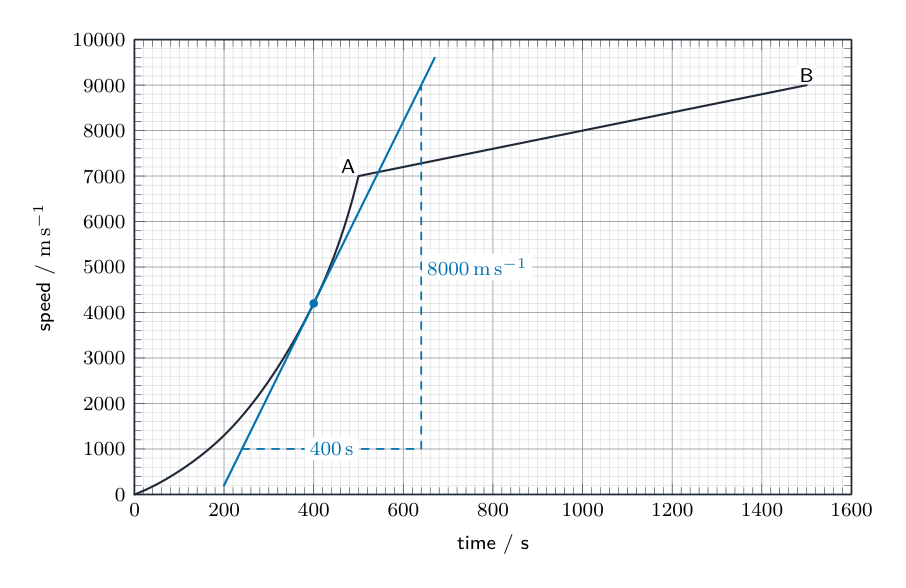
Fig. 1.1 shows part of the speed-time graph for the rocket as it leaves the ground and travels into space.

(i)

Describe the motion of the rocket:

From O to A

From A to B [2]

(ii)

Draw a tangent to the graph at time = 400 s and use this to calculate the acceleration of the rocket at this time. Show your working.

acceleration = [2]

(c)

Rockets are used to launch satellites into space. When the satellite is released, the rocket returns to the Earth.

Explain in terms of forces why the rocket reaches terminal velocity as it travels through the atmosphere back to the Earth.

[2]

[Total: 8]

Show the mark scheme

These are the official mark-scheme rows. Each point that matches your answer earns a mark.

Tap the mark scheme to open it full size.

Show a worked answer

How to reach each mark, step by step. Try the question yourself first.

1(a)(i)

  • Use $F_W = mg$.
  • $F_W = (7.4\times10^6\,\mathrm{kg})(9.8\,\mathrm{N/kg}) = \mathbf{7.3\times10^7}\,\mathrm{N}$.

1(a)(ii)

  • Weight is the gravitational force on an object.

1(b)(i)

  • From O to A, the rocket has increasing acceleration.
  • From A to B, it has constant acceleration.

1(b)(ii)

  • The blue tangent touches the curve at $400\,\mathrm{s}$. Two points on it are $(240\,\mathrm{s},1000\,\mathrm{m/s})$ and $(640\,\mathrm{s},9000\,\mathrm{m/s})$.
  • $a=\Delta v/\Delta t=(9000-1000)/(640-240)=\mathbf{20\,\mathrm{m/s^2}}$.
Worked answer drawing

1(c)

  • As the rocket speeds up, air resistance $F_D$ increases.
  • Eventually $F_D$ balances its weight $F_W$. The resultant force is zero, so it reaches terminal velocity and its speed stays constant.
Original question

Log in or create account

IGCSE, A-Level & AP