Skip to content

IGCSE Physics · November 2024 · Paper 41 · Difficulty 3 · Standard

Question 8

8

The nuclide notation for the radioactive isotope carbon-14 is $^{14}_{6}\text{C}$.

(a)

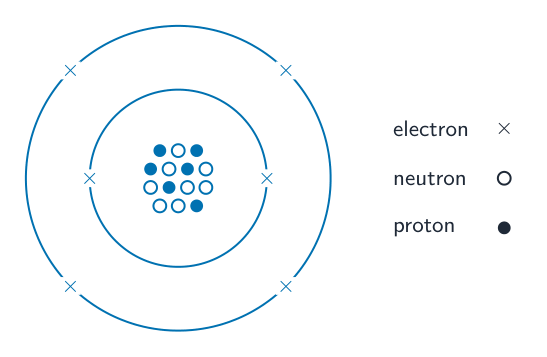
Using the symbols shown in Fig. 8.1, draw a diagram to show the number of electrons, neutrons and protons in a neutral atom of carbon-14 and how they are arranged.

Fig. 8.1

[3]

(b)

Describe how the composition of a neutral atom of carbon-14 is different from the composition of a neutral atom of nitrogen-14 ($^{14}_{7}\text{N}$).[2]

(c)

Carbon-14 decays by beta ($\beta$) emission.

(i)

State the name of a particle that is identical to a beta-particle.[1]

(ii)

Describe the change that takes place in carbon-14 as a beta-particle is emitted.[1]

(d)

The half-life of carbon-14 is 5700 years.

A very old object is made of wood. It contains $1.2 \times 10^{11}$ atoms of carbon-14. When it was manufactured, it contained $9.6 \times 10^{11}$ atoms of carbon-14.

Determine the time that has passed since it was manufactured.

time passed = [3]

[Total: 10]
Show the mark scheme

These are the official mark-scheme rows. Each point that matches your answer earns a mark.

Tap the mark scheme to open it full size.

Show a worked answer

How to reach each mark, step by step. Try the question yourself first.

8(a)

  • Draw a nucleus containing 6 protons and 8 neutrons.
  • Draw 6 electrons around the nucleus: two in the inner shell and four in the next shell.
Worked answer drawing

8(b)

  • Carbon-14 has one more neutron than nitrogen-14.
  • Carbon-14 has one fewer proton and one fewer electron.

8(c)(i)

  • A beta-particle is an electron.

8(c)(ii)

  • In the nucleus, a neutron changes into a proton as an electron is emitted.

8(d)

  • The fraction remaining is $1.2\times10^{11}/(9.6\times10^{11}) = 1/8$, which is three half-lives.
  • Use $t = n t_{1/2}$.
  • $t = 3(5700\,\mathrm{years}) = \mathbf{17\,000}\,\mathrm{years}$ to two significant figures.
Original question

Log in or create account

IGCSE, A-Level & AP