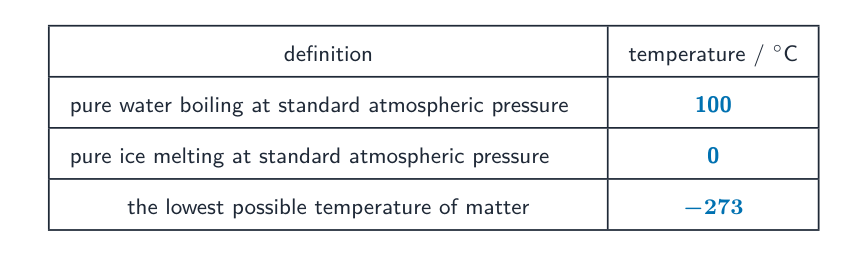
Table 5.1 defines three specific temperatures.
Complete Table 5.1 by writing the correct temperature for each definition.
Table 5.1
| definition | temperature/ °C |
| pure water boiling at standard atmospheric pressure | |
| pure ice melting at standard atmospheric pressure | |
| the lowest possible temperature of matter |
[3]
The temperature of air in a room is 15°C. Calculate the temperature of the air in kelvin.
temperature = K[2]
A teacher demonstrates thermal energy transfer through some metal rods. Fig. 5.1 shows the arrangement.

The metal rods are placed on a block of wood.
The demonstration compares how quickly thermal energy is transferred to the wax at the end of each rod.
State the name of the process for thermal energy transfer through the metal rods.
[1]
The rods are made from different metals. The rods have the same length and diameter. The ends of the rods in the Bunsen flame are at the same temperature.
State how the demonstration shows which metal transfers thermal energy at the greatest rate.
[2]
A playground includes a concrete area with white and black squares, as shown in Fig. 5.2.

The Sun shines on the concrete area during the day. The temperature of the concrete area increases. During the afternoon, students compare the temperature of the white squares with the temperature of the black squares.
State and explain whether the white squares or the black squares have the higher temperature. Include the name of the process of thermal energy transfer from the Sun to the squares.
[2]
[Total: 10]