Skip to content

IGCSE Physics · November 2024 · Paper 32 · Difficulty 2 · Core

Question 10

10
(a)
(i)

Name three types of nuclear emission from radioactive sources.

1

2

3 [2]

(ii)

State the type of nuclear emission which has a relative charge of +2.

[1]

(iii)

State the type of nuclear emission which is part of the electromagnetic spectrum.

[1]

(b)

The isotope technetium-99m decays to technetium-99.

(i)

The half-life of technetium-99m is 6 hours.

Determine the fraction of technetium-99m remaining in a sample after 18 hours.

fraction remaining = [2]

(ii)

The nuclide notation for technetium-99 is:

$$^{99}_{43}\mathrm{Tc}$$

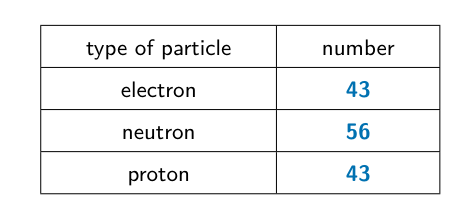
Complete the table below to show the number of each type of particle in a neutral atom of technetium-99.

type of particlenumber
electron
neutron
proton

[2]

[Total: 8]

Show the mark scheme

These are the official mark-scheme rows. Each point that matches your answer earns a mark.

Tap the mark scheme to open it full size.

Show a worked answer

How to reach each mark, step by step. Try the question yourself first.

10(a)(i)

  • The three types are alpha, beta and gamma radiation.

10(a)(ii)

  • An alpha particle has relative charge +2.

10(a)(iii)

  • Gamma radiation is an electromagnetic wave.

10(b)(i)

  • The number of half-lives is $n = t/t_{1/2} = 18\,\mathrm{h}/6\,\mathrm{h} = 3$.
  • The remaining fraction is $(1/2)^n = (1/2)^3 = \mathbf{1/8}$.

10(b)(ii)

  • The atomic number is 43, so there are $\mathbf{43}$ protons and, in a neutral atom, $\mathbf{43}$ electrons.
  • Neutrons $= 99 - 43 = \mathbf{56}$.
Worked answer drawing
Original question

Log in or create account

IGCSE, A-Level & AP