Skip to content

IGCSE Physics · November 2024 · Paper 31 · Difficulty 3 · Standard

Question 8

8
(a)

Fig. 8.1 shows a ray diagram for a thin converging lens.

The lens forms an image of the object. The object is positioned 30 cm from the centre of the lens.

(i)

Determine the distance of the image from the centre of the lens. Use information from Fig. 8.1.

image distance = m[1]

(ii)

Determine the focal length of the lens. Use information from Fig. 8.1.

focal length = m[1]

(iii)

State two characteristics of the image formed by the lens in Fig. 8.1.

1

2 [2]

(b)

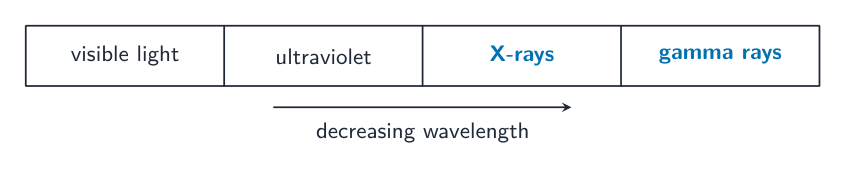
Fig. 8.2 shows labels for part of the electromagnetic spectrum in order of decreasing wavelength.

visible lightultraviolet

decreasing wavelength

Fig. 8.2

(i)

Complete Fig. 8.2 by writing the name of one type of radiation in each box.[2]

(ii)

State one use of ultraviolet radiation.

[1]

(iii)

State one danger to people from excessive exposure to ultraviolet radiation.

[1]

[Total: 8]
Show the mark scheme

These are the official mark-scheme rows. Each point that matches your answer earns a mark.

Tap the mark scheme to open it full size.

Show a worked answer

How to reach each mark, step by step. Try the question yourself first.

8(a)(i)

  • The image distance is $8.0\,\mathrm{cm} + 3.0\,\mathrm{cm} = \mathbf{0.11}\,\mathrm{m}$.

8(a)(ii)

  • The focal length is $8.0\,\mathrm{cm} = \mathbf{0.08}\,\mathrm{m}$.

8(a)(iii)

  • The image is inverted and smaller than the object.

8(b)(i)

  • Write X-rays in the left box and gamma rays in the right box. X-rays have shorter wavelengths than ultraviolet; gamma rays have still shorter wavelengths.
Worked answer drawing

8(b)(ii)

  • Ultraviolet radiation can sterilise medical instruments.

8(b)(iii)

  • Too much ultraviolet radiation can cause skin damage.
Original question

Log in or create account

IGCSE, A-Level & AP