Skip to content

IGCSE Physics · November 2024 · Paper 31 · Difficulty 3 · Standard

Question 7

7
(a)

A student demonstrates three different processes that change the direction of water waves in a ripple tank.

Fig. 7.1, Fig. 7.2 and Fig. 7.3 illustrate the three processes.

(i)
Fig. 7.1

State the name of the process shown in Fig. 7.1.

[1]

(ii)
Fig. 7.2

State the name of the process shown in Fig. 7.2.

[1]

(iii)
Fig. 7.3

State the name of the process shown in Fig. 7.3.

[1]

(iv)

Give a reason why the waves in Fig. 7.3 change direction as they move from deep water to shallow water.

[1]

(b)

Describe the direction of vibration of particles in a transverse wave.

[2]

(c)

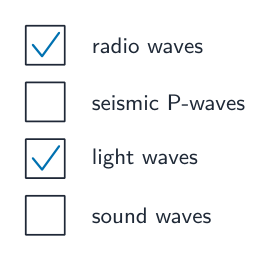
Fig. 7.4 lists examples of waves. Two of the examples are transverse waves.

radio waves

seismic P-waves

light waves

sound waves

Fig. 7.4

Indicate which of the examples are transverse waves.

Put a tick (✓) in the box next to each example of a transverse wave.[2]

(d)

The velocity of a wave is 1500 m/s. The frequency of the wave is 250 Hz.

Calculate the wavelength of the wave.

wavelength = m[3]

[Total: 11]
Show the mark scheme

These are the official mark-scheme rows. Each point that matches your answer earns a mark.

Tap the mark scheme to open it full size.

Show a worked answer

How to reach each mark, step by step. Try the question yourself first.

7(a)(i)

  • The process is reflection.

7(a)(ii)

  • The process is diffraction.

7(a)(iii)

  • The process is refraction.

7(a)(iv)

  • The waves slow down as they enter shallow water, so their direction changes.

7(b)

  • The particles vibrate at right angles to the direction in which the wave travels.

7(c)

  • Tick radio waves and light waves. Both are electromagnetic waves, with vibrations at right angles to the direction of travel.
Worked answer drawing

7(d)

  • Use $v = f\lambda$, so $\lambda = v/f$.
  • $\lambda = 1500\,\mathrm{m/s}/250\,\mathrm{Hz} = \mathbf{6.0}\,\mathrm{m}$.
Original question

Log in or create account

IGCSE, A-Level & AP