Sand is a granular material composed of very small, irregularly-shaped mineral particles. A student determines the density of sand by two methods.
She uses the apparatus shown in Fig. 1.1 and Fig. 1.2.

Method 1
The student measures the mass of a $250\text{ cm}^3$ measuring cylinder, as shown in Fig. 1.1.
She pours sand into the measuring cylinder and measures the mass of the measuring cylinder and sand, as shown in Fig. 1.2.
Use the values shown in Fig. 1.1 and Fig. 1.2 to calculate the mass $m$ of the sand.
$m =$ g[1]
The student measures the volume $V_1$ of the sand in the measuring cylinder.
$V_1 =$ 108 $\text{cm}^3$
Calculate a value for the density $\rho_1$ of the sand sample. Use the values from (a)(i) and the equation $\rho_1 = \frac{m}{V_1}$. Include a unit.
$\rho_1 =$ [2]
Method 2

The student pours $100\text{ cm}^3$ of water into the measuring cylinder containing the sample of sand.
Some of the water soaks into the sand sample and she waits for the water level to become constant.
Record the reading $V_2$ of the water level in the measuring cylinder shown in Fig. 1.3.
$V_2 =$ $\text{cm}^3$[1]
Calculate another value for the density $\rho_2$ of the sand sample.
Use the values from (a)(i) and (b)(i) and the equation $\rho_2 = \frac{m}{(V_2 - k)}$, where $k = 100\text{ cm}^3$.
$\rho_2 =$ [2]

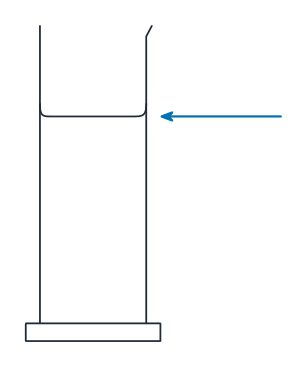
On Fig. 1.4, draw an arrow showing the correct line of sight for reading the volume of water in the measuring cylinder.[1]
Another student wants to determine the density of the particles in a similar sample of sand.
Explain why method 1 would not be a suitable method for him to use.
[1]
Explain why method 2 would give a more accurate value for the density of the particles in this sample of sand.
[1]
Describe two possible sources of inaccuracy in the measurements taken in method 1 or method 2, even if they are carried out carefully.
1
2
[2]
[Total: 11]