Skip to content

IGCSE Physics · November 2023 · Paper 53 · Difficulty 3 · Standard

Question 1

1

In this experiment, you will determine the density of sand by two methods.

Carry out the following instructions, referring to Fig. 1.1 and Fig. 1.2.

Method 1

(a)
(i)

Measure the mass $m_1$ of measuring cylinder A using the top-pan balance, as shown in Fig. 1.1.

$m_1 =$ g

Pour approximately $100\text{ cm}^3$ of sand into measuring cylinder A.

The sand is to remain in the measuring cylinder for the rest of the experiment.

Measure the volume $V_1$ of sand in measuring cylinder A.

$V_1 =$ $\text{cm}^3$

Measure the mass $m_2$ of measuring cylinder A and the sand using the top-pan balance, as shown in Fig. 1.2.

$m_2 =$ g

Use your values of $m_1$ and $m_2$ to calculate the mass $m_3$ of the sand.

$m_3 =$ g[2]

(ii)

Calculate a value for the density $\rho_1$ of the sand. Use your values from (a)(i) and the equation $\rho_1 = \frac{m_3}{V_1}$. Include a unit.

$\rho_1 =$ [2]

(iii)

Describe one possible source of inaccuracy in the measurements taken in method 1. You may assume that all measurements are taken carefully and involve good experimental practice.

[1]

Method 2

(b)
(i)

Pour exactly $100\text{ cm}^3$ of water into measuring cylinder B.

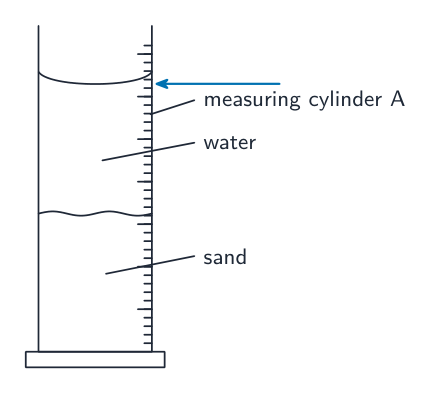
Pour this water into measuring cylinder A, as shown in Fig. 1.3.

Wait until the water level is constant then record the reading $V_2$ of the water level in measuring cylinder A.

$V_2 =$ $\text{cm}^3$[1]

(ii)

On Fig. 1.3, draw an arrow showing the correct line of sight for reading the water level in measuring cylinder A.[1]

(iii)

Calculate another value for the density $\rho_2$ of the sand.

Use your values from (a)(i) and (b)(i) and the equation $\rho_2 = \frac{m_3}{(V_2 - k)}$, where $k = 100\text{ cm}^3$.

$\rho_2 =$ [2]

(c)

Another student wants to determine the density of the particles in a sample of sand.

(i)

Explain why method 1 would not be a suitable method for her to use.

[1]

(ii)

Explain why method 2 would give a more accurate value for the density of the particles in the sample of sand.

[1]

[Total: 11]
Show the mark scheme

These are the official mark-scheme rows. Each point that matches your answer earns a mark.

Tap the mark scheme to open it full size.

Show a worked answer

How to reach each mark, step by step. Try the question yourself first.

1(a)(i)

  • Record your measurements; for example, $m_1 = 50\,\mathrm{g}$, $m_2 = 200\,\mathrm{g}$ and $V_1 = 100\,\mathrm{cm^3}$.
  • Use $m_3 = m_2 - m_1$ to find the mass of sand alone.
  • For these example readings, $m_3 = 200\,\mathrm{g} - 50\,\mathrm{g} = \mathbf{150}\,\mathrm{g}$. Use your own readings in the same way.

1(a)(ii)

  • Use $\rho_1 = m_3/V_1$.
  • For example, if $m_3 = 150\,\mathrm{g}$ and $V_1 = 100\,\mathrm{cm^3}$, then $\rho_1 = 150\,\mathrm{g}/100\,\mathrm{cm^3} = \mathbf{1.50}\,\mathrm{g/cm^3}$. Use your own readings.

1(a)(iii)

  • The surface of the sand may not be flat, so its volume is difficult to read precisely.

1(b)(i)

  • Read the bottom of the water meniscus at eye level after the level stops changing. Record your measured $V_2$; it should be greater than $V_1$ and less than $200\,\mathrm{cm^3}$.

1(b)(ii)

  • The arrow shows a $\mathbf{horizontal}$ line of sight at the bottom of the meniscus. This avoids parallax error.
Worked answer drawing

1(b)(iii)

  • Use $\rho_2 = m_3/(V_2-k)$, where $k = 100\,\mathrm{cm^3}$.
  • For example, if $m_3 = 150\,\mathrm{g}$ and $V_2 = 160\,\mathrm{cm^3}$, then $\rho_2 = 150\,\mathrm{g}/(160-100)\,\mathrm{cm^3} = \mathbf{2.50}\,\mathrm{g/cm^3}$. Use your own readings.
  • Give both densities to 2 or 3 significant figures. The second should be greater because water fills the gaps between the grains.

1(c)(i)

  • The measured volume includes gaps between the sand grains, so it is greater than the volume of the particles alone.

1(c)(ii)

  • Water fills the gaps between the grains, so the calculated volume is the volume of the sand particles.
Original question

Log in or create account

IGCSE, A-Level & AP