Skip to content

IGCSE Physics · November 2023 · Paper 42 · Difficulty 3 · Standard

Question 1

1

A car accelerates uniformly in a straight line from rest at time $t = 0$. At $t = 3.2\text{s}$, the speed of the car is $13.0\text{m/s}$.

(a)
(i)

Calculate the acceleration of the car.

acceleration = [2]

(ii)

Explain in words what is meant by the term acceleration.

[1]

(b)

The car travels at $13.0\text{m/s}$ from $t = 3.2\text{s}$ to $t = 12.0\text{s}$.

(i)

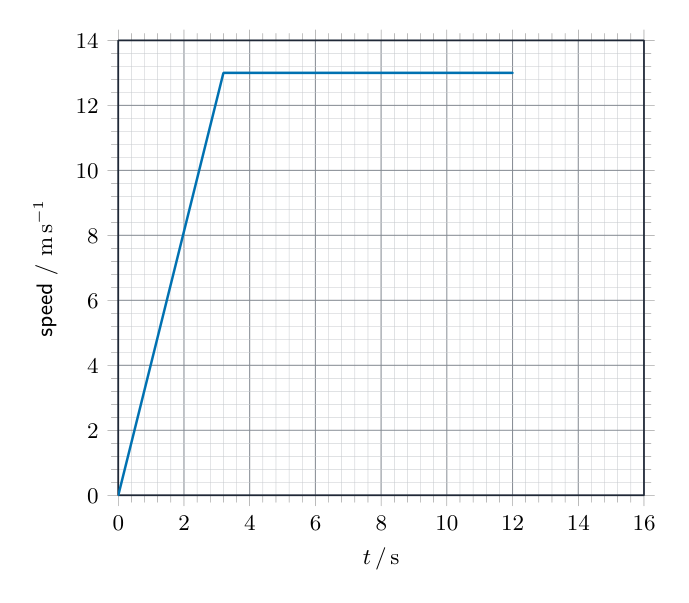
Plot the speed–time graph for the car from $t = 0$ to $t = 12.0\text{s}$.

[2]

(ii)

Determine the distance travelled by the car between $t = 0$ and $t = 3.2\text{s}$.

distance = [2]

(c)

The car decelerates from $13.0\text{m/s}$ to $0\text{m/s}$ at a constant deceleration. The mass of the car is $1350\text{kg}$. The car travels $13\text{m}$ in $2.0\text{s}$ as it decelerates.

Show that the work done by the car as it decelerates is approximately $1.1 \times 10^{5}\text{J}$.[4]

(d)

On another day, the car in (c) travels a longer distance while it decelerates from $13.0\text{m/s}$ to $0\text{m/s}$. The deceleration is constant.

Suggest and explain what causes the stopping distance to increase.

suggestion

explanation

[2]

[Total: 13]
Show the mark scheme

These are the official mark-scheme rows. Each point that matches your answer earns a mark.

Tap the mark scheme to open it full size.

Show a worked answer

How to reach each mark, step by step. Try the question yourself first.

1(a)(i)

  • Use acceleration $a = \Delta v/\Delta t$.
  • $a = \frac{13.0\,\mathrm{m/s} - 0\,\mathrm{m/s}}{3.2\,\mathrm{s}} = \mathbf{4.1}\,\mathrm{m/s^2}$.

1(a)(ii)

  • Acceleration is the rate of change of velocity.

1(b)(i)

  • The graph shows uniform acceleration, followed by constant speed.
Worked answer drawing

1(b)(ii)

  • Distance is the area under the speed–time graph: $s = \frac{1}{2}tv$.
  • $s = \frac{1}{2}(3.2\,\mathrm{s})(13.0\,\mathrm{m/s}) = \mathbf{21}\,\mathrm{m}$.

1(c)

  • Use the size of the deceleration $a = |\Delta v|/\Delta t$: $a = \frac{|0-13.0|\,\mathrm{m/s}}{2.0\,\mathrm{s}} = 6.5\,\mathrm{m/s^2}$.
  • Use $F = ma$ for the braking force magnitude: $F = (1350\,\mathrm{kg})(6.5\,\mathrm{m/s^2}) = 8775\,\mathrm{N}$.
  • Use work done $W = Fd$: $W = (8775\,\mathrm{N})(13\,\mathrm{m}) = \mathbf{1.1\times10^5}\,\mathrm{J}$.

1(d)

  • The road could be wet.
  • Less friction acts on the tyres, so the car decelerates more slowly and travels farther before stopping.
Original question

Log in or create account

IGCSE, A-Level & AP