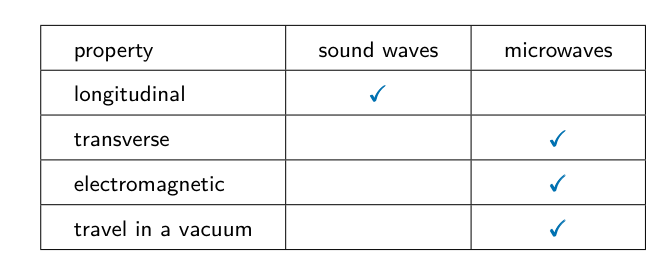
Place ticks (✓) in Table 7.1 to show the properties of sound waves and of microwaves.
property
sound waves
microwaves
longitudinal
transverse
electromagnetic
travel in a vacuum
[2]
(b)
Scientists have placed reflectors on the Moon. Scientists use the reflectors to measure the distance between the Earth and the Moon.
Fig. 7.1 (not to scale)
A scientist in an observatory sends a ray of red light from the observatory to the reflector on the Moon, as shown in Fig. 7.1.
The ray takes a total time of 2.5s to travel from the observatory to the reflector and back to the observatory. The speed of light is $3.0 \times 10^{8} \text{m/s}$.
Calculate the distance between the observatory and the reflector.
distance = m[3]
(c)
(i)
State one use of ultraviolet rays.
[1]
(ii)
State one harmful effect of ultraviolet rays.
[1]
[Total: 7]
Show the mark scheme
These are the official mark-scheme rows. Each point that matches your answer earns a mark.
Tap the mark scheme to open it full size.
Show a worked answer
How to reach each mark, step by step. Try the question yourself first.
7(a)
The completed table is shown below. $\textbf{Sound}$ is longitudinal; $\textbf{microwaves}$ are transverse electromagnetic waves and can travel in a vacuum.
7(b)
Use $d = vt$. The given time is for the journey there and back, so use half of it for one way.