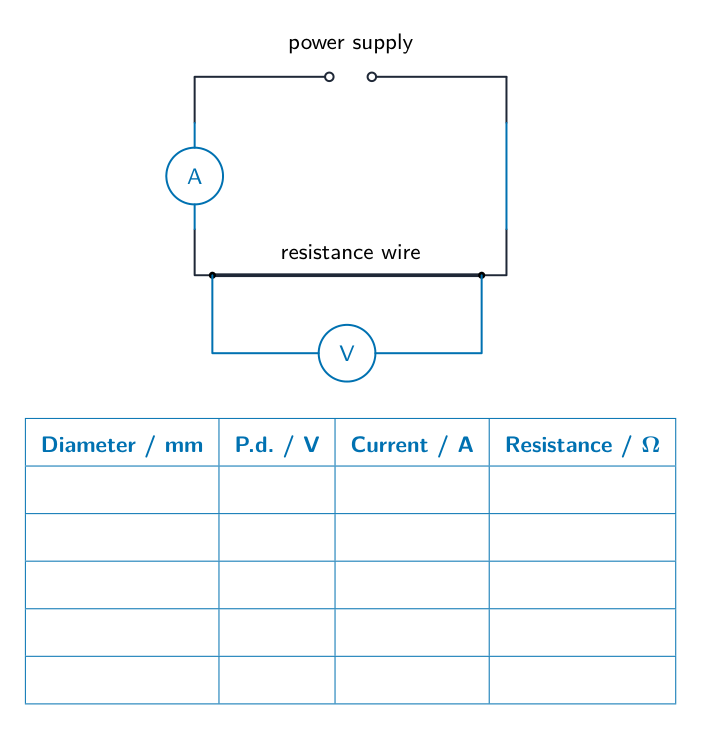
A student investigates the relationship between the diameter of a wire and the electrical resistance of the wire.
Plan an experiment which enables him to investigate how the diameter of a wire affects the resistance of the wire.
Resistance $R$ is calculated from the equation $R = \frac{V}{I}$
where $V$ is the potential difference (p.d.) across the wire and $I$ is the current in the wire.
You are not required to do this experiment.
The apparatus available includes wires of different known diameters.
In your plan:
list any additional apparatus needed
complete Fig. 4.1 to show a circuit suitable for measuring the resistance of a wire
explain briefly how to do the experiment, including the measurements to take so that the resistance can be determined
state the key variables to keep constant
draw a table, or tables, with column headings, to show how to display the readings (you are not required to enter any readings in the table)
explain how to use the readings to reach a conclusion.
Fig. 4.1
Show the mark scheme
These are the official mark-scheme rows. Each point that matches your answer earns a mark.
Tap the mark scheme to open it full size.
Show a worked answer
How to reach each mark, step by step. Try the question yourself first.
Use an ammeter in series and a voltmeter in parallel across the wire, as shown below.
For at least five known diameters, measure the p.d. and current. Keep the wire length, material and temperature the same; use a low current and switch off between readings.
Calculate $R=V/I$ for each wire. Repeat the readings and calculate a mean resistance for each diameter.
Record each set in the table below, then calculate the means. Compare the mean resistances to see how diameter affects resistance.