Fig. 11.1 represents all the particles in an atom which is a radioactive isotope of carbon.
(a)
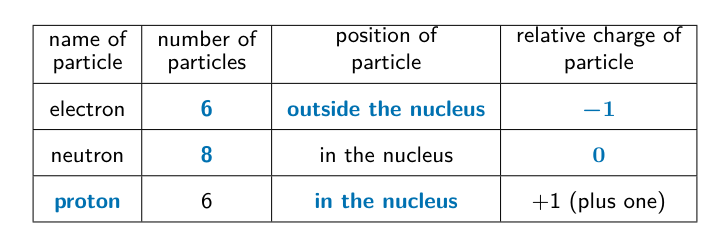
Table 11.1 gives information about the particles shown in Fig. 11.1.
Using the information in Fig. 11.1, write in the empty boxes to complete Table 11.1.
name of particle
number of particles
position of particle
relative charge of particle
electron
neutron
in the nucleus
6
+1 (plus one)
(b)
A museum displays an item made of ancient wood. When the wood was new, the item contained 8.00 mg of the isotope shown in Fig. 11.1. The item now contains 2.00 mg of the isotope. The half-life of the isotope is 5700 years.
Calculate the age of the wood in the item.
age of wood = years[3]
Show the mark scheme
These are the official mark-scheme rows. Each point that matches your answer earns a mark.
Tap the mark scheme to open it full size.
Show a worked answer
How to reach each mark, step by step. Try the question yourself first.
11(a)
Electron: $\mathbf{6}$, outside the nucleus, relative charge $\mathbf{-1}$.
Neutron: $\mathbf{8}$, in the nucleus, relative charge $\mathbf{0}$.
Proton: $\mathbf{6}$, in the nucleus, relative charge $\mathbf{+1}$.
11(b)
The mass falls from $8.00\,\mathrm{mg}$ to $4.00\,\mathrm{mg}$ and then to $2.00\,\mathrm{mg}$: this takes two half-lives.
Use age $t = nT_{1/2}$, where $n$ is the number of half-lives.