4
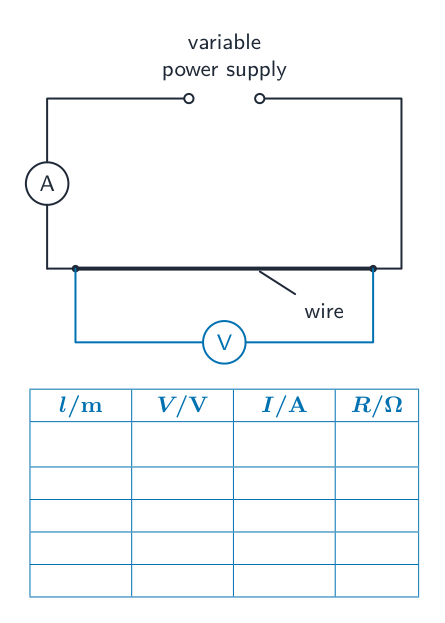
Fig. 4.1
A student investigates the resistance of a wire.
Plan an experiment which enables him to investigate how the length of a wire affects the resistance of the wire.
Resistance $R$ is calculated from the equation: $R = \frac{V}{I}$
where $V$ is the potential difference (p.d.) across the wire and $I$ is the current in the wire.
The apparatus available includes:
- a selection of wires
- a variable power supply
- an ammeter
- a voltmeter.
In your plan:
- list any additional apparatus needed
- complete Fig. 4.1 to show a voltmeter connected to measure the potential difference across the wire
- explain briefly how to do the experiment, including the measurements to take so that the resistance can be determined
- state the key variables to keep constant
- draw a table, or tables, with column headings, to show how to display the readings (you are not required to enter any readings in the table)
- explain how to use the readings to reach a conclusion.