Skip to content

IGCSE Physics · March 2025 · Paper 42 · Difficulty 4 · Challenging

Question 9

9

Strontium-90 is a radioactive isotope of strontium. The nuclide notation for strontium-90 is:

$^{90}_{38}Sr$

(a)
(i)

Explain what isotopes are.

[1]

(ii)

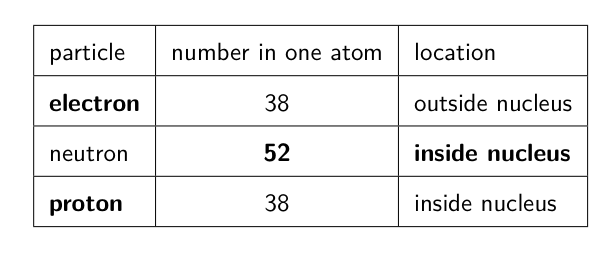
Complete Table 9.1 for strontium-90.

Table 9.1

particlenumber in one atomlocation
38outside nucleus
neutron
38inside nucleus

[2]

(b)

Strontium-90 is used to measure the thickness of metal sheets in industry.

Strontium-90 decays by emitting beta ($\beta$) particles which pass through a metal sheet to a detector.

(i)

One metal sheet is 0.75 mm thick. Suggest why strontium-90 is a suitable radioactive source to measure the thickness of the metal sheets.

[2]

(ii)

The half-life of strontium-90 is approximately 27 years. Fig. 9.1 shows the shape of a decay curve.

The strontium-90 source is replaced with a new source after 15 years. Using Fig. 9.1, suggest why a strontium-90 source that is more than 15 years old needs to be replaced with a new source.

[2]

[Total: 7]
Show the mark scheme

These are the official mark-scheme rows. Each point that matches your answer earns a mark.

Tap the mark scheme to open it full size.

Show a worked answer

How to reach each mark, step by step. Try the question yourself first.

9(a)(i)

  • Isotopes are atoms of the same element with different numbers of neutrons.

9(a)(ii)

  • The completed table is shown below. The neutron number is $90 - 38 = \mathbf{52}$.
Worked answer drawing

9(b)(i)

  • Beta particles can pass through thin metal, but thicker metal absorbs more of them.
  • The detected count rate therefore changes with sheet thickness.

9(b)(ii)

  • After 15 years about $68\%$ of the source remains, so about $32\%$ has decayed.
  • The lower activity makes differences in thickness harder to detect.
Original question

Log in or create account

IGCSE, A-Level & AP