Skip to content

IGCSE Physics · March 2024 · Paper 52 · Difficulty 4 · Challenging

Question 4

4

A student investigates the effect of insulation on the cooling of a liquid.

Plan an experiment which will enable her to investigate how changing the thickness of insulation surrounding a beaker affects the rate of cooling of hot water in the beaker.

You are not required to do the experiment.

The apparatus available includes:

  • a glass beaker
  • a supply of hot water
  • a lid to fit the beaker
  • strips of insulation which can be cut to size.

In your plan:

  • list any additional apparatus needed
  • explain briefly how to do the experiment, including the measurements to take so that the rate of cooling can be determined
  • state the key variables to keep constant
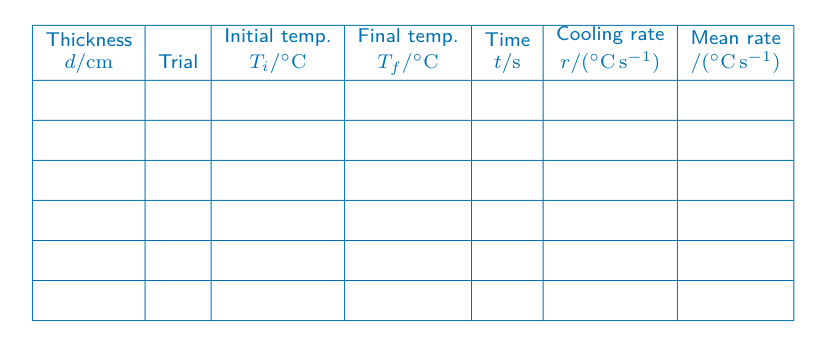
  • draw a table, or tables, with column headings, to show how to display the readings (you are not required to enter any readings in the table)
  • explain how to use the readings to reach a conclusion.

You may draw a diagram if it helps to explain your plan.

[7]
Show the mark scheme

These are the official mark-scheme rows. Each point that matches your answer earns a mark.

Tap the mark scheme to open it full size.

Show a worked answer

How to reach each mark, step by step. Try the question yourself first.

  • Use a thermometer, stopwatch and ruler. Wrap insulation around the beaker and measure its thickness. Add hot water and fit the lid. Record initial temperature $T_i$ and final temperature $T_f$ after a measured time $t$.
  • Repeat for at least five insulation thicknesses. Keep the water volume, initial temperature, beaker, lid and cooling time the same.
  • Use the table below. Record a new row for each trial. Repeat each thickness and average the cooling rates.
  • Calculate $\mathbf{r=(T_i-T_f)/t}$. Plot mean cooling rate on the y-axis against insulation thickness on the x-axis. Use the trend to explain how thickness affects cooling.
Worked answer drawing
Original question

Log in or create account

IGCSE, A-Level & AP