Skip to content

IGCSE Physics · March 2024 · Paper 42 · Difficulty 4 · Challenging

Question 5

5
(a)
(i)

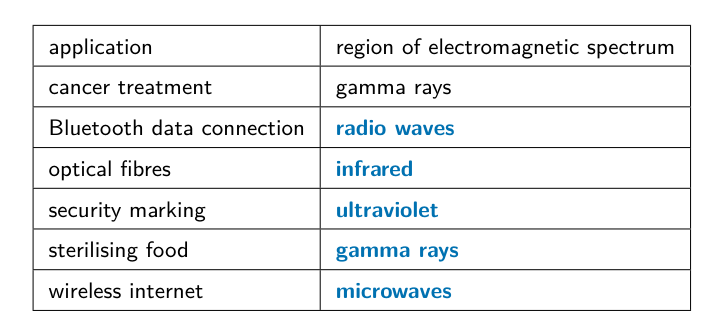
Table 5.1 shows applications of regions of the electromagnetic spectrum.

Complete the second column of the table with the region of the electromagnetic spectrum used for each application.

Choose from the regions in this list:

gamma rays infrared microwaves radio waves ultraviolet

Each region may be used once, more than once or not at all.

Table 5.1

applicationregion of electromagnetic spectrum
cancer treatmentgamma rays
Bluetooth data connection
optical fibres
security marking
sterilising food
wireless internet

[3]

(ii)

State the approximate speed of radio waves in air.

speed = m/s[1]

(b)

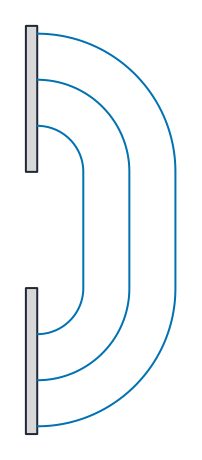
Fig. 5.1 shows successive crests of a wave after a plane wave has passed through a gap.

(i)

On Fig. 5.1 draw three successive crests before the wave reaches the gap.[2]

(ii)

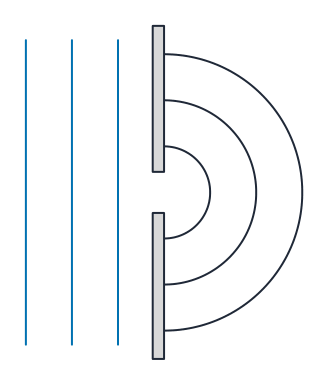
Fig. 5.2 shows a much wider gap. A plane wave of the same wavelength as in (b)(i) is incident on the gap from the left side of the barrier.

Fig. 5.2

On Fig. 5.2, draw three successive crests of the wave after the wave has passed through the gap.[2]
Show the mark scheme

These are the official mark-scheme rows. Each point that matches your answer earns a mark.

Tap the mark scheme to open it full size.

Show a worked answer

How to reach each mark, step by step. Try the question yourself first.

5(a)(i)

  • Bluetooth uses radio waves to carry data over short distances. Wireless internet uses microwaves to carry data without cables.
  • Optical fibres use infrared because it can carry signals through glass with little energy loss.
  • Security marking uses ultraviolet because it makes fluorescent marks glow.
  • Food sterilisation uses gamma rays because they penetrate the food and kill microorganisms.
Worked answer drawing

5(a)(ii)

  • Radio waves travel at approximately $\mathbf{3.0\times10^8}\,\mathrm{m/s}$ in air.

5(b)(i)

  • The completed wavefront diagram is shown below.
Worked answer drawing

5(b)(ii)

  • The wavefronts after the wider gap are shown below.
Worked answer drawing
Original question

Log in or create account

IGCSE, A-Level & AP