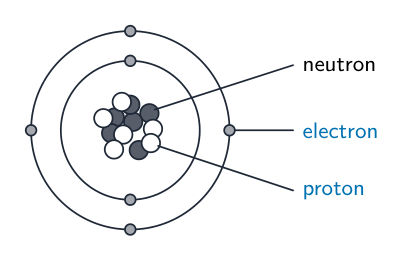
Complete the labels for the particles in Fig. 10.1. On each dotted line, write the name of the particle.[2]
(b)
An atom of lithium has the nuclide notation:
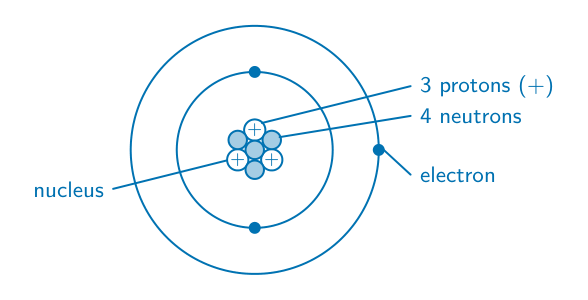
Draw a clearly labelled diagram to represent one atom of lithium.[3]
(c)
An isotope of carbon has a half-life of 5700 years. A sample contains 120 mg of this isotope.
Calculate the time taken for this isotope of carbon to decay from 120 mg to 15 mg.
time taken = years[2]
[Total: 7]
Show the mark scheme
These are the official mark-scheme rows. Each point that matches your answer earns a mark.
Tap the mark scheme to open it full size.
Show a worked answer
How to reach each mark, step by step. Try the question yourself first.
10(a)
Label the particle outside the nucleus electron and the positively charged particle in the nucleus proton.
10(b)
The nucleus contains $\mathbf{3}$ protons and $\mathbf{4}$ neutrons.
The atom has $\mathbf{3}$ electrons: two in the first shell and one in the second.
10(c)
Use $t = n t_{1/2}$. The mass halves three times: $120 \to 60 \to 30 \to 15\,\mathrm{mg}$.