A student investigates the evaporation of water in an open dish.
Plan an experiment which will enable the student to compare the effect on evaporation of using different diameters of dish.
The mass $m_e$ of water evaporated can be determined by using the equation:
$$m_e = m_b - m_a$$
where $m_b$ = the mass of water in the dish before experiment and $m_a$ = the mass of water in the dish after experiment.
The apparatus available includes:
a range of shallow dishes with different diameters
an adjustable laboratory lamp to heat the water
a variable power supply for the lamp
a stop-watch
a supply of cold water.
You are not required to do the experiment.
You do not need to write about any safety precautions.
In your plan:
list any additional apparatus needed
explain briefly how to do the experiment, including what measurements need to be taken
state the key variables to keep constant
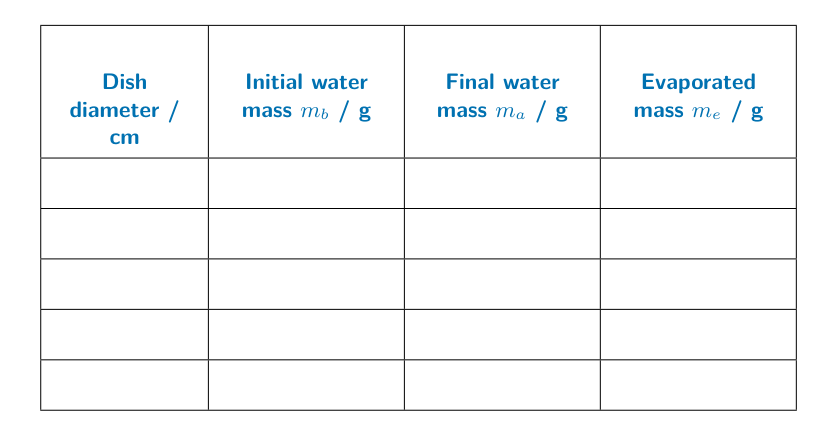
draw a table, or tables, with column headings, to show how to display the readings (you are not required to enter any readings in the table)
explain how to use the readings to reach a conclusion.
You may draw a diagram or add to Fig. 4.1 if it helps to explain your plan.
Show the mark scheme
These are the official mark-scheme rows. Each point that matches your answer earns a mark.
Tap the mark scheme to open it full size.
Show a worked answer
How to reach each mark, step by step. Try the question yourself first.
Use a ruler to measure dish diameter. Set a balance to zero with the empty dish on it, then add water and record its mass. Switch on the lamp and record the water mass again after a fixed time.
Repeat with at least five dish diameters. Keep the initial mass of water, heating time and lamp distance the same.
Record readings in the table below. Calculate $m_e=m_b-m_a$ for each dish.
Compare the evaporated masses to see how diameter affects evaporation: a larger mass lost in the same time means faster evaporation.